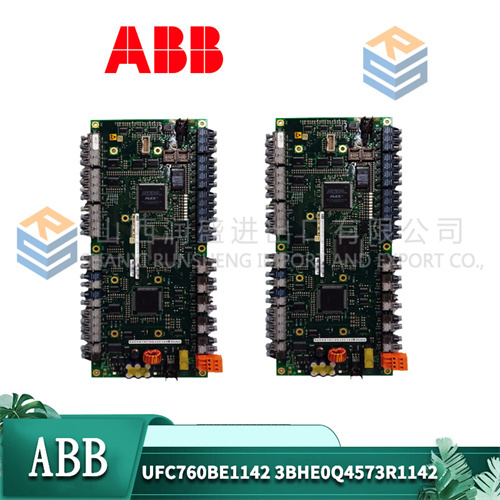
Processor type: MPC862P microprocessor.
Memory: 32 megabytes.
Power supply: 24 volts DC (19.2-30 volts DC).
Power consumption:
Typical value: 3.8 watts.
Maximum: Up to 250 MA at +24V.
specification
Security: SIL3 certification ensures a high level of security integrity.
Computing power: Equipped with a high-performance CPU, it can quickly process large amounts of data and complex algorithms.
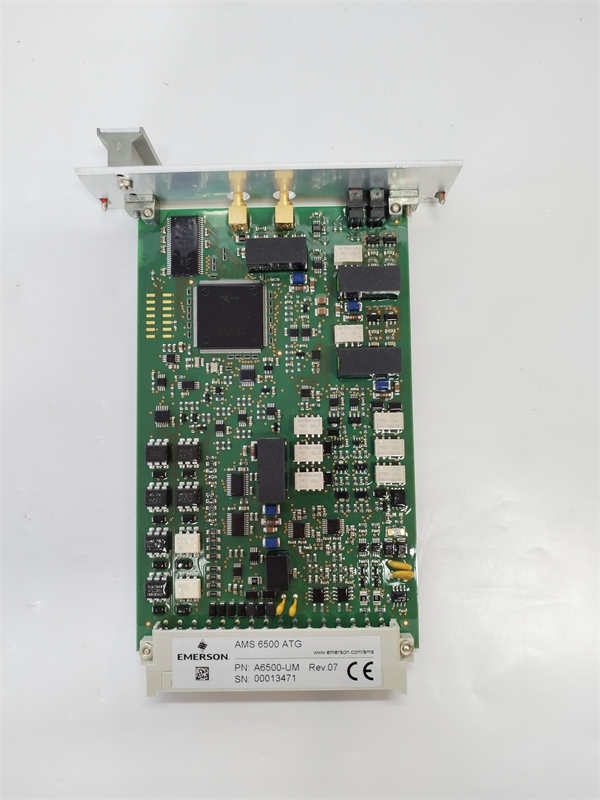
For the A6500-UM shaft vibration monitor, the main parameters and specifications may include:
Flow range: Although this is usually associated with flowmeters, it may refer here to a certain range or sensitivity for vibration monitoring, but the specific parameters are not directly given.
Accuracy: High precision shaft vibration measurement, possible to achieve ±1% accuracy.
Temperature range: -40°C to 150°C.
Power Supply: 100-240VAC, 50/60Hz.
Output: 4-20mA, RS485 Modbus, relay.
Display: 2×16 LCD.
Ultrasonic frequency: 1MHz or 500KHz (this may refer to a specific model of ultrasonic flowmeter, not a shaft vibration monitor).
Measurement period: 1 second (default).
Protection level: IP67 (sensor), IP65 (transmitter).
Communication protocol: Modbus RTU, M-Bus, etc.
Type: High performance sensors, especially force sensors.
Measurement range: Depending on the use, such as when used in steel mills or power plants, the measurement range may be 0-500 (the unit is not clear, may be pressure, force, etc.).
Voltage: 24V.
Current: 100-400A (Note: current parameters may be less common for sensors, which may be related to specific application scenarios or supporting devices).
Type: thyristor excitation pulse module.
Communication protocol: Support Modicon S908 RIO fieldbus protocol, communication rate up to 1.544Mbps.
Network topology: supports point-to-point communication, chain network, star network, redundant double network and self-healing protection of fiber ring network.
specification
Interface: Supports one or two Profibus DP electrical ports and one or two 155M optical fiber ports, supporting redundant dual-network optical fiber ring network topology.
Power supply: DC9-36V wide redundant dual power supply, DC1500V power isolation, reverse protection.
Lightning protection and protection: electrical interface 4000V lightning protection, 1.5A overcurrent, 600W surge protection.
Protection class: IP30.
Number of channels: Dual channels.
Module size: 3U size, single slot plug.
Interface and communication: Support analog communication, may include front and rear buffer and proportional output, 0/4-20 mA output, 0-10 V output.
Compliance: Compliant with API 670 and API 618 standards.
Size and weight
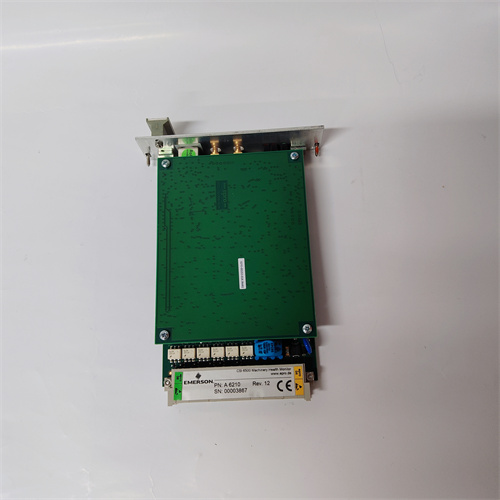
Size: May vary depending on the specific model or manufacturer, but based on experience with similar products, its size should be moderate and easy to install and maintain. For example, some versions of the A6210 monitor module measure 170mm x 105mm x 32mm.
Weight: Approximately 2kg
CPU: Celeron M, clocked at 1.0GHz (there are also claims of 1.1GHz, but according to search results, 1.0GHz is more common).
Memory: 20 MB user memory (RAM) and 20 MB flash memory.
Storage space: 128 MB.
I/O operation speed: Capable of up to 32K I/O operations per second.
Block support: A maximum of 512 blocks are supported, each 128 KB in size.
specification
Communication interface: Ethernet, RS-232, RS-485.
Power supply voltage: 24V DC.
Operating temperature: -40°C ~ +70°C.
Protection class: IP65.
Series: S800 series
Voltage: 24V
Processor capability: Equipped with a high-performance processor with fast data processing and decision making capabilities
Multitasking: The ability to perform multiple tasks simultaneously, including data acquisition, control logic execution, communication, etc
Communication interface: Supports a variety of communication interfaces, such as Modbus RTU, Modbus TCP/IP, etc., in order to efficiently exchange data with other control devices
Programmability: Programmable, allowing users to write and load custom control logic and programs according to specific application requirements
Data storage: With data storage function, historical data can be recorded for analysis and reporting
Size and weight
Size: The exact size may vary from model to model or version, but typically industrial-grade processor modules are designed in a compact form to accommodate different installation environments. For example, some ABB industrial products may have a similar form factor of 140mm × 90mm × 70mm, but the exact size of the PM825 may be different.
Weight: Approximately 2KG
Voltage: Usually 24VDC.
Current: Range may include 100-400A.
specification
Type: Power distribution module or programmable controller.
Brand: B&R.
trait
Automation control: Suitable for automation systems, providing stable power distribution or control functions.
Programming and integration: Multiple programming languages and system integration tools may be supported for easy integration with other devices and systems.
Reliability: Produced by well-known brands, with high reliability and durability.
Processor: It has a 1.1GHz Atom processor.
Memory: 10 MB.
Communication interface: Embedded Ethernet interface supports two kinds of connections of 10Mb/ s and 100 MB/ s; It has RS-485 and RS-232 serial ports.
Block support: Up to 512 blocks of 128 KB each are supported.
Input voltage range: 12-48VDC.
Output voltage range: 5VDC.
Output current: Max. 10A.
Efficiency: greater than 90%.
specification
Dimensions: 170mm x 105mm x 32mm.
Weight: About 120g.
Operating temperature: -20°C to +50°C.
Storage temperature: -40°C to +70°C.
Ambient humidity: 5% to 95% relative humidity (no condensation).
Manufacturer: ABB
Part number: BC810K02
Status: Unused and rebuilt
Technical specifications:
Kit includes: BC810 (interconnect unit, 2 units), TP857 (Baseplate, width = 60 mm, 2 units), TK851 (cable interconnect length 1.0 m), TB850 (CEX bus terminator, 2 units)
The BC810 device consists of a backboard (TP857) and a power/logic board
The backplane is where the CEX bus connector and external power supply are located, and also carries components such as external power voting diodes and fuses
Size and weight
Dimensions: The exact dimensions are not given directly, but it is mentioned that the width of the base plate is 60 mm.
Weight: It is mentioned that the weight of the BC820K02 is 1.4kg (including the base)
Output voltage: 24VDC
Maximum output current: 10A
Operating temperature range: -40 ° C ~ +85 ° C (in some cases -10 ° C ~ 55 ° C, but -40 ° C ~ +85 ° C is a wider operating temperature range)
Accuracy level: 0.2%F·S
Long-term stability: ≤±0.2%/ year, no cumulative error
Response time: <400ms
Output ripple: <0.4% (peak-peak)
Input power consumption: current <0.2VA, voltage <0.1VA
Operating frequency: nominal frequency ±10%
specification
Input channels: 8
Redundancy: Dual power supply and processor
Maximum I/O points: 384
Communication protocol: Support Modbus, Ethernet, OPC, etc
Reference standard: GB/T 13850-1998(IEC688-1992)
Voltage:
Input voltage: 24VDC
Output voltage: -0.6V DC
Voltage range: 220VDC
Current:
Working current range: 100-400A
Current (drive) : 5A
Operating temperature range: 0~55℃
NVRAM: 8 KB
Diagnostic bus: 2 Mbps HDLC
specification
Support system: PLC
Size: 5SHX2645L0004mm (one way), or 166mm x 112mm x 36mm (another way)


.jpg)
.jpg)
.jpg)
-1.jpg)