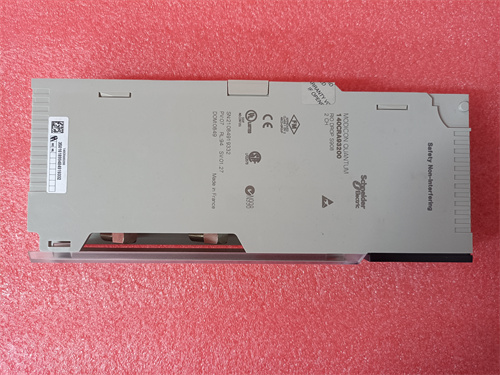
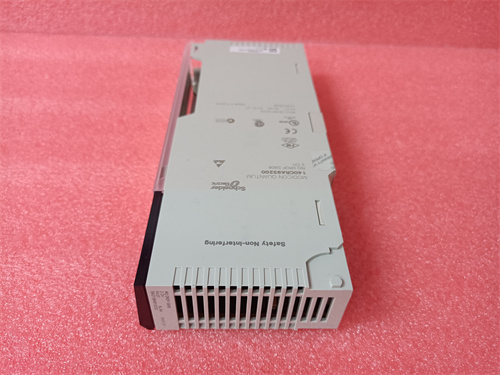
Eight analog output channels: for controlling and monitoring current.
LED indicator: LED with 8 different indicators to display module status and error messages.
Configurability: It can be configured through UnityPro software, and the configuration can be modified online.
Certification: Meets multiple safety standards such as UL 508, CSA 22.2-142, FM Class 1 Div.2, ATEX Zone 2/22, etc.
effect
Control and monitoring: Mainly used in industrial automation systems to control and monitor the current of equipment or processes through analog output signals, such as material handling, packaging and textile machinery.
Size and weight
Size: One says 170mm x 105mm x 32mm, while the other says 132mm x 105mm x 52mm. This may be due to slight differences between batches or models, it is recommended to refer to the specific product manual or contact the manufacturer for accurate information.
Input range: 0 ~ 4000psi (pressure input)
Output range: 4 to 20ma DC (current output)
Power supply: 12v DC to 45v DC
Accuracy: +/ -0.1% of the range
Operating temperature: -40 to 85°C (-40 to 185°F)
specification
Material: Stainless steel
Process connection: 1/2 inch NPT
Electrical connection: 1/2 inch NPT catheter
One saying is 42*52mm
Another saying is 12165cm
Weight:
One saying is 0.5kg
Another way to say it is 2kg
trait
Embedded Ethernet controller: Supports SRTP, Ethernet global data, and Modbus/TCP client/server protocols
Multi-communication interface: Support RS-485 and 2 Ethernet ports
Built-in switch and timer/counter: provides system clock and RAM power
Power supply voltage: 200V
Power: 1800W
Operating temperature: -40°F to +150°F (-40°C to +65°C)
Storage temperature: -40°C to +85°C
Energy consumption: Maximum 4.6 watts (or mention 10.5 watts, which may be power consumption under different conditions)
Equipped with interfaces: RS422 interface hardware, 10/100BaseT(X) ports (power consumption range of 3 watts -9.6 watts), 100Base-FX ports for 2
USB cable length: 5 meters
specification
Type: High voltage M-type interface board, a member of the Mark V series optional and replacement board
Input voltage range: 12-48VDC (some models may vary)
Output voltage range: 5VDC
Output current: Max. 10A
Dimensions: 170mm x 105mm x 32mm
Weight: Approx. 120g (some models may vary)
Features:
High precision, with ±2% high precision measurement capability
Wide measuring range, suitable for all kinds of shaft vibration measurement
Power Supply: 5 VDC
Power consumption: 5W
Working temperature:
0°C to 60°C (32°F to 140°F)
Other information mentioned -10-70℃ (wide temperature optional)
Storage temperature:
-40°C to 85°C (-40°F to 185°F)
Other information mentions -40 ~ 80 ° C
Bus current: 750 mA
Power consumption: Typical power consumption is 3 W, another information mentions 3.8W
Transmission rate: 1544 Mbit/s
Dynamic range: 35 dB
Isolation voltage: 500 V DC
Working environment temperature: 0… 60 °C
Storage ambient temperature: -40… 85 °C
Relative humidity: 95% non-condensing
Altitude: <= 5000 m
Working voltage: 220V
Output frequency: 350kHz
Product certification: 54100
Bom number: 87540
Voltage range: May be a wider industrial voltage range, but it depends on the application
specification
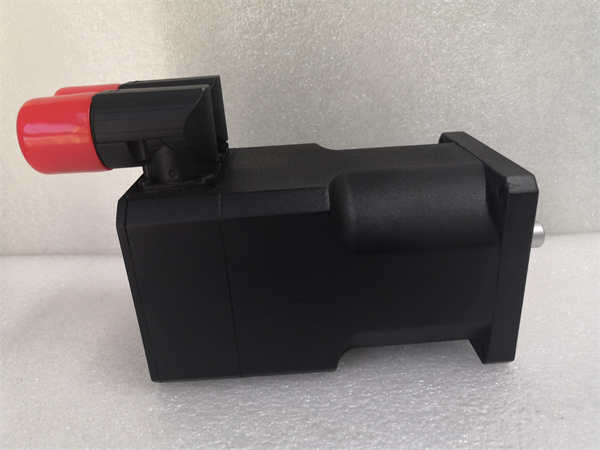
Brand: KOLLMORGEN
Color: White
Series: KOLLMORGEN
Operating environment: normal temperature and pressure
Power: 1200W
System capability: Intelligent
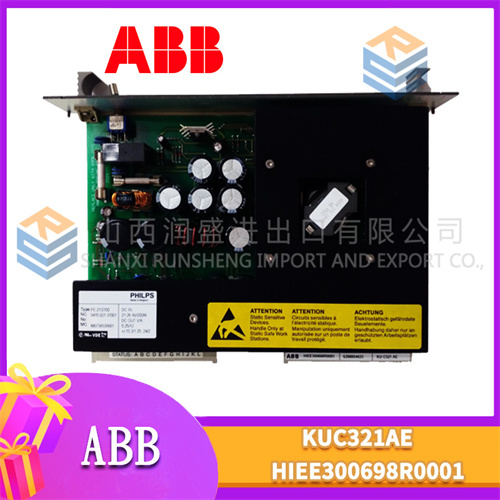
Voltage: The voltage parameters vary depending on the search results. Some mentioned that the operating voltage is 220V, while another message mentioned that the voltage is 24V. This may be due to product model or configuration differences, the specific voltage parameters need to be determined according to the actual product model.
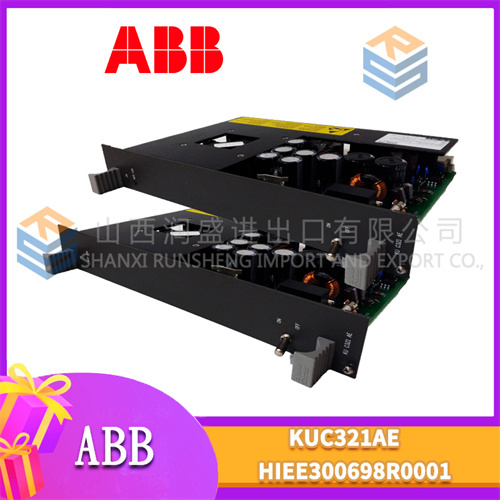
Current: It is mentioned in some information that the current range is 100-400A, but please note that this is not a universal parameter for all KUC321AE HIEE300698R0001 products, which needs to be confirmed according to the product specification.
Output frequency: Some information mentions the output frequency as 350kHz, while another information mentions 220Hz. This may also vary depending on the product model or configuration.
Voltage: 24V
Current: 100-400A
Operating temperature: May be 60 ° C, but please note that this temperature may be a value under specific conditions, not the usual operating environment temperature range.
specification
Brand: EMERSON
Origin: Switzerland
Year: 2020
Functions: Mainly used for industrial automation control, supporting a variety of communication protocols (such as DeviceNet, ControlNet, etc.) and programming functions
Multi-core architecture: This module usually adopts multi-core processor architecture to improve parallel processing capability and system response speed.
High voltage capability: The module has high voltage capability and can handle input and output signals in a large voltage range, which is suitable for the control and monitoring of high voltage power systems.
Scalability and flexibility: With good scalability and flexibility, can adapt to different application requirements. Supports multiple expansion slots that can be connected to other modules and interfaces to expand the functions and connectivity of the system.
Communication interface: supports a variety of communication interfaces, such as Modbus, Profibus, etc., to facilitate data exchange and communication with other devices and control systems.
dimension
Size: 554mm*41.5mm * 440.4mm(W×H×D)
Input current: 500mA (but not explicitly mentioned in some descriptions)
Output voltage: 24VDC
Output power: 360W
Input voltage range: 85~264VAC
Maximum output current: 15A (may vary in some cases, e.g. 1A)
Operating temperature range:
– 25 ~ 70 ℃
-40°C to 85°C (for ABB IMASI23 as a smart pressure protocol)
Accuracy: ±0.15% FS (only when used as a smart pressure protocol)