
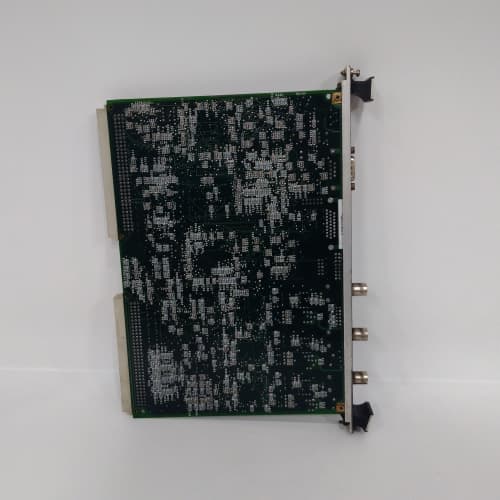
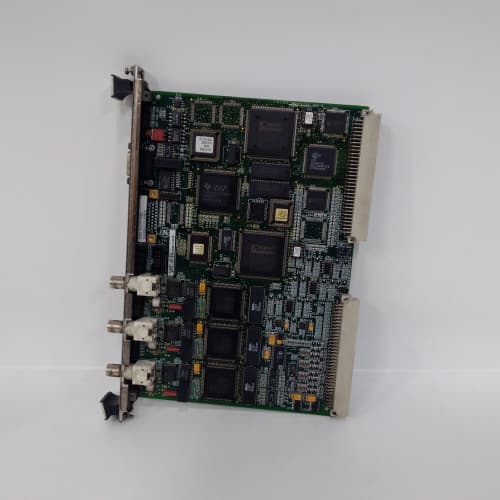
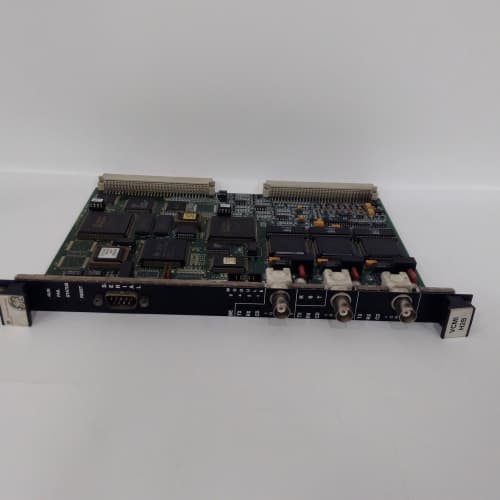
Description
Product Parameters
| Parameter | Specification |
|---|---|
| Brand / Series | GE Mark VIe Speedtronic |
| Model | IS200SRTDH1A |
| Input Channels | 16 RTD inputs (3-wire or 4-wire, software-selectable per channel) |
| RTD Types | Pt100 (α = 0.00385), Ni120 (DIN 43760) |
| Input Range | 0–400 Ω (Pt100: –200°C to +850°C; Ni120: –60°C to +250°C) |
| Excitation Current | 1 mA (programmable per channel) |
| ADC Resolution | 24-bit delta-sigma with programmable sampling rate (4–200 SPS) |
| Accuracy | ±0.1% of reading + ±0.3°C |
| Lead-Wire Compensation | Automatic (3-wire and 4-wire) with imbalance detection |
| Isolation | 1500 VAC (field-to-system) |
| Common Mode Rejection | >100 dB @ 50/60 Hz |
| Diagnostics | Open-circuit detection, short-circuit detection, lead-wire resistance imbalance monitoring |
| Status Indication | 16 green LEDs (channel active), 1 red LED (diagnostic fault summary) |
| Operating Temperature | –30°C to +65°C |
| Mounting | VME rack-mount terminal board with front-panel I/O connector |
| Backplane Interface | VME64 (A24/A32, D16/D32) |
Advantages & Key Features
-
High Channel Density: IS200SRTDH1A provides 16 RTD inputs in a single VME slot, significantly reducing rack space compared to competing RTD modules that typically offer 4–8 channels. This high density is particularly valuable for turbines with extensive bearing and winding temperature monitoring requirements.
-
Multi-Wire Flexibility: Each channel supports both 3-wire and 4-wire RTD configurations, selectable via GE ToolboxST software. This eliminates the need for separate termination boards for different RTD types and simplifies retrofit projects.
-
Automatic Lead-Wire Compensation: The board’s advanced analog front-end automatically compensates for lead-wire resistance in 3-wire configurations and fully eliminates it in 4-wire configurations. Lead-wire imbalance monitoring alerts operators to wiring degradation before accuracy is compromised.
-
High-Precision Conversion: The 24-bit delta-sigma ADC with >100 dB CMRR delivers stable, noise-free RTD readings even in high-electromagnetic-interference environments typical of turbine generator halls. Programmable sampling rate allows operators to trade speed for resolution based on application needs.
-
Comprehensive Diagnostics: Real-time open-circuit, short-circuit, and lead-wire imbalance detection per channel enables predictive maintenance and prevents undetected sensor failures that could cause turbine trips. The summary fault LED provides quick visual indication of any channel fault.
-
Programmable Excitation Current: The 1 mA excitation current minimizes self-heating errors in RTD sensors while providing sufficient signal level for accurate measurement. The current can be reduced for low-power applications.
-
ToolboxST Integration: Full configuration, calibration, and diagnostics via GE ToolboxST software, enabling online channel monitoring, sensor health trending, and fault logging.
-
Drop-In Replacement: Direct replacement for earlier GE RTD boards such as IS200SRTDH1 and IS200SRTDG1A, with identical mounting holes, connectors, and backplane addressing.
Application Fields
-
Gas & Steam Turbines (GE Frame 6B/7EA/9E/HA): Monitors bearing metal temperature, generator stator winding temperature, turbine casing temperature, inlet air temperature, and lube oil temperature.
-
Combined Cycle Plants: Used in HRSG for superheater outlet temperature monitoring, feedwater temperature, and steam turbine bearing temperature.
-
Compressor Stations: Monitoring gas turbine compressor inlet temperature, discharge temperature, and intercooler performance.
-
Aeroderivative Turbines (LM series): Monitors engine oil temperature, inlet guide vane temperature, and exhaust casing temperature.
-
Hydropower Plants: Used for generator bearing temperature and transformer winding temperature monitoring.
Comparison with Competing Products
| Feature | GE IS200SRTDH1A | Competitor A (Emerson RTD Module) | Competitor B (Siemens RTD Module) |
|---|---|---|---|
| Input Channels | 16 (3-wire or 4-wire) | 8 (3-wire only) | 8 (3-wire or 4-wire) |
| RTD Types | Pt100, Ni120 | Pt100 only | Pt100, Ni100, Ni120 |
| ADC Resolution | 24-bit delta-sigma | 16-bit SAR | 16-bit sigma-delta |
| Accuracy | ±0.1% reading + ±0.3°C | ±0.2% reading + ±0.5°C | ±0.15% reading + ±0.5°C |
| Excitation Current | 1 mA (programmable) | 0.5 mA (fixed) | 1 mA (fixed) |
| Lead-Wire Imbalance Detection | Yes | No | No |
| CMRR | >100 dB | >80 dB | >85 dB |
| Isolation | 1500 VAC | 1000 VAC | 500 VDC |
| Operating Temp | –30°C to +65°C | 0°C to 50°C | 0°C to 60°C |
Key Advantage: IS200SRTDH1A provides double the channel density, higher accuracy, and more comprehensive diagnostics (lead-wire imbalance detection) than competing RTD modules. Its ability to mix 3-wire and 4-wire sensors on the same board reduces rack space and simplifies wiring, while the extended temperature range makes it suitable for harsh turbine environments.
Selection Guidelines & Recommendations
-
Sensor Type Verification: Confirm whether your application uses Pt100 or Ni120 RTDs. IS200SRTDH1A supports both, but the linearization tables differ—configure the correct sensor type per channel in GE ToolboxST before commissioning.
-
Wiring Configuration: For 3-wire RTDs, ensure the two current-carrying leads are of identical gauge and length to maintain lead-wire compensation accuracy. For 4-wire RTDs, the board provides maximum accuracy by eliminating lead-wire resistance entirely.
-
Excitation Current Selection: The default 1 mA excitation current is suitable for most applications. For sensors with high self-heating sensitivity (e.g., small-diameter RTDs), reduce to 0.5 mA via GE ToolboxST to minimize measurement errors.
-
Controller Firmware: Ensure your Mark VIe main processor (e.g., IS420UCSBH1A, IS420UCSCH1A, IS200SPROH2ADD) is running firmware v7.0 or later for full diagnostic support on IS200SRTDH1A.
-
ToolboxST Configuration: In GE ToolboxST, configure each channel’s RTD type, wiring mode (3-wire/4-wire), excitation current, and sampling rate. Enable lead-wire imbalance monitoring for critical bearing temperature channels.
-
Wiring Guidelines: Use shielded twisted-pair cables for RTD wiring. Maintain shield grounding only at the Mark VIe cabinet end to prevent ground loops that degrade CMRR.
-
Spare Strategy: For critical plants, keep one spare IS200SRTDH1A per turbine. Lead times typically 6–10 weeks.
-
Retrofit: Direct replacement for IS200SRTDH1 and IS200SRTDG1A—no chassis or cable changes required. However, configuration files must be regenerated in GE ToolboxST to access enhanced diagnostics.
Important Cautions
-
No Hot-Swap: IS200SRTDH1A is not hot-swappable. Always de-energize the Mark VIe rack before insertion/removal to prevent backplane damage.
-
RTD Wiring Polarity: For 3-wire RTDs, the two current-carrying leads must be connected to the correct terminals—incorrect wiring will produce offset errors. Refer to GE wiring diagram IS200SRTDH1A-DWG for proper terminal assignments.
-
Lead-Wire Imbalance: Lead-wire imbalance detection will trigger a fault if the two current-carrying leads differ by more than 5 Ω. Ensure field wiring uses matching cable lengths and gauges to avoid false diagnostics.
-
Excitation Current Self-Heating: Higher excitation current increases self-heating errors in RTD sensors. For small-diameter or slow-response sensors, reduce excitation current to 0.5 mA to minimize measurement drift.
-
Grounding: The board’s analog ground (AGND) must connect to the Mark VIe system ground at a single star point. Multiple ground paths introduce 50/60 Hz noise and degrade the >100 dB CMRR specification.
-
Shield Termination: RTD cable shields must be grounded only at the Mark VIe cabinet end. Grounding at both ends creates ground loops that degrade measurement accuracy.
-
ESD Handling: Use grounded wrist straps during handling; the 24-bit ADC and analog front-end are ESD-sensitive. Field repair is not possible due to conformal coating.
-
Sampling Rate Trade-Off: Higher sampling rates (200 SPS) reduce measurement resolution and increase noise. For steady-state temperature monitoring (bearings, windings), use 4–10 SPS for maximum accuracy. For dynamic temperature tracking, use 50–100 SPS.
WESTINGHOUSE 1C31219G01
A-B 440R-E21358
Bently Nevada 330180-91-00
A-B 1756-PA75



Reviews
There are no reviews yet.