
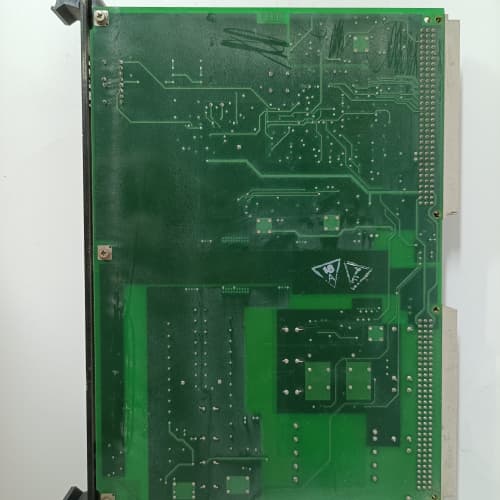
Description
Key Specifications
| Parameter | Specification |
|---|---|
| Speed Input Channels | 3 independent channels (redundant configuration) |
| Sensor Types Supported | Magnetic pickups, proximity probes, tachometers, hall-effect sensors, variable reluctance sensors |
| Input Signal Range | 100 mV to 100 V p-p (magnetic); 5–24 VDC (proximity/tacho/hall) |
| Frequency Range | 0.5 Hz to 50 kHz |
| Speed Range | 0 to 100,000 RPM (programmable) |
| Accuracy | ±0.002% of reading |
| Protection Functions | Overspeed trip (2-out-of-3 voting), under-speed, zero-speed, rate-of-change, speed mismatch detection, acceleration-based overspeed prediction |
| Response Time | <2 ms for overspeed trip |
| Isolation | 1500 VDC (channel-to-backplane) |
| Diagnostics | 1000-event fault log with timestamps and waveform snapshots |
| Operating Temp | –30 °C to +75 °C (extended range) |
| Humidity | 5–100% condensing (silicone coating standard) |
| Coating | Thicker silicone conformal coating + enhanced edge encapsulation (UV-traceable) |
| Manufacturing | 120-hour burn-in, 100% X-Ray/AOI, military-grade components, enhanced thermal cycling (–40 to +85 °C, 100 cycles) |
| Power | 12 W (+5 V / +3.3 VDC) |
| Connectors | 24-pin terminal block with gold-plated contacts and captive washer screws |
| Built-in Test | Sensor health monitoring, signal quality analysis, self-diagnostic routines |
Advantages & Distinctive Features
-
Redundant Speed Measurement: 3 independent channels with 2-out-of-3 voting logic—ensures trip integrity while preventing false trips.
-
Ultra-Fast Response: <2 ms overspeed trip detection meets the most stringent turbine protection requirements.
-
Highest Accuracy: ±0.002% reading ensures precise speed measurement for governor control and synchronization.
-
Expanded Frequency Range: 50 kHz supports very high-speed turbines and finer gear tooth resolution.
-
Acceleration-Based Overspeed Prediction: Predictive algorithm detects rapid acceleration and trips before mechanical overspeed occurs.
-
Self-Diagnostic Routines: Periodic internal self-tests verify hardware integrity.
-
Thicker Silicone Coating + Enhanced Edge Encapsulation: Superior protection against humidity, salt spray, chemicals, and condensing environments—suitable for offshore, Arctic, and chemical plants.
-
Extended Temperature Range: –30 °C to +75 °C operation—suitable for extreme environments.
-
1000-Event Fault Log with waveform snapshots—enables comprehensive post-event analysis.
-
Gold-Plated Captive Washer Terminals: Corrosion-resistant and vibration-proof connections.
-
Hot-Swappable: No rack power-down for replacement.
-
Direct Retrofit: Replaces all VTURH1A, H1B, H2B, and H2BAA series boards.
Application Fields
-
High-speed gas turbines: Aero-derivative and high-frame turbines requiring <2 ms response
-
Steam turbines: HP/IP/LP overspeed protection
-
Ultra-high-speed compressors: >60,000 RPM applications
-
Turbo-expanders: Speed measurement and overspeed protection
-
Nuclear power plants: Safety-critical overspeed protection
-
Offshore platforms: Salt-spray and condensing environments
-
Arctic installations: Extreme cold (–30 °C) environments
-
Desert power plants: Extreme heat (+75 °C) environments
-
Chemical processing: Corrosive environments
Comparison with Competitors
| Feature | GE IS200VTURH2BAB | Bently Nevada 3500/50 | Rockwell XM-140 |
|---|---|---|---|
| Speed Channels | 3 | 1 | 1 |
| Response Time | <2 ms | <10 ms | <15 ms |
| Accuracy | ±0.002% | ±0.02% | ±0.05% |
| Max Frequency | 50 kHz | 10 kHz | 10 kHz |
| Max RPM | 100,000 | 60,000 | 60,000 |
| Acceleration Prediction | Yes | No | No |
| Self-Diagnostics | Yes | No | No |
| Coating | Silicone (std) + edge encaps. | Optional | Optional |
| Temp Range | –30 to +75 °C | 0 to +60 °C | 0 to +55 °C |
| Humidity | 5–100% condensing | 5–95% | 5–90% |
| Fault Logging | 1000 events + waveforms | 100 events | No |
The GE IS200VTURH2BAB offers unmatched accuracy, fastest response, expanded frequency range, advanced predictive features, and extreme-environment protection—making it the definitive choice for critical overspeed protection in the world’s most demanding turbine applications.
Selection Guidelines
-
When to choose:
-
Critical overspeed protection requiring <2 ms response and ±0.002% accuracy
-
Ultra-high-speed turbines (>60,000 RPM, 50 kHz frequency)
-
Extreme environments (–30 to +75 °C, condensing, chemical exposure, salt spray)
-
Applications needing acceleration-based overspeed prediction
-
Maximum reliability (nuclear, critical infrastructure)
-
-
Sensor Selection: Variable reluctance sensors provide improved high-frequency response for ultra-high-speed applications.
-
Redundancy: Use all 3 channels with 2-out-of-3 voting for maximum protection integrity.
-
Scaling: Enter correct pulses per revolution (gear teeth) in Toolbox ST.
-
Trip Levels: Set per manufacturer spec (typically 110–115% of rated speed).
-
Acceleration Prediction: Configure acceleration threshold to predict overspeed before mechanical limits are reached.
-
Speed Mismatch Threshold: Default 1%—adjust based on sensor accuracy.
-
Coating Verification: Inspect under UV (365 nm)—thicker silicone coating shows distinct fluorescence; verify enhanced edge encapsulation bead is continuous.
-
Compatibility: Fits all Mark VIe VME64x racks. Requires ControlST v7.0 or higher for full features.
Operational Precautions
-
Wiring: Follow GEH-6855 diagrams—correct polarity and shield grounding essential. Use shielded twisted-pair cables; ground shield at terminal board only.
-
Sensor Gap: For proximity probes, verify air gap and bias voltage are correct.
-
Calibration: Verify speed reading against known reference (portable tachometer) during commissioning.
-
Overspeed Testing: Simulate overspeed with function generator to verify <2 ms response and trip logic.
-
Acceleration Prediction Testing: Simulate rapid acceleration events to verify predictive trip logic.
-
Voting Logic Test: Simulate single-channel failures to verify 2-out-of-3 logic.
-
Speed Mismatch Test: Introduce offset on one channel to verify alarm generation.
-
Self-Diagnostic Verification: Allow self-test to complete during commissioning—verify “SELF-TEST PASSED” in fault log.
-
Signal Quality Monitoring: Review amplitude trends in Toolbox ST—degrading amplitude indicates sensor/cable issues.
-
LED Diagnostics: Green = signal OK; Amber = marginal; Red = fault/overspeed. Refer to GEH-6855 for H2B-specific blink codes.
-
Fault Log: Access 1000-event log via Toolbox ST for post-event analysis.
-
Coating Care: Thicker silicone coating provides superior chemical resistance; use GE-approved silicone-safe cleaner. Inspect annually under UV—rework voids with approved silicone coating per GE FSB-MKVIe-112.
-
Hot-Swap: Remove/insert slowly under power—processor auto-recognizes new module.
-
Spare Stock: Maintain 1 spare per 3–4 racks; “H2BAB” backward-compatible with all VTURH sockets.
-
Annual Verification: Perform speed and overspeed tests during outages; document <2 ms response times.
-
Firmware Updates: Ensure the GE IS200VTURH2BAB is in “standby” mode during updates. Use ControlST v7.0 or higher.
-
ESD: Handle by edges only with grounded wrist strap—coating does not protect connectors.
-
Storage: Anti-static bag with desiccant at –40 to +85 °C; rotate every 3 years for coating inspection.
ABB SB822
GE IC697MDL750E
LG MY13
siemens 6ES7090-0XX84-0AB0

Reviews
There are no reviews yet.