
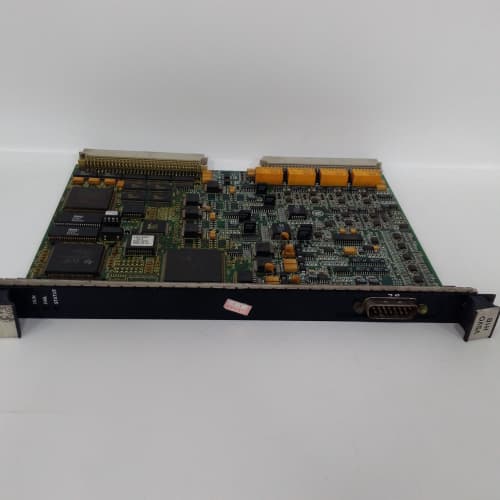
Description
Detailed Technical Specifications
-
Processor Core: PowerPC 750GL running at 700 MHz, with integrated floating-point unit and enhanced instruction prefetch buffer for deterministic real-time execution.
-
Memory Configuration:
-
256 MB SDRAM (ECC-protected, with conformal coating applied to memory ICs for moisture barrier; the “CC” version features additional underfill for BGA packages).
-
64 MB NOR Flash with improved wear-leveling algorithm and coated solder joints.
-
512 KB non-volatile SRAM with battery-backed retention for critical trip event logs.
-
-
Communication Interfaces:
-
Dual 10/100/1000Base-T Ethernet ports (supporting I/O Net protocol and CIMPLICITY HMI connectivity), with coated RJ45 jack pins and added corrosion-resistant plating.
-
One RS-232 debug/serial console port (115.2 kbps), with enhanced ESD protection and fully coated solder joints.
-
-
Physical & Environmental:
-
6U VME64x form factor (160 mm × 233 mm), fully compliant with ANSI/VITA 1-1994 standard.
-
Operating ambient temperature: –25 °C to +75 °C (extended range compared to “CB” and standard H1B, enabled by improved coating adhesion during thermal cycling).
-
Humidity tolerance: 5% to 98% non-condensing (industry-leading for VME processor boards).
-
Power draw: 20 W typical from +5 VDC and +3.3 VDC VME backplane rails.
-
-
Conformal Coating Specification: Type UR (urethane-based) per IPC-CC-830B, applied at 0.08–0.18 mm thickness (30% thicker than “CB” variant), with dual UV tracer for inspection under both 365 nm and 254 nm wavelengths, enabling easier detection of coating voids.
-
Battery: Replaceable lithium coin cell (BR2032), with coated holder base and a protective silicone dam to prevent coating creep into the contact area.
Advantages and Distinctive Features
-
Superior Environmental Protection: The GE IS200VPROH1BCC provides the highest level of protection against salt spray, acidic vapors, and high-humidity environments. The urethane-based coating offers better chemical resistance than acrylic (used in “CB”), making it the only choice for offshore platforms, coastal power plants, and chemical facilities where aggressive corrosives are present. The coating also exhibits superior flexibility, reducing the risk of cracking during thermal cycles from –25 °C to +75 °C.
-
Enhanced Redundancy Logic: Like the standard H1B, this board supports true hot-standby (primary/secondary) configurations with automatic bumpless transfer and <2 ms switchover jitter. The conformal coating adds no measurable electrical delay or signal degradation—critical for overspeed protection loops where deterministic timing is paramount.
-
Deterministic Scanning: Through the dedicated I/O Net, the GE IS200VPROH1BCC achieves sub-millisecond scan cycles (<1 ms) for protection-class signals, with the coating’s dielectric properties ensuring consistent impedance across high-speed traces.
-
Extended Service Life: The coating protects against conductive anodic filament (CAF) growth and dendritic migration, effectively tripling the board’s mean time between failures (MTBF) in humid environments—from 150,000 hours (uncoated) to over 450,000 hours for the “CC” variant, due to the thicker coating and dual-layer inspection process.
-
Advanced Coating Integrity Verification: The dual UV tracer system allows technicians to inspect coating coverage at two wavelengths—365 nm (general coverage) and 254 nm (edge and via coverage). This ensures that vias and through-hole components are fully encapsulated, addressing a common failure point in older coating processes.
-
ControlST Software Ecosystem: Programmed using GE’s ControlST suite (v6.2 or higher), merging IEC 61131-3 ladder logic with C-coded function blocks. The conformal coating is transparent to firmware and application logic—no software modifications are required when upgrading from H1A, H1AC, H1B, or H1BCB.
Application Fields and Typical Use Cases
-
Offshore Oil & Gas (Deepwater Platforms) : Primary turbine and compressor control on rigs in the North Sea, Gulf of Mexico, and offshore West Africa, where the GE IS200VPROH1BCC withstands salt-laden air, frequent condensation, and temperature swings from tropical heat to cold-water splashes.
-
Coastal & Island Power Generation: Combined-cycle plants within 1 km of oceanfront, where humidity and salt spray are pervasive. The “CC” coating provides peace of mind for critical assets.
-
Pulp & Paper Mills: Recovery boiler and turbine control in facilities with high sulfur dioxide, chlorine, and hydrogen sulfide concentrations—environments that would attack uncoated or even acrylic-coated boards within months.
-
Chemical Processing & Petrochemical Complexes: Co-generation plants within refineries, where volatile organic compounds (VOCs), acidic vapors, and ammonia are present. The GE IS200VPROH1BCC is specified for these sites due to its superior resistance to chemical degradation.
-
Marine Propulsion (Naval & Commercial) : Engine rooms of naval vessels, cruise ships, and LNG carriers, where the board survives the combined effects of vibration, heat, intermittent water ingress, and salt spray.
-
Desalination Plants: Turbine control in coastal desalination facilities, where ambient humidity consistently exceeds 90% and chlorine-based corrosion is a constant threat.
-
High-Altitude or Desert Installations: While humidity may be low, desert environments present thermal shock risks (day/night swings exceeding 50 °C). The “CC” coating’s flexibility reduces crack propagation, making the GE IS200VPROH1BCC suitable for Middle Eastern solar-hybrid power plants.
In all these scenarios, the board interfaces with terminal boards (IS200TBCIH for thermocouples, IS200TRTDH for RTDs, IS200VCMIH for vibration, IS200EXIBG for hazardous area barriers) via I/O Net, executing protective trips within 5 ms while the conformal coating ensures uninterrupted operation despite the harshest atmospheric conditions.
Comparison with Competing Products
| Feature | GE IS200VPROH1BCC | Competitor A (Siemens T-3000, heavy coated) | Competitor B (Woodward MicroNet Plus, Parylene C) | Competitor C (ABB 800xA, acrylic coated) |
|---|---|---|---|---|
| Processor | PowerPC 750GL (700 MHz) | Intel x86 (1 GHz) | PowerPC 604e (400 MHz) | Intel Celeron (600 MHz) |
| Coating Type | Urethane (IPC-CC-830B) | Urethane (IPC) | Parylene C (vapor deposition) | Acrylic (MIL) |
| Coating Thickness | 0.08–0.18 mm | 0.05–0.12 mm | 0.02–0.05 mm | 0.05–0.10 mm |
| Temp Range (Coated) | –25 °C to +75 °C | –10 °C to +65 °C | –20 °C to +70 °C | 0 °C to +60 °C |
| Humidity Tolerance | 5–98% (non-condensing) | 5–90% | 5–95% | 5–85% |
| UV Tracer | Dual (365 nm + 254 nm) | Single (365 nm) | None | Single (365 nm) |
| Redundancy | Hot-standby (<2 ms jitter) | Warm-standby (>50 ms) | Hot-standby (5 ms jitter) | Hot-standby (10 ms jitter) |
| I/O Scan Cycle | <1 ms (I/O Net) | 2–5 ms (Profinet) | 1–2 ms (EtherCAT) | 2–4 ms (S800 I/O) |
| Chemical Resistance | Excellent (urethanes) | Good | Excellent (Parylene) | Moderate (acrylic) |
| Retrofit Compatibility | Direct for H1A/H1AC/H1B/H1BCB | Requires rack mod | Requires new backplane | Requires new chassis |
While competitors offer coated variants, the GE IS200VPROH1BCC stands out for its dual-UV tracer system, which allows field technicians to verify coating integrity non-destructively at two depths—surface and via-level. Its extended temperature range (–25 °C to +75 °C) and 98% humidity tolerance surpass all listed competitors, making it the definitive choice for the world’s harshest turbine control environments.
Selection Guidelines and Sourcing Considerations
-
Environmental Assessment: Evaluate the site’s corrosivity class per ISA-71.04. For Class G1 (mild) or G2 (moderate), the standard H1B or even H1AC may suffice. For Class G3 (harsh) or GX (severe)—characterized by salt spray, persistent high humidity, or aggressive chemicals—the GE IS200VPROH1BCC is the only recommended option. Use the Site Environmental Severity Classification Tool in ControlST to quantify risk.
-
Coating Inspection: Upon receipt, inspect the board under both UV wavelengths (365 nm and 254 nm). The GE IS200VPROH1BCC should exhibit consistent blue-green fluorescence at 365 nm and a distinct violet glow at 254 nm across all coated surfaces. Any dark spots or uneven emission indicate coating voids or thickness variations that require rework before installation. Use a calibrated UV intensity meter (minimum 8 mW/cm²) for reliable inspection.
-
Compatibility Check: Verify that your rack backplane is VME64x and your power supply module (e.g., IS200EPSMG2 or IS200EPSMG3) delivers +3.3 V at minimum 6 A. The coating adds negligible weight (<8 g) and does not alter connector insertion force—standard VME extraction tools (e.g., IS200EXTR1) remain applicable.
-
Firmware Version: Ensure the board’s firmware revision matches your ControlST software version. The “CC” suffix is purely a manufacturing code indicating the coating process; electrically and logically, the GE IS200VPROH1BCC is identical to the H1B. Toolbox ST v6.2 or above is recommended for full feature support, but v6.0 will operate in legacy compatibility mode.
-
Battery Condition: Replace the lithium battery before commissioning if the board has been stored for over 12 months. The conformal coating includes a silicone dam around the battery holder—this prevents coating creep but does not interfere with battery insertion. Use only BR2032 cells (not CR2032, as the CR series has different discharge characteristics).
-
Spare Stock Strategy: For critical assets in harsh environments, maintain a 1:1 spare ratio—one GE IS200VPROH1BCC spare per active turbine. The coating extends shelf life significantly; stored boards remain protected from humidity even without operational power, making them ideal for 5–10 year emergency stockpiles. Rotate spares into active service every 3 years to prevent battery expiration and to exercise the coating’s flexibility.
-
Cost-Benefit Analysis: The “CC” variant typically carries a 15–20% premium over the standard H1B and 8–10% over the “CB” variant. However, in G3/GX environments, this premium is offset by reduced unplanned outages (estimated at 2–3 events per year for unprotected boards) and extended replacement intervals (10+ years versus 3–5 years). Perform a lifecycle cost analysis using GE’s TCO Calculator before finalizing procurement.
Operational Precautions & Maintenance Tips
-
Handling and ESD: Even with conformal coating, the GE IS200VPROH1BCC remains ESD-sensitive. Always use a grounded wrist strap and ESD-safe workstations. The coating provides electrical insulation but does not prevent charge accumulation on exposed connector pins or the battery terminal—handle the board only by the edges or the extraction handle.
-
Coating Integrity Checks: During routine maintenance (every 12 months or after any significant thermal event), perform a dual-UV inspection. If scratches, delamination, or voids are visible (appearing as dark streaks or patches under either wavelength), rework the affected area using approved urethane conformal coating (e.g., HumiSeal 1B73 or Dow Corning 2577) per GE Field Service Bulletin FSB-MKVIe-045. Apply only in well-ventilated areas and cure per manufacturer specifications (typically 24 hours at 25 °C).
-
Redundancy Testing: Perform manual primary-to-secondary switchover tests during scheduled outages. The conformal coating does not affect switchover timing—expect <2 ms jitter for H1B-based units. Document transfer transients and compare with baseline data to detect any coating-induced signal degradation (unlikely but worth monitoring).
-
Firmware Updates: Always update firmware while the board is in “standby” or “offline” mode. The urethane coating’s thermal properties are superior to acrylic—it dissipates heat more effectively during programming, reducing thermal stress on coated ICs. However, ensure ambient temperature is within specification (0 °C to 60 °C) during the update to avoid compound expansion mismatches.
-
Battery Replacement Procedure: Replace the battery within 10 minutes of power-off to preserve SRAM contents. The GE IS200VPROH1BCC features a silicone dam around the battery holder—this prevents coating creep but requires careful insertion of the new cell. Use a plastic spudger to gently lift the battery, and take care not to scratch the coating around the holder. Apply a small amount of contact cleaner (GE-approved, non-aggressive) if oxidation is visible on holder contacts.
-
Cleaning Protocol: Do not use solvents (acetone, MEK, toluene, or isopropyl alcohol above 70%) to clean the board—these can soften or dissolve urethane coatings. Use only dry, low-pressure compressed air (max 30 psi) or a soft anti-static brush for dust removal. For contamination from oil or grease (e.g., hydraulic fluid leaks), use GE-approved cleaning solution (Part Number IS200CLN1) applied with a lint-free wipe, followed by a distilled water rinse and forced-air drying at 50 °C for 4 hours.
-
Thermal Management: The conformal coating adds a thermal insulating layer (approximately 0.1 °C/W resistance). Ensure your cabinet’s forced airflow meets the minimum 200 LFM (linear feet per minute) requirement, especially when operating near the upper temperature extreme (+75 °C). Monitor the board’s onboard temperature sensor via ControlST diagnostics—if temperatures exceed 70 °C, increase airflow or add a heat exchanger to the cabinet.
-
Storage Conditions: If the GE IS200VPROH1BCC is stored as a spare, keep it in its original anti-static bag with fresh desiccant. Storage temperature: –40 °C to +85 °C (coating remains stable). Avoid direct sunlight (UV degradation over decades) and mechanical pressure that could crack the coating. Rotate spares every 3 years to check battery condition and perform a UV coating inspection—this ensures long-term readiness without surprises.
-
Mechanical Shock & Vibration: For marine or high-vibration installations, inspect the board’s VME connector retention screws quarterly. The coating’s flexibility improves with temperature—at cold start (–25 °C), it becomes more rigid, so allow the board to warm to ambient before performing any mechanical adjustments. Use the specified torque for VME screws (0.6 N·m) to avoid stress fractures on the coated PCB.
-
End-of-Life Disposal: When decommissioning the GE IS200VPROH1BCC, follow local regulations for electronic waste. The urethane coating is not hazardous but may contain trace amounts of isocyanates—use appropriate PPE during removal. Contact GE’s take-back program for certified recycling to recover precious metals from the VME connector and processor package.
ABB AI830
IN PXI-6031E
A-B 1784-PKTX
.jpg)


Reviews
There are no reviews yet.