
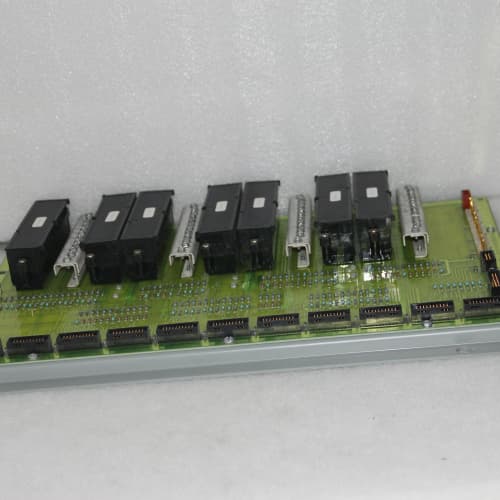
Description
Key Parameters
-
Channels: 8 digital inputs
-
Input Type: 24 V DC (sourcing/sinking configurable)
-
Input Current: 4–8 mA per channel
-
Input Impedance: >5 kΩ
-
Isolation: 1500 V RMS (channel-to-backplane); 500 V RMS between channels
-
On-state Threshold: ≥15 V DC
-
Off-state Threshold: ≤5 V DC
-
Time-Stamping Resolution: 1 ms (per channel, absolute timestamp)
-
Change-of-State (COS) Detection: Yes – captures every state transition with timestamp
-
Diagnostics: Open-wire detection, short-circuit detection, per-channel LED status, blown-fuse indication (if fused)
-
Input Filtering: Software-selectable 0.5–50 ms debounce
-
Power: 24 V DC backplane power, ≤2.5 W (plus external field supply)
-
Operating Temperature: –40°C to +70°C
Advantages
-
High-resolution time-stamping – 1 ms resolution per channel; essential for sequence-of-events (SOE) recording and fault analysis.
-
Change-of-State (COS) detection – captures every state transition; reduces PLC CPU load by only reporting changes.
-
Open-wire and short-circuit diagnostics – detects wiring faults (broken wires, sensor shorts) for proactive maintenance.
-
Per-channel filtering – independently configurable 0.5–50 ms debounce; eliminates false triggers from contact bounce.
-
Optical isolation – protects backplane from field transients and ground loops.
-
Hot-swappable – replace without rack power-down.
-
High channel density – 8 channels in a single slot; saves rack space.
-
Event buffer – stores up to 256 events per channel; prevents data loss during communication bus congestion.
Applications
-
Power generation – sequence-of-events recording for turbine trips, breaker operations, and protection relay activation
-
Substations – monitoring circuit breaker status, disconnect switches, and protective relay contacts with SOE
-
Process control – critical alarm monitoring (high-high pressure, emergency shutdown) with time-stamped logs
-
Oil & gas pipelines – valve status monitoring with event history for leak detection and incident analysis
-
Water/wastewater – pump start/stop monitoring and alarm logging
-
Manufacturing – machine cycle monitoring with event sequencing for diagnostics
-
Building automation – fire alarm and security system contact monitoring with event logging
Competitor Comparison
| Feature | DS3820DIMA | Standard 24 V Digital Input Module (no SOE) | Competitor SOE Input Module |
|---|---|---|---|
| Time-Stamping | 1 ms resolution | No | 1 ms resolution |
| COS Detection | Yes | No | Yes |
| Event Buffer | 256 events/channel | None | 128 events/channel |
| Open-Wire Detection | Yes | No | Optional |
| Short-Circuit Detection | Yes | No | Optional |
| Configurable Filtering | Yes (0.5–50 ms) | Fixed or software | Fixed only |
| Cost per channel | Mid | Low | High |
The DS3820DIMA is the SOE-enabled variant of the digital input family. Compared to standard digital input modules, it adds critical time-stamping and diagnostic capabilities – essential for fault analysis and regulatory compliance. Against competitor SOE modules, the DS3820DIMA offers a larger event buffer (256 vs. 128 events/channel) and superior diagnostics (open-wire and short-circuit detection) at a lower cost. For applications requiring sequence-of-events recording or root-cause analysis of trips, the DS3820DIMA is the most cost-effective choice.
Selection Tips
-
Choose DS3820DIMA when you need sequence-of-events recording or time-stamped fault diagnostics.
-
Ideal for power plants, substations, pipeline monitoring, and any application requiring post-event root-cause analysis.
-
Verify the input voltage matches your field devices – the DS3820DIMA accepts 24 V DC only.
-
Consider the event buffer size – 256 events per channel is sufficient for most applications; high-frequency systems may require faster uploading.
-
Not suitable for AC input signals – use the DS3820C12A family for 120 V AC inputs.
-
Ensure your PLC/DCS can receive and process time-stamped data from the DS3820DIMA.
Precautions
-
Time synchronization: The DS3820DIMA requires accurate time sync from the backplane (e.g., IRIG-B or network time protocol). Without sync, timestamps are relative only.
-
Event buffer management: Upload events regularly to avoid buffer overflow – the module does not overwrite old events.
-
Filtering: Longer filter settings (50 ms) improve noise immunity but delay event detection – match to your application requirements.
-
Wiring: Use shielded cables for inputs located in high-EMI areas. The DS3820DIMA‘s diagnostic functions (open-wire detection) require proper termination resistors.
-
Open-wire detection: Requires a pull-up/pull-down resistor in the field wiring – verify your sensor wiring supports this feature.
-
Power sequencing: Apply backplane power before field power to avoid false events during startup.
-
Grounding: Maintain proper grounding to avoid ground loop errors that could affect time-stamping accuracy.
-
Spare: Keep one spare DS3820DIMA for critical SOE applications – the time-stamping feature makes it unique, with potentially longer lead times.
A-B 1756-BA1
A-B MVI56-MCM
A-B 1756-BA2


Reviews
There are no reviews yet.