
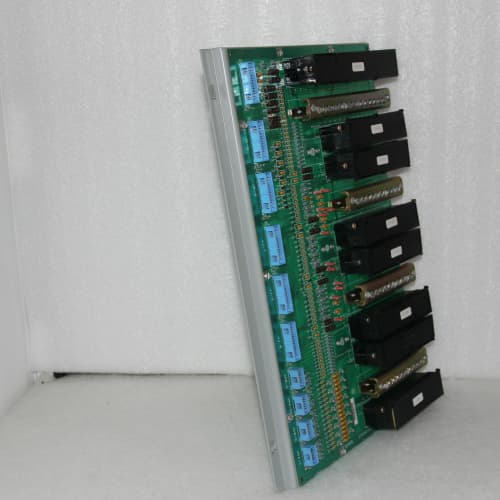
Description
Key Parameters
-
Communication Ports: 4 independent serial ports
-
Protocols Supported: Modbus RTU (Master/Slave), GE Mark IV proprietary protocol, ASCII, DNP3, and user-configurable serial protocols
-
Physical Interfaces: RS-232, RS-422, RS-485 (per-port jumper-selectable)
-
Baud Rates: 300 to 921.6 kbps (software-selectable – enhanced)
-
Data Formats: 7 or 8 data bits, 1 or 2 stop bits, parity (none, even, odd)
-
Network Functionality: Acts as a gateway between the VME backplane and multiple external serial networks
-
Diagnostics: Per-port LED status (TX/RX/error), communication error counters, signal quality monitoring, self-test on power-up
-
Isolation: 2500V RMS port-to-backplane (enhanced)
-
Temp Range: –40°C to +85°C (extended)
-
Power Supply: +5V (logic) from backplane (higher current draw due to advanced features)
-
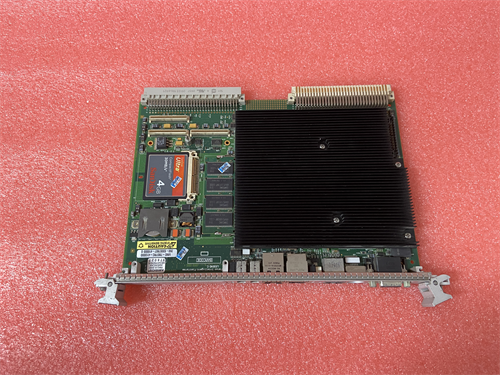
Physical: 6U VME single-slot board
-
Key Variant Features: 4 ports, 921.6 kbps max baud, 2500V isolation, extended temp range, enhanced diagnostics, firmware rev 1A1A
Advantages
-
High-speed communication – the DS3800XJBA1A1A supports baud rates up to 921.6 kbps, enabling faster data exchange with modern DCS and SCADA systems.
-
Extended communication capacity – 4 serial ports allow connection to multiple external systems simultaneously (DCS, SCADA, HMI, historians, etc.).
-
Protocol flexibility – supports Modbus RTU, GE proprietary protocols, DNP3, and user-configurable ASCII protocols.
-
Multiple physical interfaces – each port can be independently configured for RS-232, RS-422, or RS-485.
-
Enhanced diagnostics – signal quality monitoring and self-test provide early warning of deteriorating communication links or board issues.
-
Superior isolation – 2500V RMS isolation protects the backplane from field-side surges and transients.
-
Extended temperature range – operates from –40°C to +85°C for harsh environments.
-
Drop-in compatible – works with all Mark IV backplanes and processor configurations.
Applications
-
Large combined-cycle plants – connects the Mark IV turbine controller to DCS, multiple HMIs, plant historians, and remote monitoring systems simultaneously.
-
High-speed data acquisition – transmits turbine operational data to modern SCADA systems at higher baud rates for real-time monitoring.
-
Multi-vendor environments – interfaces with various third-party devices (vibration monitors, gas detectors, fuel flow computers) using different protocols and interfaces.
-
Remote monitoring centers – the General Electric DS3800XJBA1A1A enables fast data transmission to multiple remote locations.
-
Offshore and harsh environments – extended temperature range and improved isolation make it suitable for demanding applications.
vs Competitors & Previous Variants
| Feature | DS3800XJBA1A1A | Standard DS3800XJBA | DS3800XIBA | Generic VME Serial Board |
|---|---|---|---|---|
| Serial ports | 4 | 4 | 2 | 2–4 |
| Max baud rate | 921.6 kbps | 115.2 kbps | 115.2 kbps | 115.2 kbps |
| Protocols | Modbus, GE, DNP3, ASCII | Modbus, GE, ASCII | Modbus, GE, ASCII | Varies |
| Isolation | 2500V | 1500V | 1500V | 500–1000V |
| Signal quality monitoring | Yes | No | No | No |
| Self-test | Yes | No | No | No |
| Temp range | –40°C to +85°C | –30°C to +70°C | –30°C to +70°C | 0°C to +60°C |
| Firmware revision | 1A1A | Varies | Varies | N/A |
Selection Tips
-
High-speed communication needs – choose the DS3800XJBA1A1A when connecting to modern DCS or SCADA systems that support higher baud rates (>115.2 kbps).
-
Multiple external systems – use this board when you need to connect to more than two external systems simultaneously.
-
Complex plant integration – the General Electric DS3800XJBA1A1A is ideal for large combined-cycle plants or multi-unit installations requiring extensive communication.
-
DNP3 support – if your SCADA system uses DNP3, this variant supports the protocol natively.
-
Power budget verification – the DS3800XJBA1A1A draws more power than standard communication boards due to advanced features; verify your backplane power capacity.
-
Firmware compatibility – confirm your Mark IV main processor firmware supports the enhanced diagnostic and protocol features of the DS3800XJBA1A1A.
-
Spare strategy – keep one DS3800XJBA1A1A per 5–8 installed units, especially in communication-heavy installations.
-
Configuration documentation – document the protocol, interface, and baud rate settings for each of the 4 ports.
Critical Precautions
-
Interface selection – ensure each port’s RS-232/422/485 jumpers are correctly set before connecting field devices. Incorrect settings can damage the DS3800XJBA1A1A or connected devices.
-
Cable length limits – RS-232: <15 m; RS-422/485: <1200 m. Higher baud rates may require shorter cable lengths; consult the DS3800XJBA1A1A technical manual for derating guidelines.
-
Grounding – for RS-485 multi-drop networks, ensure proper termination resistors (120Ω) are installed at each end of the bus to prevent reflections.
-
Shielded cabling – use shielded twisted-pair cables for RS-422/485 connections. Ground the shield only at the General Electric DS3800XJBA1A1A end to prevent ground loops.
-
Address configuration – when using Modbus RTU or DNP3, ensure each device has a unique slave address on each network.
-
Data format matching – verify that data bits, stop bits, and parity settings on the DS3800XJBA1A1A match each external device exactly.
-
Bandwidth management – with 4 ports at higher baud rates, the DS3800XJBA1A1A can generate significant backplane traffic. Ensure your Mark IV processor can handle the data throughput.
-
Heat dissipation – due to higher component density and performance, ensure adequate cabinet cooling (>250 CFM) if multiple advanced boards are installed.
-
Self-test – allow the DS3800XJBA1A1A to complete its power-up self-test (~2 seconds) before relying on communications.
-
Hot-swap – never insert or remove the DS3800XJBA1A1A while the rack is powered; this can cause communication buffer corruption or damage.
-
ESD handling – always use a grounded wrist strap; serial interface chips are ESD-sensitive.
-
Storage – store spare DS3800XJBA1A1A boards in anti-static bags in a dry, temperature-controlled environment.
OMRON TL-N20ME1
A-B 1769-ECR
Ӹ NBN8-18GM50-EO




Reviews
There are no reviews yet.