
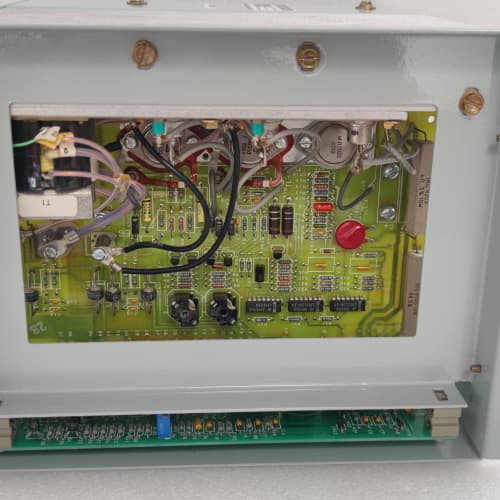
Description
Key Parameters
-
Analog Input Channels: 16 differential or 32 single-ended (software-configurable)
-
Analog Input Types: 0–10V, ±10V, 4–20mA (jumper-selectable per channel)
-
Analog Output Channels: 8 independent (0–10V, ±10V, or 4–20mA)
-
Resolution: 14-bit ADC (inputs), 12-bit DAC (outputs)
-
Accuracy: ±0.1% of full scale (inputs), ±0.2% of full scale (outputs)
-
Isolation: 1000V RMS channel-to-backplane
-
Diagnostics: LED status per channel, over-range/under-range detection, open-circuit detection on inputs
-
Temp Range: –30°C to +70°C
-
Power Supply: +5V, ±15V from VME backplane
-
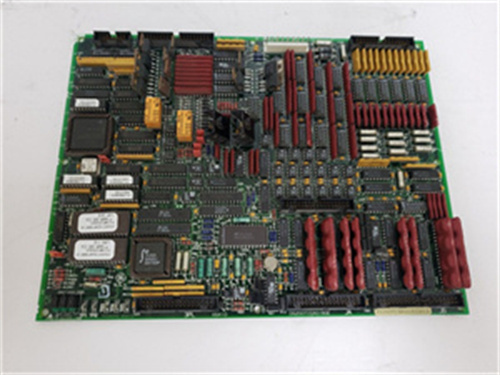
Physical: 6U VME single-slot board
Advantages
-
Expanded channel count – the DS3800XAIA adds 16 analog inputs and 8 analog outputs, increasing system capacity without requiring additional racks.
-
Dual function – combines both analog input and output capability on a single board, saving rack slots compared to separate input and output boards.
-
Flexible input configuration – each input channel can be independently configured for voltage or current without hardware changes (jumper-selectable).
-
Software scaling – input and output ranges can be scaled via Mark IV configuration software, eliminating the need for external signal conditioners.
-
Built-in diagnostics – detects open-circuit conditions on current inputs and over-range conditions, aiding troubleshooting.
-
Drop-in compatible – works seamlessly with all Mark IV backplanes and processor configurations.
Applications
-
Expanded turbine monitoring – adds additional temperature, pressure, and flow measurement points in large gas and steam turbine installations.
-
Valve position feedback – monitors extra LVDT or potentiometer feedback from multiple servo valves.
-
DAC outputs – provides additional analog command signals for trim control valves, bypass valves, or auxiliary actuators.
-
Retrofit projects – the General Electric DS3800XAIA allows adding I/O points to legacy Mark IV systems without replacing the entire control cabinet.
-
Data acquisition – collects extra process variables for performance monitoring and trending.
vs Competitors & Related Variants
| Feature | DS3800XAIA | Standard DS3800NVPA (Input Only) | Generic VME Analog I/O Board |
|---|---|---|---|
| Analog inputs | 16 diff / 32 SE | 16 diff / 32 SE | 8–16 diff typical |
| Analog outputs | 8 | None | 2–4 typical |
| Input resolution | 14-bit | 16-bit | 12–14-bit |
| Output resolution | 12-bit | N/A | 12-bit typical |
| Configurable input ranges | Voltage/current | Voltage, TC, RTD, current | Usually fixed |
| Isolation | 1000V | 1500V | 500–1000V |
| Temp range | –30°C to +70°C | –30°C to +70°C | 0°C to +60°C |
Selection Tips
-
Channel planning – identify which new sensors and actuators will be connected to the DS3800XAIA; group similar signal types together (voltage vs current) to simplify configuration.
-
Scaling verification – ensure your Mark IV system software supports the input/output scaling ranges required for the General Electric DS3800XAIA; older firmware may need updates.
-
Output load verification – confirm that the 8 outputs of the DS3800XAIA can drive your field devices; output drive capability is limited to 10mA for 0–10V and 22mA for 4–20mA outputs.
-
Spare strategy – keep one DS3800XAIA per 10 installed units; the combined input/output design makes it versatile but critical for expanded systems.
-
Calibration – perform a two-point calibration (zero and span) on critical input and output channels after installation using a precision calibrator.
Critical Precautions
-
Over-voltage on inputs – never apply voltage above ±30V to any analog input of the DS3800XAIA; this can damage the ADC front-end circuitry.
-
Output short circuit – do not short the analog outputs to ground or positive supply; the DS3800XAIA has limited current protection and may be damaged.
-
Ground loops – use single-point grounding for field transmitters to avoid common-mode voltage exceeding ±10V on the General Electric DS3800XAIA inputs.
-
Wiring separation – keep analog signal wiring away from AC power lines and high-voltage cables to prevent noise coupling into the DS3800XAIA inputs.
-
Calibration intervals – schedule periodic calibration verification (every 6–12 months) to maintain accuracy, especially for thermocouple and 4–20mA loops.
-
ESD handling – always use a grounded wrist strap when handling the DS3800XAIA; CMOS components are ESD-sensitive.
-
Humidity – avoid condensation; high humidity can affect analog accuracy even though the DS3800XAIA has conformal coating.
-
Hot-swap – never insert or remove the DS3800XAIA while the rack is powered; this can cause bus errors or component damage.
SCHNEIDER GV2-ME16C
Notifier FST-851C
GE IC698ACC701


Reviews
There are no reviews yet.