
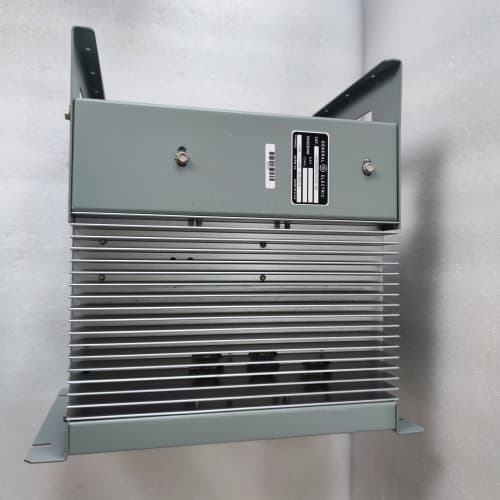
Description
Key Parameters
-
Analog Input Channels: 32 differential or 64 single-ended (software-configurable)
-
Analog Input Types: 0–10V, ±10V, 4–20mA (jumper-selectable per bank of 8)
-
Analog Output Channels: 16 independent (0–10V, ±10V, or 4–20mA)
-
Resolution: 16-bit ADC with DSP-enhanced oversampling (inputs), 12-bit DAC (outputs)
-
Accuracy: ±0.03% of full scale (inputs), ±0.15% of full scale (outputs)
-
Sampling Rate: 200 Hz per channel (aggregate)
-
Isolation: 2500V RMS channel-to-backplane
-
Diagnostics: LED status per bank, over-range/under-range detection, open-circuit detection, output fault detection, self-calibration on power-up, enhanced diagnostics reporting (firmware 1E1E)
-
EMI/RFI Filtering: Advanced DSP-based digital filtering (programmable cutoff frequencies)
-
Temp Range: –40°C to +85°C
-
Power Supply: +5V, ±15V from VME backplane
-
Physical: 6U VME single-slot board
-
Key Variant Features: 16-bit ADC with oversampling, DSP filtering, 2500V isolation, extended temp range, self-calibration, enhanced diagnostics, firmware rev 1E1E
Advantages
-
Superior precision – ±0.03% accuracy with DSP-enhanced oversampling, the highest precision available in the Mark IV analog I/O lineup.
-
Advanced noise filtering – programmable DSP filters reject specific noise frequencies (50/60 Hz, VFD harmonics) for stable readings in harsh electrical environments.
-
Enhanced diagnostics – the firmware revision 1E1E provides improved diagnostic reporting over the 1E1D, including more detailed fault codes and self-test results via the VME backplane.
-
Maximum I/O density – 32 inputs and 16 outputs per board replace multiple standard boards, saving rack slots.
-
Self-calibration – automatic on-board calibration at power-up compensates for temperature drift and component aging.
-
Extended isolation – 2500V RMS isolation protects the backplane from field-side surges.
-
Bank configuration – inputs grouped into banks of 8, each configurable for voltage or current.
-
Conformal coating – protects against moisture, salt spray, and contaminants.
-
Drop-in replacement – fully compatible with DS3800XAIB1E1D and standard DS3800XAIB boards with no wiring changes.
Applications
-
Critical turbine protection – ultra-precise measurements for exhaust temperature averaging, overspeed detection, and vibration monitoring.
-
Combined-cycle power plants – monitors gas turbines, HRSGs, and steam turbines from a single rack.
-
Offshore platforms – designed for saltwater environments requiring extended temperature range and corrosion resistance.
-
Noisy environments – preferred choice for sites with VFDs, large motors, or switchgear.
-
Performance optimization – high-speed, high-accuracy data acquisition for efficiency calculations and condition monitoring.
vs Competitors & Previous Variants
| Feature | DS3800XAIB1E1E | DS3800XAIB1E1D | DS3800XAIB1C1C | Generic VME Board |
|---|---|---|---|---|
| Input resolution | 16-bit + oversampling | 16-bit + oversampling | 16-bit | 12–14-bit |
| Accuracy | ±0.03% | ±0.03% | ±0.05% | ±0.2–0.5% |
| DSP filtering | Yes (programmable) | Yes (programmable) | No | No |
| Sampling rate | 200 Hz | 200 Hz | 100 Hz | 50–100 Hz |
| Isolation | 2500V | 2500V | 1500V | 500–1000V |
| Self-calibration | Yes | Yes | No | No |
| Diagnostic detail | Enhanced (1E1E) | Standard | Standard | Basic |
| Temp range | –40°C to +85°C | –40°C to +85°C | –40°C to +85°C | 0°C to +60°C |
| Firmware revision | 1E1E | 1E1D | 1C1C | N/A |
Selection Tips
-
Diagnostic requirements – choose the DS3800XAIB1E1E over the 1E1D if your facility requires enhanced diagnostic reporting for condition monitoring or predictive maintenance. The 1E1E firmware provides additional fault codes.
-
Highest precision required – select this board for critical measurements where accuracy is paramount (e.g., turbine efficiency monitoring, emissions calculations).
-
Noisy environment – use the General Electric DS3800XAIB1E1E for sites with VFDs, large motors, or transients; DSP filtering can be tuned to reject specific interference frequencies.
-
Firmware compatibility – confirm your Mark IV main processor firmware supports the enhanced diagnostics of the DS3800XAIB1E1E; older versions may not display all diagnostic codes.
-
Power budget verification – the DS3800XAIB1E1E draws higher current due to DSP processing. Verify power supply capacity before multiple installations.
-
Spare strategy – keep one DS3800XAIB1E1E per 8 installed units; its advanced features make it critical for high-precision applications.
-
Calibration – although self-calibrating, perform a verification check with a precision calibrator during commissioning.
Critical Precautions
-
Power supply loading – do not exceed backplane power ratings; DSP processing increases current draw.
-
Over-voltage on inputs – never apply voltage above ±30V to any analog input; this can permanently damage the 16-bit ADC front-end.
-
Output short circuit – do not short outputs to ground or positive supply; the General Electric DS3800XAIB1E1E has limited current protection.
-
Ground loops – use single-point grounding for field transmitters to avoid common-mode voltage exceeding ±10V on inputs.
-
Wiring separation – keep analog signal wiring away from AC power lines and high-voltage cables to maximize DSP filter effectiveness.
-
Bank grouping – ensure all channels within each 8-channel bank are set to the same input type (voltage or current); mismatched settings can degrade DSP performance.
-
Self-calibration – allow the DS3800XAIB1E1E to complete its power-up self-calibration cycle (approximately 5 seconds) before relying on measurements.
-
DSP filter configuration – do not set filter cutoff frequencies too low; this can attenuate real signal changes. Consult GE application notes for proper settings.
-
Firmware version tracking – maintain documentation of the 1E1E firmware revision on each board; mixing 1E1D and 1E1E in redundant systems may cause diagnostic inconsistencies.
-
ESD handling – always use a grounded wrist strap; the high-density, high-precision design is particularly ESD-sensitive.
-
Humidity – avoid condensation; conformal coating protects against moisture, but extreme humidity can still affect high-impedance input circuits.
-
Hot-swap – never insert or remove the DS3800XAIB1E1E while the rack is powered; high current draw increases the risk of arcing and damage.
Schneider CAD32M7
A-B 1756-TBCH
A-B 1756-TBNH
.jpg)

Reviews
There are no reviews yet.