
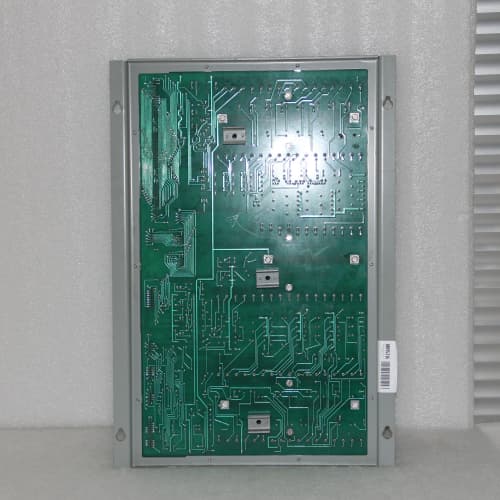
Description
Key Technical Parameters
| Parameter | Specification |
|---|---|
| Manufacturer | General Electric (GE) |
| Series | Mark V (Speedtronic) |
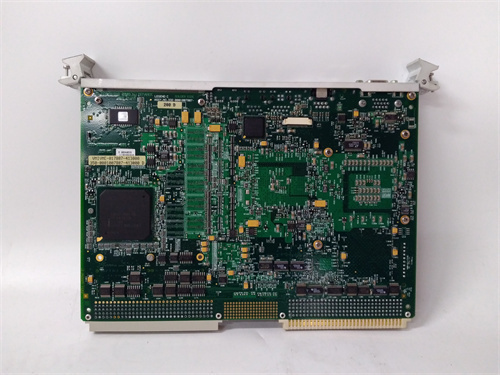
| Full Model | DS3800NHVK |
| Power Supply | +5V DC @ 4.5A, +15V DC @ 0.8A, -15V DC @ 0.6A |
| Temperature Inputs | 8 thermocouple + 8 RTD = 16 total channels (16-bit ADC, ±1°C / ±0.5°C) |
| Relay Outputs | 8 mechanical relays, 2A continuous @ 125VDC (surge 4A) |
| SS Outputs | 4 solid-state relays, 3A continuous @ 24–48VDC |
| Tachometer Inputs | 2 channels with enhanced filtering (up to 10 kHz) |
| Communication | Mark V proprietary parallel backplane bus |
| Operating Temperature | 0°C to +60°C |
| LED Indicators | Power, Relay Run (8x amber), SS Run (4x green), Tach Fail (red x2), RTD Fault (yellow), Over-Temp Alarm, Backplane Active |
Advantages and Distinctive Features
-
Dual Temperature Sensor Support (T/C + RTD): The DS3800NHVK provides 8 thermocouple + 8 RTD inputs (16 total channels), supporting mixed sensor types or redundant monitoring in a single board.
-
Hybrid Output + Tachometer Feedback: Combines 8 high-voltage DC relay outputs, 4 high-current solid-state outputs, AND 2 tachometer inputs.
-
Higher Solid-State Current (3A): Supports larger 48VDC auxiliary fans.
-
Higher Relay Current (2A @ 125VDC): Supports more powerful 110–125VDC fans.
-
RTD Fault Detection: Continuous monitoring for open-circuit, short-circuit, or lead-wire degradation.
-
Enhanced Temperature Accuracy: 16-bit ADC with improved cold-junction compensation.
Typical Application Fields
-
Safety-Critical 125VDC Cooling Systems: Where redundant temperature sensing and fan failure detection are mandatory.
-
High-Voltage Industrial Fan Systems: 110–125VDC exhaust fans with higher-power 48VDC auxiliary controls and speed monitoring.
-
Military & Naval Applications: 125VDC systems with mixed sensor types.
-
Nuclear Auxiliary Turbines: High reliability with redundant temperature sensing.
-
Legacy Turbine Installations: Older systems requiring both T/C and RTD monitoring.
Comparison with Related Models
| Feature | DS3800NHVK | DS3800NHVJ | DS3800NHVH | DS3800NHVF |
|---|---|---|---|---|
| Relay Outputs | 8 × 2A @ 125VDC | 8 × 2A @ 125VDC | 8 × 2A @ 125VDC | 8 × 1A @ 250VDC |
| SS Outputs | 4 × 3A @ 48VDC | 4 × 3A @ 48VDC | 4 × 2A @ 48VDC | 4 × 2A @ 48VDC |
| Tach Inputs | 2 channels | 2 channels | 2 channels | 2 channels |
| T/C Inputs | 8 | 8 | 8 | 8 |
| RTD Inputs | 8 channels | None | None | None |
| Total Temp Channels | 16 | 8 | 8 | 8 |
| RTD Fault Detection | Yes | No | No | No |
| ADC Resolution | 16-bit | 16-bit | 12-bit | 12-bit |
| Operating Temp | 0°C to +60°C | 0°C to +60°C | 0°C to +60°C | 0°C to +60°C |
| Cost | Very High | High | High | High |
Selection Recommendations
-
Choose the DS3800NHVK if:
-
You need 125VDC relay outputs with 2A current capacity for more powerful fans.
-
You need higher-current solid-state outputs (3A @ 48VDC) for larger auxiliary fans.
-
You require both thermocouple and RTD inputs (16 total temperature channels).
-
You require RTD fault detection for sensor integrity monitoring.
-
You require tachometer feedback for fan speed verification.
-
You have a climate-controlled environment (0°C to +60°C).
-
-
Choose the DS3800NHVJ if: You need the same relay/SS/tachometer features but only require thermocouple inputs (no RTDs).
-
Choose the DS3800NHVH if: You need 2A @ 125VDC relays and tachometer feedback but can accept 2A solid-state outputs and 12-bit ADC.
Critical Precautions
-
ESD Protection: Always wear a grounded wrist strap.
-
High-Voltage Hazard: Relay outputs switch 125VDC—lethal voltage present on terminals. Observe all high-voltage safety procedures. Use wiring rated for ≥125VDC.
-
RTD Wiring: Use 3-wire Pt100 RTDs. All three wires must be connected. Open/short circuits trigger the yellow “RTD Fault” LED.
-
RTD Lead Resistance: Use wire with resistance ≤10Ω per lead for accurate measurements.
-
DC Polarity (Relay): Relay outputs are DC only—observe correct polarity.
-
DC Polarity (SS): Solid-state outputs are DC-only and polarity-sensitive—reverse polarity destroys the MOSFET.
-
Tachometer Wiring: Use shielded twisted-pair cable. Connect shield to designated terminal—not at the fan end.
-
Relay Current Limitation: Rated at 2A continuous @ 125VDC. Verify fan current does not exceed this limit.
-
SS Current Limitation: Rated at 3A continuous @ 24–48VDC. At elevated temperatures, consider derating.
-
Inductive Load Derating (Relay): Derate to 1.5A or use external RC snubbers (rated for 125VDC).
-
No AC Connection: Do not connect AC loads to either output type.
-
No Hot-Swap: Always depower the rack before insertion/removal.
-
Slot Assignment: Install in slots 8–10 (auxiliary I/O).
-
CPU Dependency: If backplane communication is lost, the board defaults to 100% fan speed—tachometer monitoring and RTD fault detection disabled in fallback mode.
-
Firmware Compatibility: The DS3800NHVK is compatible with Mark V CPU firmware v4.0 and above for full RTD support and 16-bit ADC functionality. For v3.x, RTD inputs may be partially disabled—confirm compatibility before purchasing.
SCHNEIDER BMXDDI1602
Siemens 5SP4391-8.3P 100A
GE IC200PWR102



Reviews
There are no reviews yet.