
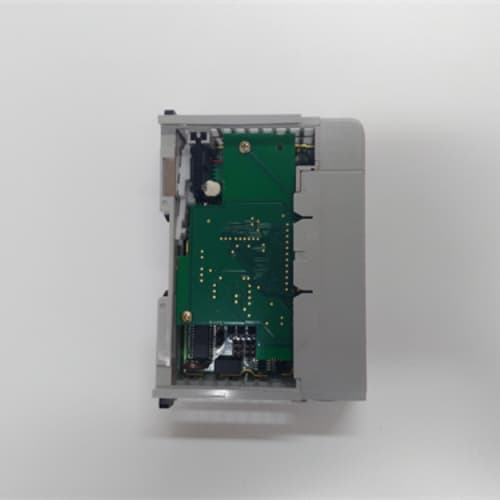
Description
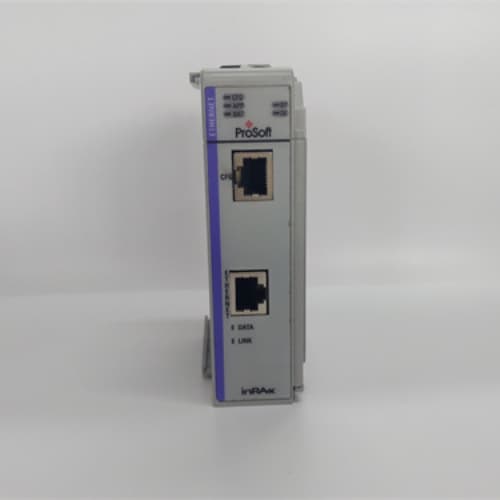
Product Parameters
| Parameter | Specification |
|---|---|
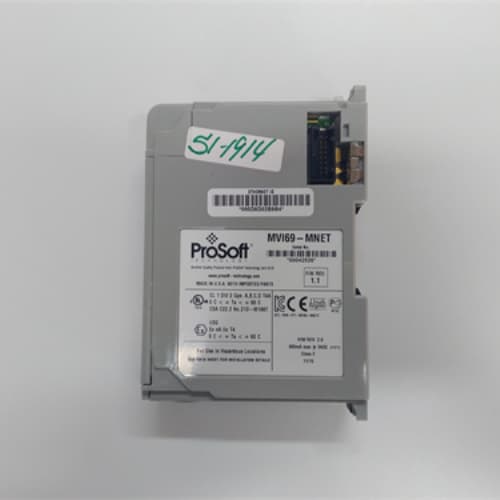
| Model | MVI69-MNET |
| Brand | ProSoft Technology (Belden) |
| Platform | Allen-Bradley CompactLogix |
| Function | Modbus TCP/IP communication module |
| Chassis Slots | 1 slot |
| Network Port | Ethernet 10/100 Mbps |
| Protocol Support | Modbus TCP/IP Client (Master) and Server (Slave) |
| Client Connections | Multiple simultaneous Modbus TCP client connections |
| Server Support | Modbus TCP server for supervisory data access |
| Backplane Interface | CompactLogix backplane, tag-based data exchange |
| Data Mapping | Modbus TCP registers mapped to controller tags |
| Diagnostics | LED indicators, status registers, ProSoft diagnostics |
| Configuration Tool | ProSoft Configuration Builder (PCB) |
| Operating Temperature | Industrial range |
| Design Intent | Modbus TCP/IP device and system integration into CompactLogix |
Advantages and Features
The ProSoft MVI69-MNET provides dedicated Modbus TCP/IP connectivity that offloads Modbus polling and server handling from the CompactLogix controller, preserving controller scan time for control logic. The MVI69-MNET supports multiple simultaneous client connections, allowing the module to poll several Modbus TCP devices concurrently, and its server capability enables supervisory systems to read and write data through the same module. The module maps Modbus TCP register data directly to CompactLogix tags through the backplane, simplifying ladder logic development and reducing integration effort. Diagnostic LEDs and status data on the MVI69-MNET provide clear visibility into network and connection health, and ProSoft Configuration Builder software simplifies setup, client configuration, and troubleshooting. The module is field-proven in demanding industrial environments, with a stable firmware baseline and broad compatibility with existing CompactLogix programs.
Application Cases and Fields
The ProSoft MVI69-MNET is commonly applied in:
-
Oil and gas facilities integrating Modbus TCP flow computers, RTUs, and drives
-
Water and wastewater plants connecting Modbus TCP meters, analyzers, and pump controllers
-
Manufacturing lines interfacing Modbus TCP VFDs, servo drives, and power meters
-
Power generation and utility substations linking Modbus TCP protection relays and meters
-
SCADA and supervisory systems requiring Modbus TCP data access from CompactLogix
In these applications, the MVI69-MNET performs Modbus TCP polling and data concentration, presenting clean tag data to the CompactLogix controller for use in control and SCADA logic, while also serving data to supervisory clients.
Comparison with Competing Products
Compared with using the CompactLogix controller’s built-in Ethernet port for Modbus TCP, the ProSoft MVI69-MNET offloads protocol handling to a dedicated module, preserving controller scan time and providing deterministic polling independent of controller workload. Competing Modbus TCP gateways typically require external hardware and separate power supplies, whereas the MVI69-MNET installs directly in the CompactLogix chassis and exchanges data over the backplane without external wiring. For ControlLogix applications, the equivalent ProSoft MVI56-MNETC provides the same functionality in the larger platform. For Modbus TCP integration into CompactLogix, the ProSoft MVI69-MNET remains a field-proven and cost-effective option.
Selection Suggestions and Precautions
-
Confirm the CompactLogix chassis, firmware revision, and ProSoft module compatibility before specifying the MVI69-MNET.
-
Verify the network architecture, IP addressing, subnet, and switch configuration for all Modbus TCP devices and clients.
-
Plan Modbus TCP register mapping and CompactLogix tag structures in advance to streamline commissioning.
-
Consider network segmentation and firewall rules to protect the MVI69-MNET and connected devices from unauthorized access.
-
Follow ProSoft installation and configuration manuals and observe ESD precautions when inserting the MVI69-MNET into the chassis.
-
Procure the ProSoft MVI69-MNET through authorized channels to ensure authenticity and access to firmware and support.
-
Document IP assignments, client configurations, and register mappings, and maintain configuration backups for rapid recovery.
-
Test Modbus TCP polling rates, connection limits, and timeout behavior in a staging environment to confirm network performance before production deployment.


Reviews
There are no reviews yet.