
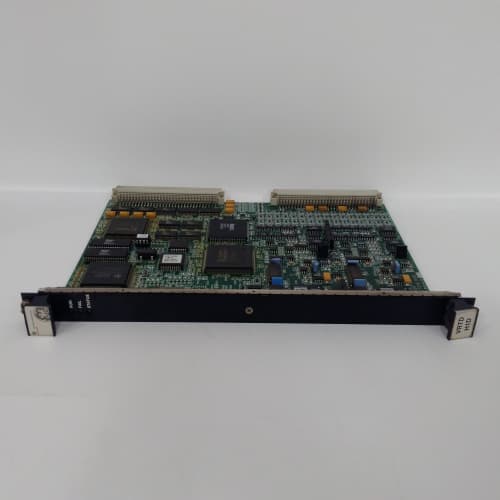
Description
Product Parameters
| Parameter | Specification |
|---|---|
| Model | IS230TNAIH4C |
| Manufacturer | GE Energy / Baker Hughes |
| Platform | Mark VIe |
| Type | Analog I/O termination board |
| Compatible Modules | IS220PAICH1A, IS220PAICH1B, IS220PIOAH1A |
| Analog Input Channels | Up to 8 (depending on module configuration) |
| Analog Output Channels | Up to 4 (depending on module configuration) |
| Signal Type | Voltage (0–10 V, ±10 V) or Current (4–20 mA, 0–20 mA) |
| Terminal Type | Screw‑clamp (pluggable, 2‑piece) |
| Number of Positions | 24 positions (field wiring side) |
| Wire Gauge | 0.2–2.5 mm² (AWG 24–14) |
| Signal Conditioning | Configurable termination resistors, RC filters, ESD protection |
| Isolation | 1500 V (field‑to‑backplane via module) |
| LED Indicators | None (status via I/O module) |
| Operating Temperature | -30°C to +65°C |
| Storage Temperature | -40°C to +85°C |
| Humidity | 5% to 95% (non‑condensing) |
| Dimensions | Standard Mark VIe terminal board form factor |
| Weight | Approx. 0.40 kg |
| MTBF | > 180,000 hours |
Advantages and Key Features
-
High-Density Analog Termination – The IS230TNAIH4C provides up to 8 analog inputs and 4 analog outputs per board, offering a compact and organized interface for field wiring.
-
Flexible Signal Configuration – Each channel on the IS230TNAIH4C can be configured for voltage (0–10 V, ±10 V) or current (4–20 mA, 0–20 mA) via jumper settings, matching the I/O module configuration.
-
Integrated Signal Conditioning – Provides mounting locations for termination resistors and filter capacitors to match sensor characteristics and reject noise, reducing external components.
-
Pluggable Terminal Design – The IS230TNAIH4C features a 2‑piece pluggable terminal block design, allowing field wiring to be disconnected without removing individual wires, simplifying maintenance and module replacement.
-
ESD Protection – Basic ESD protection (IEC 61000‑4‑2 Level 3) protects the IS230TNAIH4C and connected I/O modules from electrostatic discharge during maintenance and field wiring operations.
-
Wide Wire Range – Accepts wire gauges from AWG 24 to AWG 14, accommodating both small‑gauge instrument wiring and larger power connections.
-
Wide Temperature Range – Rated for -30°C to +65°C, suitable for most industrial and turbine environments.
-
Flame‑Retardant Housing – UL 94 V‑0 rated material provides safety in the event of electrical faults.
Application Fields and Use Cases
1. Pressure and Flow Monitoring
The IS230TNAIH4C connects 4–20 mA pressure transmitters and flow meters to the IS220PAICH1B, providing critical process data for turbine control and monitoring.
2. Temperature Transmitter Monitoring
Provides connections for 4–20 mA temperature transmitters (with built‑in signal conditioning), reducing the need for direct thermocouple or RTD termination.
3. Valve Positioner Control
Provides connections for 4–20 mA analog outputs to valve positioners, enabling precise control of fuel valves, steam admission valves, and other actuators.
4. Level Monitoring
Connects 4–20 mA level transmitters in auxiliary systems (lube oil tanks, water treatment) for automated control and alarm annunciation.
5. Speed and Vibration Monitoring
Supports ±10 V signals from vibration monitoring systems and speed sensors, providing data for condition monitoring and protection.
6. Retrofit Projects
The IS230TNAIH4C is a cost‑effective analog termination solution for Mark VIe upgrades from legacy Mark VI analog termination boards (IS200TNAIH4C), offering pluggable connections and improved reliability.
Comparison with Competing Products
| Feature | IS230TNAIH4C (GE) | IS200TNAIH4C (GE Mark VI) | IS230TBTCH1B (GE Mark VIe) | ABB TU830 (AC 800M) | Siemens 6ES7 392-1AJ00 (S7-400) |
|---|---|---|---|---|---|
| Platform | Mark VIe | Mark VI (VME) | Mark VIe | AC 800M | S7-400 |
| Type | Analog termination | Analog termination | Universal terminal | Terminal unit | Terminal block |
| Analog Capacity | 8 inputs + 4 outputs | 8 inputs + 4 outputs | Up to 32 mixed | 8–16 mixed | 8 mixed |
| Signal Conditioning | Configurable R/C | Fixed | Configurable | Configurable | Limited |
| Terminal Type | Screw, pluggable | Screw, fixed | Screw, pluggable | Screw, pluggable | Screw, fixed |
| Pluggable | Yes | No | Yes | Yes | No |
| Wire Gauge | AWG 24–14 | AWG 22–14 | AWG 24–14 | AWG 24–14 | AWG 24–12 |
| Isolation | Via module (1500 V) | Via module (1500 V) | Via module (1500 V) | Via module (1500 V) | Via module (500 V) |
| Temp Range | -30°C to +65°C | -30°C to +65°C | -40°C to +85°C | -25°C to +60°C | 0°C to +60°C |
| MTBF | > 180,000 hrs | > 150,000 hrs | > 200,000 hrs | > 120,000 hrs | > 80,000 hrs |
Key Differentiators: The IS230TNAIH4C is a dedicated analog termination board specifically optimized for analog input and output modules, offering dedicated signal conditioning for voltage/current signals. Unlike the universal IS230TBTCH1B, the IS230TNAIH4C is tailored for analog applications with simplified configuration and lower cost. Compared to the legacy IS200TNAIH4C, it provides pluggable connections for easier maintenance.
Selection Suggestions and Precautions
Selection Criteria
-
Choose the IS230TNAIH4C for analog I/O applications requiring dedicated voltage/current signal termination with the IS220PAICH1A, IS220PAICH1B, or IS220PIOAH1A modules.
-
For universal applications with mixed signal types (analog, discrete, temperature), consider the IS230TBTCH1B.
-
Verify the number of analog inputs and outputs matches the I/O module capacity (8 inputs, 4 outputs for IS220PAICH1B).
-
Ensure proper channel configuration: jumper settings must match the module configuration (voltage or current).
Critical Precautions
-
Signal Configuration – Configure each channel on the IS230TNAIH4C for the correct signal type (voltage or current) using jumpers before connecting field wiring. Incorrect configuration can damage the module or produce erroneous readings.
-
Termination Resistors – For 4–20 mA current inputs, install the required termination resistors (typically 250 Ω) on the IS230TNAIH4C. For voltage inputs, remove termination resistors.
-
Loop Power – The IS230TNAIH4C does not provide loop power for 4–20 mA transmitters. Ensure external power supplies are provided for loop‑powered devices.
-
Shielding – Use shielded twisted‑pair cables for all analog connections to the IS230TNAIH4C. Terminate shields at the field device end, not at the board, to prevent ground loops.
-
Polarity – For DC signals, observe proper polarity on the IS230TNAIH4C to prevent incorrect readings and potential damage.
-
Wiring – Use appropriate wire gauge (AWG 24–14). Recommended torque: 0.5–0.6 N·m. Over‑tightening may damage terminals; under‑tightening may cause intermittent connections.
-
Grounding – Ensure all field devices and the Mark VIe chassis share a common reference ground to prevent ground loops.
-
ESD Handling – Use grounded wrist straps when handling the IS230TNAIH4C to prevent static damage.
-
Obsolescence – The IS230TNAIH4C is in active production with long‑term support. For future projects requiring additional analog channels or enhanced features, evaluate the IS230TNAIH4D when available. Keep spare boards for critical analog applications.
A-B 1746-P2
SIEMENS 6ES216-2BD23-0XB8
A-B 1756-A17
A-B 1769-HSC


Reviews
There are no reviews yet.