
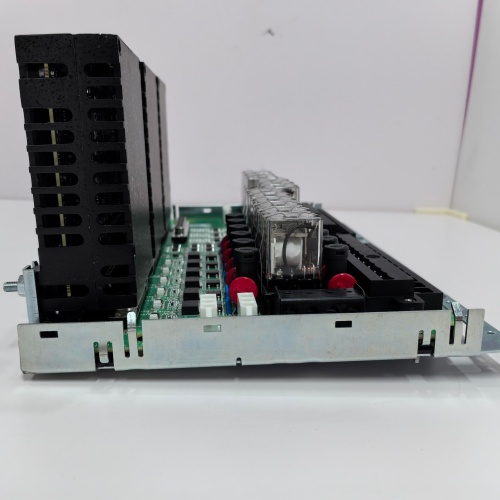
Description
Product Parameters
| Parameter | Specification |
|---|---|
| Brand / Series | GE Mark VIe Speedtronic |
| Model | IS200TRPLH1A |
| Transducer Power Channels | 16 isolated channels |
| Output Voltage | 5 VDC / 10 VDC / 15 VDC (selectable, programmable per channel) |
| Output Current | 50 mA per channel (800 mA total maximum) |
| Input Voltage Range | 24/48/125 VDC (auto-ranging, from Mark VIe rack) |
| Voltage Regulation | ±0.1% |
| Ripple/Noise | < 10 mV peak-to-peak |
| Isolation | 1500 VAC (channel-to-channel and field-to-system) |
| Diagnostics | Overcurrent detection, short-circuit detection, under/over-voltage monitoring, open-circuit detection |
| Status Indication | 16 green LEDs (channel active), 16 red LEDs (channel fault), 2 red summary fault LEDs |
| Operating Temperature | –30°C to +65°C |
| Storage Temperature | –55°C to +85°C |
| Mounting | VME rack-mount terminal board with front-panel I/O connectors |
| Backplane Interface | VME64x (A24/A32, D16/D32/D64) |
| EMC Compliance | IEC 61000-4 Level 4 |
Advantages & Key Features
-
Low-Voltage Transducer Support: IS200TRPLH1A provides selectable 5 VDC, 10 VDC, or 15 VDC outputs per channel, accommodating a wide range of low-voltage transducers.
-
High Channel Density: 16 isolated transducer power channels in a single VME slot—double the density of competing modules.
-
Programmable Output Voltage: Per-channel adjustable voltage selection via GE ToolboxST.
-
High Accuracy Regulation: ±0.1% voltage regulation ensures stable transducer operation.
-
Comprehensive Diagnostics: Overcurrent, short-circuit, under/over-voltage, and open-circuit detection per channel enable predictive maintenance.
-
Low Ripple/Noise: < 10 mV peak-to-peak ripple ensures clean power for sensitive transducers.
-
Opto-Isolation: 1500 VAC isolation protects the Mark VIe backplane from field wiring faults.
-
ToolboxST Integration: Full configuration, monitoring, and diagnostics via GE ToolboxST.
-
Drop-In Replacement: Direct replacement for earlier GE low-voltage transducer power terminal boards.
Application Fields
-
Gas & Steam Turbines (GE Frame 6B/7EA/9E/HA): Powering low-voltage pressure transmitters, temperature transmitters, position transducers, and vibration sensors.
-
Combined Cycle Plants: Powering HRSG low-voltage pressure and temperature transmitters.
-
Compressor Stations: Powering low-voltage suction/discharge pressure transmitters and temperature transmitters.
-
Aeroderivative Turbines: Powering low-voltage fuel flow, oil pressure, and temperature transmitters.
-
General Industrial: Powering low-voltage field transducers requiring 5 V, 10 V, or 15 V excitation.
Comparison with Competing Products
| Feature | GE IS200TRPLH1A | Competitor A (Low-Voltage Power Module) | Competitor B (Power Supply Module) |
|---|---|---|---|
| Power Channels | 16 isolated | 8 isolated | 8 non-isolated |
| Output Voltage | 5/10/15 VDC (programmable) | 5 VDC fixed | 24 VDC fixed |
| Output Current | 50 mA/channel | 40 mA/channel | 50 mA/channel |
| Voltage Regulation | ±0.1% | ±1% | ±0.5% |
| Diagnostics | Overcurrent, short, under/over-voltage, open | Overcurrent only | Overcurrent only |
| Isolation | 1500 VAC | 1000 VAC | 500 VDC |
| Operating Temp | –30°C to +65°C | 0°C to 50°C | 0°C to 60°C |
Key Advantage: IS200TRPLH1A provides 16 isolated low-voltage transducer power channels—double the density of competing modules—with programmable 5/10/15 VDC output, high accuracy regulation (±0.1%), and comprehensive diagnostics, making it ideal for powering low-voltage field transducers in turbine applications.
Selection Guidelines & Recommendations
-
Voltage Selection: Configure per-channel output voltage (5 V, 10 V, or 15 VDC) in GE ToolboxST based on transducer requirements.
-
Channel Count: Determine number of transducers requiring low-voltage power—up to 16 per board.
-
Current Requirements: Verify each transducer’s current draw does not exceed 50 mA per channel.
-
Diagnostic Configuration: Enable overcurrent, short-circuit, and under/over-voltage monitoring for critical transducers.
-
Controller Firmware: Requires Mark VIe processor firmware v7.5 or later.
-
Wiring Guidelines: Use shielded twisted-pair cables. Maintain shield grounding only at the Mark VIe cabinet end.
-
Spare Strategy: Keep one spare per turbine; lead times 6–8 weeks.
-
Retrofit: Direct replacement—regenerate configuration in GE ToolboxST.
Important Cautions
-
No Hot-Swap: De-energize rack before insertion/removal.
-
Power Polarity: Observe correct polarity for transducer connections—reverse polarity may damage field devices.
-
Voltage Verification: Verify transducer voltage requirements before powering up—incorrect voltage may damage devices.
-
Current Limit: Do not exceed 50 mA per channel—overcurrent protection will trip and latch.
-
Short-Circuit: If a short is detected, the channel will latch off. Clear the fault and reset via GE ToolboxST.
-
Grounding: Connect AGND to Mark VIe system ground at single star point.
-
Shield Termination: Ground transducer cable shields only at cabinet end.
-
ESD Handling: Use grounded wrist straps; field repair not possible.
-
Channel Mapping: With 16 channels, verify field wiring maps to correct ToolboxST channel numbers.
A-B 1756-OF4
HMS AB7000-C
WESTINGHOUSE 1C31169G02
A-B 22B-D010N104

Reviews
There are no reviews yet.