
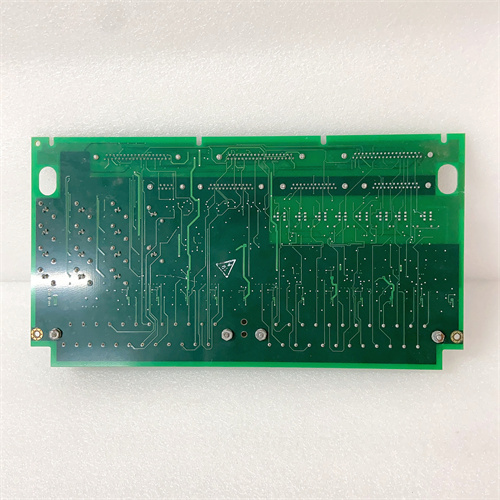
Description
Product Parameters
| Parameter | Specification |
|---|---|
| Brand / Series | GE Mark VIe Speedtronic |
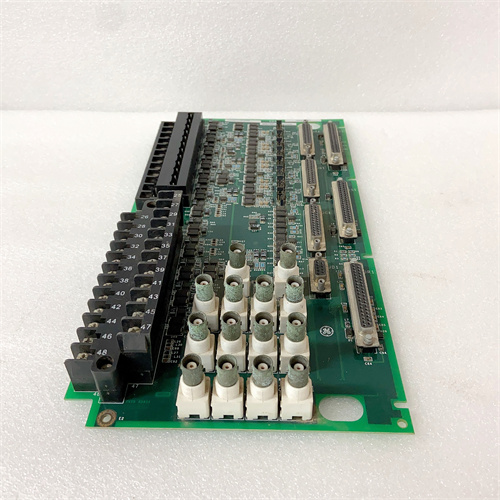
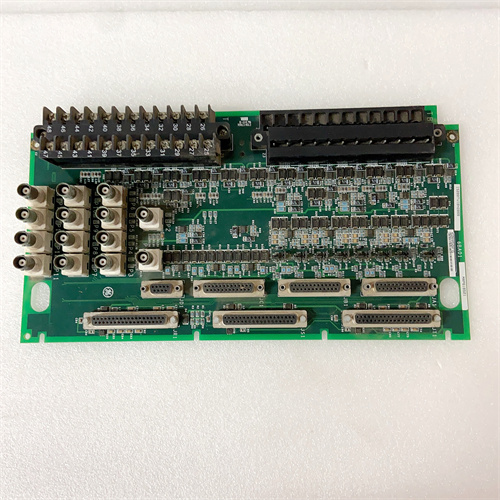
| Model | IS200TBTCH1BBB |
| Input Channels | 48 thermocouple inputs |
| Thermocouple Types | J, K, T, E, R, S, B (per-channel configurable via GE ToolboxST) |
| Input Range | ±100 mV |
| Cold-Junction Compensation | Dual redundant CJC sensors on terminal block (accuracy ±0.2°C) — upgraded from ±0.3°C |
| ADC Resolution | 24-bit delta-sigma with programmable sampling rate (2–250 SPS) |
| Accuracy | ±0.03% of reading + ±0.3°C — upgraded from ±0.05% + ±0.5°C |
| Isolation | 2000 VAC (field-to-system) |
| Common Mode Rejection | >110 dB @ 50/60 Hz |
| Diagnostics | Open-circuit detection, short-circuit detection, dual CJC fault monitoring and auto-failover, reference validation, calibration status tracking, sensor drift detection |
| Status Indication | 48 green LEDs (channel active), 2 red LEDs (diagnostic fault summary), 1 yellow LED (reference/calibration status), 1 blue LED (CJC redundancy active) |
| Operating Temperature | –40°C to +70°C |
| Storage Temperature | –55°C to +85°C |
| Mounting | VME rack-mount terminal board with front-panel I/O connectors |
| Backplane Interface | VME64x (A24/A32, D16/D32/D64) |
| EMC Compliance | IEC 61000-4 Level 4 |
Advantages & Key Features
-
Maximum Channel Density: 48 thermocouple inputs in a single VME slot—the highest density in the Mark VIe thermocouple terminal family and six times that of competing 8-channel modules.
-
Highest Accuracy: ±0.03% reading + ±0.3°C with dual CJC sensors (±0.2°C) provides the ultimate measurement precision for critical turbine temperature monitoring.
-
Dual-Redundant CJC: Two independent cold-junction sensors with automatic cross-validation and failover ensure uninterrupted thermocouple measurement accuracy. If one sensor drifts or fails, the board seamlessly switches to the redundant sensor.
-
Extended Temperature Range: –40°C to +70°C operation makes IS200TBTCH1BBB suitable for arctic, desert, and unheated turbine enclosures.
-
Enhanced Isolation: 2000 VAC isolation and >110 dB CMRR provide superior protection in high-EMI environments.
-
Multi-Type Support: Supports J, K, T, E, R, S, and B thermocouple types, software-selectable per channel via GE ToolboxST.
-
24-Bit Delta-Sigma Conversion: High-resolution ADC delivers stable, noise-free readings.
-
Programmable Sampling Rate: 2–250 SPS allows optimization for steady-state or dynamic monitoring.
-
Comprehensive Diagnostics: Open-circuit, short-circuit, dual CJC fault monitoring and auto-failover, reference validation, calibration status tracking, and sensor drift detection per channel.
-
Advanced Calibration: Onboard calibration memory with traceable records and software-triggered self-calibration.
-
Status Indication: 48 green LEDs, dual fault summary LEDs, yellow calibration status LED, and blue CJC redundancy active LED for rapid on-site troubleshooting.
-
ToolboxST Integration: Full configuration, calibration, and diagnostics via GE ToolboxST.
-
Drop-In Replacement: Direct replacement for IS200TBTCH1BAA, IS200TBTCH1B, IS200TBTCH1A, and earlier thermocouple terminal boards.
Application Fields
-
Gas & Steam Turbines (GE Frame 6B/7EA/9E/HA): Exhaust gas temperature (EGT) thermocouple arrays, turbine inlet temperature (TIT), bearing metal temperature, casing temperature, fuel gas preheat temperature.
-
Combined Cycle Plants: HRSG superheater outlet temperature, reheat steam temperature, economizer inlet monitoring.
-
Compressor Stations: Discharge gas temperature monitoring, intercooler performance tracking.
-
Aeroderivative Turbines (LM series): Engine oil temperature, exhaust thermocouple arrays, fuel gas temperature.
-
Arctic & Desert Installations: Extreme-environment turbine control cabinets requiring maximum reliability.
-
Offshore Platforms: Marine enclosures with salt-spray and wide temperature swings.
-
Nuclear Power Plants: Applications requiring documented calibration records, dual-redundant CJC, and maximum measurement precision.
Comparison with Competing Products
| Feature | GE IS200TBTCH1BBB | GE IS200TBTCH1BAA | GE IS200TBTCH1B | Competitor A (Emerson 8CH TC) | Competitor B (Siemens 8CH TC) |
|---|---|---|---|---|---|
| Input Channels | 48 TC | 48 TC | 48 TC | 8 TC | 8 TC |
| Accuracy | ±0.03% + ±0.3°C | ±0.05% + ±0.5°C | ±0.1% + ±1°C | ±0.2% + ±2°C | ±0.15% + ±1.5°C |
| CJC Accuracy | ±0.2°C (dual redundant) | ±0.3°C (dual) | ±0.5°C (single) | ±1.2°C | ±1.0°C |
| CJC Redundancy | Yes (auto-failover) | Yes | No | No | No |
| Sampling Rate | 2–250 SPS | 2–250 SPS | 4–200 SPS | Fixed | 10–50 SPS |
| Isolation | 2000 VAC | 2000 VAC | 2000 VAC | 1000 VAC | 500 VDC |
| CMRR | >110 dB | >110 dB | >110 dB | >80 dB | >85 dB |
| Operating Temp | –40°C to +70°C | –40°C to +70°C | –40°C to +70°C | 0°C to 50°C | 0°C to 60°C |
| Sensor Drift Detection | Yes | No | No | No | No |
| Calibration Records | Yes (traceable) | Yes | No | No | No |
| CJC Redundancy Status LED | Yes (blue) | No | No | No | No |
Key Advantage: IS200TBTCH1BBB delivers 48 thermocouple inputs with the highest accuracy (±0.03% + ±0.3°C), dual-redundant CJC (±0.2°C) with automatic failover, sensor drift detection, and comprehensive calibration management—making it the ultimate solution for critical turbine temperature monitoring applications requiring maximum precision, reliability, and regulatory compliance.
Selection Guidelines & Recommendations
-
Thermocouple Type: Verify your thermocouple types. IS200TBTCH1BBB supports J, K, T, E, R, S, and B—configure per channel in GE ToolboxST.
-
Dual CJC Sensors: Automatic failover—no configuration required. The blue LED indicates redundancy is active; if one CJC sensor fails, the LED will flash to alert operators.
-
Sampling Rate: For steady-state monitoring, use 2–10 SPS. For dynamic tracking, use 50–100 SPS. The 250 SPS maximum provides fastest response for transient analysis.
-
Sensor Drift Detection: Enable drift detection for critical thermocouple circuits to receive early warnings of sensor degradation.
-
Controller Firmware: Requires Mark VIe processor firmware v9.0 or later.
-
Wiring Guidelines: Use shielded thermocouple extension-grade leads with correct polarity. Maintain shield grounding only at the Mark VIe cabinet end.
-
Calibration Management: Use GE ToolboxST to review calibration status and perform software-triggered self-calibration during scheduled maintenance.
-
Spare Strategy: Keep one spare per turbine; lead times 8–14 weeks.
-
Retrofit: Direct replacement for IS200TBTCH1BAA, IS200TBTCH1B, and IS200TBTCH1A—regenerate configuration in GE ToolboxST to access enhanced accuracy, dual CJC features, drift detection, and calibration management.
Important Cautions
-
No Hot-Swap: De-energize rack before insertion/removal.
-
Thermocouple Polarity: Reverse connection produces negative readings—verify polarity against terminal labeling.
-
CJC Protection: Do not apply conformal coating or tape over the terminal block area—dual CJC sensors require free air circulation for ±0.2°C accuracy.
-
Grounding: Connect AGND to Mark VIe system ground at single star point—multiple grounds degrade CMRR.
-
Shield Termination: Thermocouple shields ground only at cabinet end to avoid ground loops.
-
ESD Handling: Use grounded wrist straps; field repair not possible.
-
Sampling Rate Trade-Off: Higher sampling rates reduce resolution—use lowest rate practical for steady-state monitoring.
-
CJC Calibration: Factory-calibrated—do not attempt field calibration; requires specialized equipment.
-
Temperature Rating: Verify cabinet ambient does not exceed +70°C or fall below –40°C.
-
Reference Validation: Yellow LED indicates reference drift—schedule factory recalibration if illuminated.
-
Self-Calibration: Perform software-triggered self-calibration only when the board is de-energized and free from field wiring faults.
-
Calibration Records: Calibration records are stored onboard. Do not attempt to manually modify or clear calibration memory via external tools—use only GE ToolboxST.
-
Channel Mapping: With 48 channels, verify field wiring maps to correct ToolboxST channel numbers.
-
CJC Redundancy Status: If the blue LED flashes, one CJC sensor has failed or drifted—schedule service while the redundant sensor maintains accuracy.
NI PXI-6713
ABB AO810V2
A-B 2711P-RP2
FOXBORO FBM204


Reviews
There are no reviews yet.