
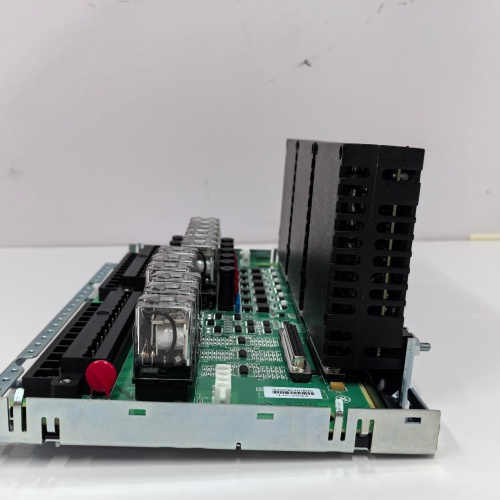
Description
Product Parameters
| Parameter | Specification |
|---|---|
| Brand / Series | GE Mark VIe Speedtronic |
| Model | IS200STAIH1A |
| Input Channels | 16 isolated analog inputs |
| Input Types | 4–20 mA (with or without loop power) or 0–10 V (software-selectable per channel) |
| Input Range | 0–20 mA, 4–20 mA, 0–5 V, 0–10 V, ±10 V |
| ADC Resolution | 16-bit SAR with programmable sampling rate (10–1000 SPS) |
| Accuracy | ±0.1% of full scale (25°C), ±0.2% over full temperature range |
| Loop Power | 24 VDC (externally supplied or internally sourced per channel) |
| Input Impedance | 250 Ω (current mode), > 1 MΩ (voltage mode) |
| Filtering | Programmable low-pass filter (1–100 Hz) |
| Isolation | 1500 VAC (channel-to-channel and field-to-system) |
| Common Mode Rejection | >100 dB @ 50/60 Hz |
| Diagnostics | Open-circuit detection, over-range/under-range detection, loop power fault monitoring |
| Status Indication | 16 green LEDs (channel active), 2 red LEDs (diagnostic fault summary) |
| Operating Temperature | –30°C to +65°C |
| Mounting | VME rack-mount terminal board with front-panel I/O connector |
| Backplane Interface | VME64 (A24/A32, D16/D32) |
Advantages & Key Features
-
High Channel Density: IS200STAIH1A provides 16 isolated analog inputs in a single VME slot, significantly reducing rack space compared to competing analog modules that typically offer 4–8 channels. This high density is valuable for turbines requiring extensive process monitoring (e.g., pressures, temperatures, flows, positions).
-
Flexible Input Configuration: Each channel supports both current (4–20 mA) and voltage (0–10 V, ±10 V) inputs, selectable via GE ToolboxST software. This eliminates the need for separate termination boards for different sensor types and simplifies retrofit projects.
-
Built-In Loop Power: Each current input channel can provide 24 VDC loop power to 2-wire transmitters, eliminating the need for external power supplies for field devices. This reduces installation cost and complexity.
-
Programmable Filtering: The onboard low-pass filter (1–100 Hz) allows optimization for different signal types—lower cutoff frequencies for slow-changing process variables (temperature, pressure) and higher frequencies for dynamic signals (vibration, position).
-
Comprehensive Diagnostics: Real-time open-circuit detection, over-range/under-range detection, and loop power fault monitoring per channel enable predictive maintenance and prevent undetected sensor failures that could cause turbine trips.
-
High Accuracy: ±0.1% full-scale accuracy ensures precise measurement of critical turbine parameters such as fuel flow, steam pressure, and exhaust temperature for optimal control performance.
-
ToolboxST Integration: Full configuration, calibration, and diagnostics via GE ToolboxST software, enabling online channel monitoring, sensor health trending, and fault logging.
-
Drop-In Replacement: Direct replacement for earlier GE analog input boards such as IS200STAIH1 and IS200STAIG1A, with identical mounting holes, connectors, and backplane addressing.
Application Fields
-
Gas & Steam Turbines (GE Frame 6B/7EA/9E/HA): Monitors fuel gas pressure and flow, steam pressure and temperature, bearing vibration (with external transmitters), exhaust temperature (via transmitters), lube oil pressure and temperature, cooling water pressure, and control valve position feedback.
-
Combined Cycle Plants: Used in HRSG for feedwater flow monitoring, steam drum pressure, superheater temperature, and condensate flow.
-
Compressor Stations: Monitoring suction/discharge pressure, gas flow, compressor speed (via transmitter), and vibration transducers.
-
Oil & Gas Pipelines: Used for pipeline pressure monitoring, flow metering, and valve position feedback.
-
Hydropower Plants: Monitors water pressure, gate position, and generator cooling water temperature.
Comparison with Competing Products
| Feature | GE IS200STAIH1A | Competitor A (Emerson Analog Module) | Competitor B (Siemens Analog Input) |
|---|---|---|---|
| Input Channels | 16 isolated | 8 isolated | 8 non-isolated |
| Input Types | 4–20 mA, 0–10 V, ±10 V | 4–20 mA only | 4–20 mA, 0–10 V |
| Loop Power | Yes (built-in per channel) | No (external required) | No (external required) |
| ADC Resolution | 16-bit SAR | 15-bit SAR | 16-bit SAR |
| Accuracy | ±0.1% full scale | ±0.2% full scale | ±0.15% full scale |
| Filtering | Programmable (1–100 Hz) | Fixed (10 Hz) | Programmable (10–50 Hz) |
| Isolation | 1500 VAC | 1000 VAC | 500 VDC |
| Operating Temp | –30°C to +65°C | 0°C to 50°C | 0°C to 60°C |
Key Advantage: IS200STAIH1A provides double the channel density (16 vs. 8) and built-in loop power per channel, significantly reducing installation complexity and cost compared to competing analog input modules. Its ability to mix current and voltage inputs on the same board, combined with programmable filtering and comprehensive diagnostics, makes it the most versatile analog input solution in the Mark VIe family.
Selection Guidelines & Recommendations
-
Input Type Verification: Confirm whether your field sensors are current (4–20 mA) or voltage (0–10 V, ±10 V) output. IS200STAIH1A supports both—configure the correct input type per channel in GE ToolboxST before commissioning.
-
Loop Power Selection: For 2-wire 4–20 mA transmitters, enable internal loop power via GE ToolboxST to provide 24 VDC to the field device. For 4-wire transmitters with external power, disable loop power to avoid conflicts.
-
Filtering Configuration: For slow-changing process variables (temperature, pressure, flow), set the filter cutoff frequency to 1–10 Hz to maximize noise rejection. For dynamic signals (vibration, position), set the filter to 50–100 Hz to preserve signal response while rejecting power-line noise.
-
Sampling Rate Selection: For steady-state monitoring (temperature, pressure), use 10–50 SPS. For dynamic monitoring (vibration, position), use 100–500 SPS. The 1000 SPS maximum rate provides fastest response but may increase noise.
-
Controller Firmware: Ensure your Mark VIe main processor (e.g., IS420UCSBH1A, IS420UCSCH1A, IS200SPROH2ADD) is running firmware v6.5 or later for full diagnostic support on IS200STAIH1A.
-
ToolboxST Configuration: In GE ToolboxST, configure each channel’s input type, range, loop power (on/off), filter cutoff frequency, and sampling rate. Enable open-circuit detection for critical process variables to receive alarms for sensor failures.
-
Wiring Guidelines: Use shielded twisted-pair cables for analog signal wiring. For current inputs, maintain shield grounding only at the Mark VIe cabinet end to prevent ground loops. For voltage inputs, use twisted-pair with shield for long cable runs (> 10 m).
-
Spare Strategy: For critical plants, keep one spare IS200STAIH1A per turbine. Lead times typically 6–10 weeks.
-
Retrofit: Direct replacement for IS200STAIH1 and IS200STAIG1A—no chassis or cable changes required. However, configuration files must be regenerated in GE ToolboxST to access enhanced diagnostics and filter settings.
Important Cautions
-
No Hot-Swap: IS200STAIH1A is not hot-swappable. Always de-energize the Mark VIe rack before insertion/removal to prevent backplane damage.
-
Loop Power Polarity: For 2-wire transmitters using internal loop power, observe correct polarity—reverse polarity will not damage the board but will prevent the transmitter from operating. Refer to GE wiring diagram IS200STAIH1A-DWG for proper connections.
-
Input Overload Protection: The board has built-in protection against over-voltage/over-current, but sustained input exceeding 30 V or 50 mA may damage the input circuitry. Ensure field signals remain within specified ranges.
-
Open-Circuit Detection Limitations: Open-circuit detection for current inputs relies on measuring loop current below a threshold (typically < 1 mA). For voltage inputs, open-circuit detection is not available. Use external monitoring for voltage sensor health.
-
Grounding: The board’s analog ground (AGND) must connect to the Mark VIe system ground at a single star point. Multiple ground paths introduce 50/60 Hz noise and degrade the >100 dB CMRR specification.
-
Shield Termination: Analog cable shields must be grounded only at the Mark VIe cabinet end. Grounding at both ends creates ground loops that degrade measurement accuracy.
-
ESD Handling: Use grounded wrist straps during handling; the analog input circuits and ADC are ESD-sensitive. Field repair is not possible due to conformal coating.
-
Filtering Trade-Off: Lower filter cutoff frequencies provide better noise rejection but introduce signal delay (phase lag). For control loops requiring fast response, use higher cutoff frequencies (50–100 Hz) to minimize delay.
-
Loop Power Current Limit: The internal loop power supply per channel is limited to 30 mA. For transmitters requiring more current, use an external power supply and disable the internal loop power for that channel.
A-B 1756-PA75
SCHNEIDER 140CRA93100
GE IC695PSA140
.jpg)
Reviews
There are no reviews yet.