
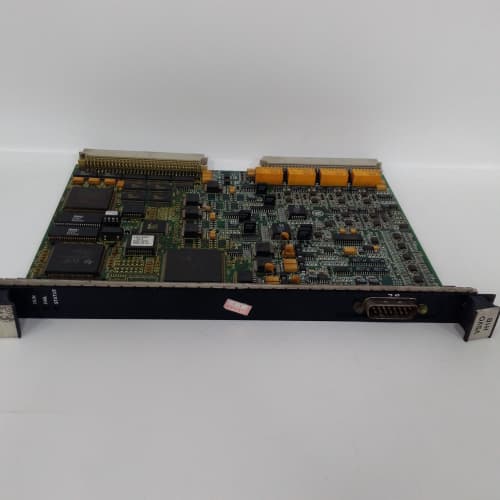
Description
Key Technical Parameters
| Parameter | Specification |
|---|---|
| Brand | GE / Emerson |
| Model | IS200BICIH1ADC |
| Input Channels | 16 configurable inputs (analog 4–20 mA/0–10 V, thermocouple J/K/T/E/R/S, or digital 24 VDC) |
| Bridge Interface | Enhanced communication bridge for external system connectivity |
| Control Interface | Advanced control interface for localized monitoring and control tasks |
| Input Impedance | 250 Ω (current), >1 MΩ (voltage) |
| Resolution | 20-bit (analog), 16-bit (digital) |
| Accuracy | ±0.02% of full scale (analog) |
| Signal Conditioning | Advanced programmable filtering, averaging, scaling, offset compensation, and linearization |
| Isolation | Channel-to-channel and channel-to-ground (1500 VAC) |
| Cold Junction Compensation | Built-in with redundant reference sensors (for thermocouple inputs) |
| Protection | Overvoltage, reverse polarity, input burnout detection, transient suppression |
| Diagnostics | Input burnout detection, communication status, self-test routines, channel-level diagnostics, bridge health monitoring, control interface status, signal quality monitoring, security event logging |
| Security Features | Secure firmware updates (digital signatures), encrypted communication (optional), security event logging |
| Communication | Fiber-optic (Mark V/VIe backplane) + Enhanced bridge interface |
| Cooling | Passive – no fan |
| Dimensions | 260 × 180 × 35 mm (standard Eurocard) |
| Operating Temp | –25°C to +70°C |
| Certifications | CE, UL, CSA, ATEX (Class I, Div 2), IEC 61508 SIL-1, IEC 62443 (cybersecurity) |
Advantages & Features
-
Enhanced Bridge, Control Interface, and Cybersecurity – The IS200BICIH1ADC provides 16 configurable input channels with enhanced bridge interface, advanced control interface, advanced signal conditioning, and cybersecurity features for secure centralized processing and localized control.
-
Configurable Inputs – Supports analog (4–20 mA, 0–10 V), thermocouple (J, K, T, E, R, S), or digital (24 VDC) inputs, providing flexibility for a wide range of field devices.
-
High Accuracy – 20-bit analog input resolution with ±0.02% accuracy ensures the highest precision measurement.
-
Enhanced Signal Conditioning – Advanced programmable filtering, averaging, scaling, offset compensation, and linearization for optimized signal processing.
-
Bridge Functionality – Enhanced communication bridge enables connectivity to external systems, providing data exchange and integration capabilities.
-
Control Interface – Advanced control interface enables localized monitoring and control tasks, offloading the main controller.
-
Cybersecurity Features – Secure firmware updates with digital signatures, encrypted communication (optional), and security event logging for enhanced security.
-
Thermocouple Support – Built-in cold junction compensation with redundant reference sensors and linearization for six thermocouple types.
-
Signal Quality Monitoring – Continuously assesses signal quality and alerts operators to degraded signal conditions.
-
Input Burnout Detection – Detects open-circuit conditions on 4–20 mA and thermocouple inputs, enabling rapid identification of sensor faults.
-
Bridge and Control Health Monitoring – Continuously monitors bridge and control interface health, detecting communication faults and connectivity issues.
-
High Isolation – 1500 VAC channel-to-channel and channel-to-ground isolation protects the module and controller.
-
Widest Temperature Range – Rated for –25°C to +70°C, suitable for the harshest environmental conditions.
-
Fiber-Optic Backplane – Interfaces with the Mark V/VIe controller via high-speed fiber-optic backplane, ensuring noise-immune data transmission.
-
Hot-Swap Capable – Supports live insertion/removal with safety interlocks, minimizing downtime.
-
High Reliability – Military-grade components, conformal-coated PCB, and robust design with MTBF of 83,000 hours.
Application Cases
-
Centralized Input Processing with Secure Control – Consolidates 16 input signals from sensors (pressure, temperature, flow, position, digital status) with enhanced signal conditioning, localized control, and secure operation for comprehensive turbine monitoring.
-
Legacy System Integration – Enhanced bridge interface enables connectivity to external systems, such as older DCS or third-party devices.
-
Localized Advanced Control – Advanced control interface enables localized monitoring and control tasks, offloading the main controller.
-
Cybersecurity-Compliant Installations – Secure firmware and security event logging meet cybersecurity requirements.
-
Process Variable Monitoring – Monitors analog and digital inputs with signal quality monitoring for comprehensive process monitoring.
-
Exhaust Temperature Monitoring – Direct thermocouple inputs (J, K, T, E, R, S) for EGT monitoring with linearization.
-
Harsh Environment Installations – Extended –25°C to +70°C range makes it suitable for desert, arctic, or offshore installations.
-
Retrofit Projects – Replaces multiple legacy input and control modules while providing enhanced bridge connectivity, signal conditioning, and cybersecurity.
Comparison with Competitor Products
| Feature | GE IS200BICIH1ADC | GE IS200BICIH1ADB | Siemens S7-1500 (AI + CP) | ABB AC800M (AI + CI) |
|---|---|---|---|---|
| Input Channels | 16 (configurable) | 16 (configurable) | 16 | 16 |
| Bridge Interface | Yes (enhanced) | Yes (enhanced) | No | No |
| Control Interface | Yes (advanced) | Yes (advanced) | Yes | Yes |
| Digital Inputs | Yes (configurable) | Yes (configurable) | Yes | Yes |
| Thermocouple Types | J, K, T, E, R, S | J, K, T, E, R, S | J, K, T | J, K, T |
| Input Resolution | 20-bit | 20-bit | 16-bit | 16-bit |
| Accuracy | ±0.02% | ±0.02% | ±0.1% | ±0.1% |
| Signal Conditioning | Advanced | Advanced | Standard | Standard |
| Signal Quality Monitoring | Yes | Yes | No | No |
| Secure Firmware Updates | Yes | No | Yes | No |
| Security Event Logging | Yes | No | Limited | No |
| Isolation | 1500 VAC | 1500 VAC | 500 VAC | 500 VAC |
| Operating Temp | –25°C to +70°C | –25°C to +70°C | 0°C to +60°C | 0°C to +55°C |
| Hot-Swap | Yes | Yes | No | No |
| MTBF | 83,000 hrs | 85,000 hrs | 85,000 hrs | 80,000 hrs |
Key Differentiator: The IS200BICIH1ADC uniquely combines 16 configurable inputs (analog, thermocouple, digital), enhanced bridge interface, advanced control interface, enhanced signal conditioning (with linearization), signal quality monitoring, cybersecurity features (secure firmware, security event logging), and the widest temperature range, making it the most advanced, secure, and comprehensive input and control interface module for GE Mark V/VIe systems.
Selection Suggestions
-
Evaluate Input, Control, and Cybersecurity Requirements – The IS200BICIH1ADC is ideal for applications requiring centralized input processing with enhanced bridge connectivity, advanced control interface, enhanced signal conditioning, and cybersecurity.
-
Configure Input Types – Supports analog (4–20 mA, 0–10 V), thermocouple (J, K, T, E, R, S), or digital (24 VDC) inputs; select based on field device requirements.
-
Identify Thermocouple Needs – Supports J, K, T, E, R, S thermocouples; verify your sensor types.
-
Consider Environment – Extended –25°C to +70°C range makes it suitable for the harshest environments.
-
Cybersecurity Requirements – Secure firmware and security event logging are essential for facilities with cybersecurity mandates.
-
Signal Conditioning – Use advanced filtering, averaging, scaling, offset compensation, and linearization for optimized processing.
-
Signal Quality Monitoring – Enable signal quality monitoring for early detection of signal degradation.
-
Bridge Integration – Use enhanced bridge interface for connectivity to external systems or legacy equipment.
-
Control Interface – Use advanced control interface for localized monitoring and control tasks.
-
Firmware – The “ADC” suffix indicates a specific firmware version with cybersecurity features; verify compatibility with your Mark V/VIe system.
-
Spares – Lead time typically 10–12 weeks; maintain a spare module for critical installations.
Precautions
-
ESD Protection – Use wrist strap and anti-static handling during installation.
-
Input Wiring – Use shielded twisted-pair cables for analog and thermocouple inputs; ground shields at the module end only.
-
Digital Input Wiring – Use proper gauge wiring; observe polarity for digital inputs.
-
Thermocouple Wiring – Use thermocouple-grade extension wire of the same type; avoid copper wire between sensor and module.
-
Bridge Interface Cabling – Use appropriate shielded cables for bridge connections to external systems.
-
Cold Junction Compensation – Ensure cold junction sensors are protected from external heat sources or drafts.
-
Avoid Ground Loops – Connect earth lug directly to system ground with 6 mm² wire; avoid ground loops.
-
Signal Conditioning Configuration – Configure filtering, averaging, scaling, offset compensation, and linearization based on sensor and application requirements.
-
Secure Firmware Updates – Use only GE’s official digitally signed firmware via secure update procedures.
-
Commissioning – Verify input readings with known signal sources before field connection.
-
Periodic Inspection – Check for dust accumulation on heatsink and connector integrity annually; clean as needed.
Summary
The IS200BICIH1ADC is the most advanced, secure, and comprehensive centralized bridge, input, and control interface module for GE Speedtronic Mark V and Mark VIe turbine control systems, providing configurable inputs, enhanced bridge connectivity, advanced control interface, enhanced signal conditioning, and cybersecurity features. Its key strengths include 16 configurable input channels (4–20 mA, 0–10 V, thermocouple J/K/T/E/R/S, or digital 24 VDC), 20-bit analog resolution with ±0.02% accuracy, enhanced bridge interface for external system connectivity, advanced control interface for localized monitoring and control, enhanced signal conditioning (filtering, averaging, scaling, offset compensation, linearization), signal quality monitoring, secure firmware updates (digital signatures), security event logging, built-in cold junction compensation with redundant sensors, input burnout detection, 1500 VAC isolation, widest –25°C to +70°C operating range, fiber-optic backplane, hot-swap capability, and MTBF of 83,000 hours. Ideal for centralized input processing with secure control, legacy system integration, localized advanced control, cybersecurity-compliant installations, process variable monitoring, exhaust temperature monitoring, harsh environment installations, and retrofit projects, it provides the most comprehensive, advanced, and secure input, bridge, and control interface functionality for Mark V/VIe systems. When paired with the Mark V/VIe controller and properly maintained, the IS200BICIH1ADC delivers decades of reliable, precise, secure, and versatile input and control interface service in the most demanding environments.
A-B 1756-IF16
ABB AI723F
GE IC200GBI001
A-B TLY-A230T-HK64AA


Reviews
There are no reviews yet.