
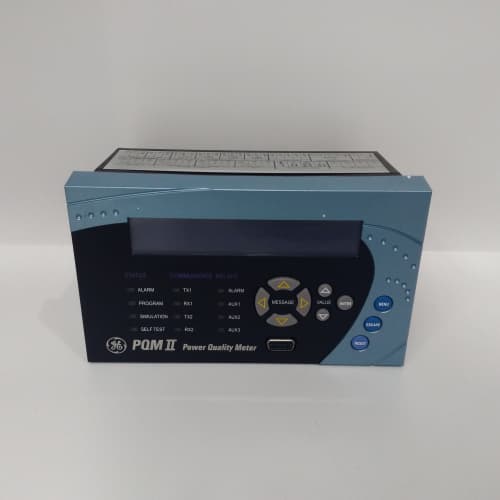
Description
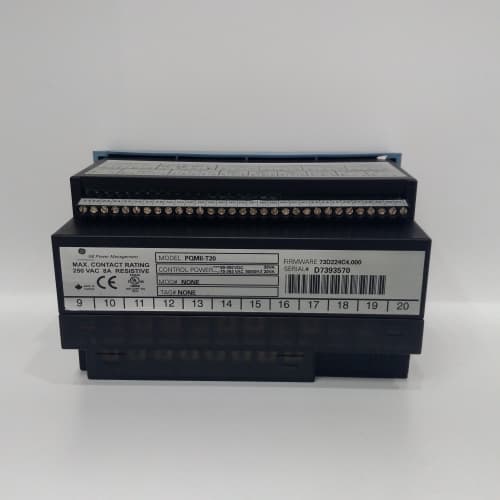
GE PQMII-T20 — Power Quality and Energy Monitoring Device
Product Description: GE PQMII-T20
GE PQMII-T20 is a versatile and advanced Power Quality and Energy Monitoring device, part of the PQMII (Power Quality Meter II) series from General Electric (now part of GE Vernova’s Grid Solutions). This device is designed for installation in electrical switchgear, motor control centers (MCCs), and distribution panels to provide comprehensive monitoring, measurement, and analysis of electrical power parameters. The GE PQMII-T20 serves a dual role: it acts as a high-accuracy revenue-grade energy meter while simultaneously capturing detailed power quality data such as harmonics, transients, sags, and swells. This makes it an essential tool for energy management, cost allocation, troubleshooting, and ensuring the reliability of electrical systems.
Product Parameters
-
Type: Multifunction Power Quality Meter and Energy Monitor.
-
Voltage Inputs: Typically supports direct connection for medium voltage via PTs (Potential Transformers) or low voltage direct inputs (e.g., up to 600V L-L).
-
Current Inputs: Accepts inputs from CTs (Current Transformers) with standard secondary ratings (e.g., 5A or 1A).
-
Measurements:
-
Basic: Volts, Amps, kW, kVAR, kVA, Power Factor, Frequency, kWh (import/export).
-
Power Quality: Total Harmonic Distortion (THD), individual harmonics up to the 63rd, voltage and current unbalance, sags/swells/interruptions, transients (with optional module).
-
-
Communication: Multiple standard communication ports:
-
Ethernet (Modbus TCP/IP, DNP3 over TCP, IEC 61850).
-
Serial ports (RS-232/485 for Modbus RTU, DNP3 serial).
-
-
I/O Capabilities: Includes programmable digital inputs (for status monitoring) and Form C relay outputs (for control or alarms).
-
Display: Front-panel LCD display for local readout of key parameters.
-
Standards Compliance: Meets ANSI C12.20 standards for revenue metering accuracy (typically 0.2% class).
Advantages and Features
-
Comprehensive Data in One Device: The GE PQMII-T20 consolidates the functions of an energy meter, power quality analyzer, and basic relay into a single package, reducing panel space, wiring, and overall system cost.
-
High Accuracy for Revenue and Diagnostics: Its revenue-grade accuracy ensures trustworthy data for billing and energy auditing, while its detailed power quality capture capability is critical for diagnosing problems that cause equipment malfunction or downtime.
-
Advanced Power Quality Analysis: Beyond simple measurements, the PQMII-T20 can capture and timestamp power quality events (like voltage sags), record harmonic spectra, and provide the data needed to identify the source of disturbances in the electrical network.
-
Flexible Integration: With support for key industrial protocols like Modbus TCP, DNP3, and IEC 61850, the device can easily integrate into SCADA systems, energy management platforms (like GE’s Power*Sense), or building management systems.
-
Rugged Industrial Design: Built for continuous operation in electrical environments, it is designed to withstand electrical noise, temperature variations, and vibration typical of switchgear installations.
Application Cases in Various Fields
-
Industrial Facilities: Monitoring energy consumption at the main service entrance and individual feeders for cost allocation and identifying inefficient loads. Troubleshooting power quality issues affecting sensitive production machinery.
-
Commercial Buildings: Sub-metering tenant spaces, monitoring HVAC and lighting system efficiency, and ensuring power quality for critical IT loads in data centers.
-
Water/Wastewater Treatment Plants: Monitoring pump and blower energy usage and protecting equipment from harmful power quality conditions.
-
Renewable Energy Integration: Monitoring the point of interconnection for solar PV or wind farms to verify power output and ensure grid code compliance (e.g., harmonic injection).
-
Electric Utilities: Used at substations or on distribution feeders for advanced metering infrastructure (AMI) and power quality monitoring.
Comparisons with Competing Products
The GE PQMII-T20 competes with similar multifunction power meters from manufacturers like Schneider Electric (ION/PowerLogic series), Siemens (SENTRON PAC), and ABB (EM/EPM series). Its strengths lie in GE’s strong reputation in the power and grid sector, its robust feature set for both energy and power quality, and its seamless integration with other GE protection and control devices. Competitors may offer devices with slightly different feature emphasis, user interfaces, or cost structures, but the PQMII-T20 is a well-established and capable player in this market segment.
Selection Suggestions and Precautions
-
Define Primary Purpose: Decide if the primary need is for revenue-grade energy billing, power quality troubleshooting, or both. This will guide the configuration and potential need for optional modules (like high-speed transient capture) for the PQMII-T20.
-
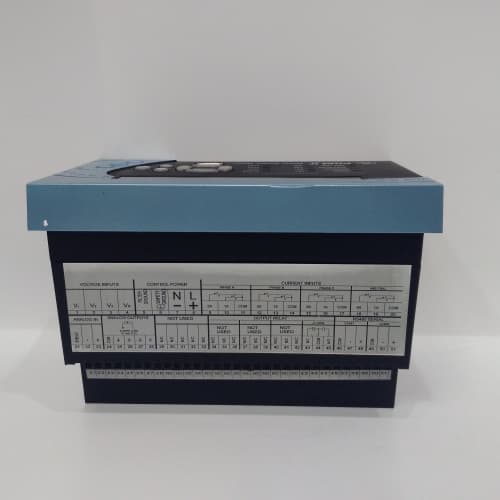
Verify CT/PT Ratios and Wiring: Correct configuration of the current transformer (CT) and potential transformer (PT) ratios in the device’s settings is critical for all measurement accuracy. Ensure the wiring follows the 3-phase, 4-wire (or other) diagram specified in the manual.
-
Plan Communications and Integration: Select the appropriate communication protocol (Modbus TCP, DNP3, IEC 61850) based on the existing SCADA or monitoring system. Plan the IP addressing and data point mapping upfront.
-
Configure Alarms and Relays: Program the digital inputs and relay outputs effectively. Use them to trigger alarms for abnormal conditions (e.g., low power factor, high THD) or to control external devices based on measured parameters.
VE4003S5B1 EMERSON
EMERSON CE4003S5B1
EMERSON VE4003S6B1
EMERSON CE4003S6B1
EMERSON VE4005S2B1 DCSPLC

Reviews
There are no reviews yet.