
Description
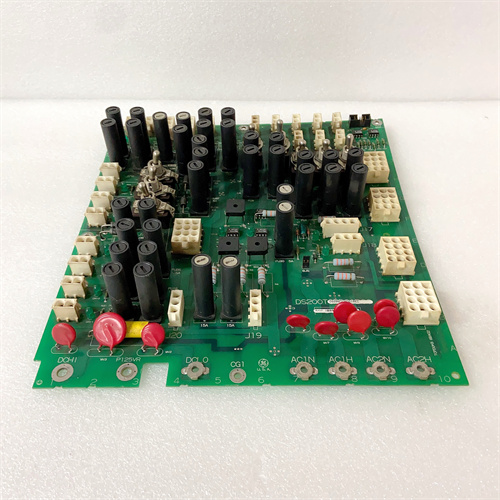
Product Parameters
Manufacturer & Series: General Electric (GE), Speedtronic Mark VIe series. Part Number: GE Mark VIe DS200CDBAG1 (the “G1” suffix denotes general-purpose variant with 32 inputs and 32 outputs). Power Supply: +5 VDC (logic) and +24 VDC (field power) drawn from the Mark VIe VME64x backplane and external field power supply. Channel Configuration: 32 digital input channels and 32 digital output channels. Input Voltage Range: 24 VDC nominal (18-30 VDC), compatible with dry contacts (voltage-free) or 24 VDC sourcing/sinking sensors. Input Current: 3-5 mA per channel at 24 VDC. Input Debounce Filter: Software-selectable: 1 ms, 5 ms, 10 ms, 20 ms, 50 ms. Input Isolation: 2500 Vrms optical isolation between field inputs and backplane logic. Output Voltage: 24 VDC nominal (18-30 VDC), supplied by external field power. Output Current: Up to 0.5 A per channel (continuous), 1.0 A peak for 100 ms. Output Protection: Over-current protection (short-circuit), over-temperature protection, and reverse polarity protection on field power. Output Type: High-side sourcing outputs (PNP). Output Isolation: 2500 Vrms optical isolation between field outputs and backplane logic. Diagnostics: Input channel status monitoring, output channel fault detection (open-load, short-circuit, over-temperature), output current monitoring, field power supply monitoring, internal reference monitoring, and channel health status reporting. Operating Temperature: -30°C to +65°C (standard range). Mounting & Connectivity: Direct VME backplane insertion; front panel features a 68-pin high-density SCSI-style connector.
Advantages & Features
High Channel Density with Balanced I/O: The GE Mark VIe DS200CDBAG1 provides 32 digital inputs and 32 digital outputs in a single VME slot, offering a balanced mix ideal for turbine applications requiring both monitoring and control. This high density reduces the number of boards required and frees up VME slots for other functions. Per-Channel Optical Isolation: Each input and output channel provides 2500 Vrms optical isolation, protecting the Mark VIe controller from field wiring faults, ground loops, and voltage transients—essential for reliability in electrically noisy turbine environments. Comprehensive Output Protection: Output channels on the GE Mark VIe DS200CDBAG1 include over-current protection (short-circuit), over-temperature protection, and reverse polarity protection on the field power supply, significantly reducing field failure rates and protecting both the board and connected actuators. Selectable Debounce Filtering: Input channels feature software-selectable debounce filters (1 ms to 50 ms), allowing engineers to optimize for different switch types and applications—fast response for emergency stop switches, and longer debounce for noisy limit switches. Output Status Feedback: The GE Mark VIe DS200CDBAG1 includes output current monitoring and open-load detection, providing real-time feedback on output health. This enables the control system to detect failed actuators or wiring faults and take corrective action or generate alarms. Flexible Input Compatibility: Inputs accept both dry contacts (voltage-free) and 24 VDC sourcing/sinking sensors, accommodating a wide range of field devices without requiring external interface modules. Comprehensive Diagnostics: The board continuously monitors input channel status, output channel faults, field power supply health, and internal reference voltages, automatically flagging anomalies to the main controller for predictive maintenance. Backward Compatibility: The GE Mark VIe DS200CDBAG1 is pin-compatible with older Mark V digital I/O boards, allowing easy field upgrades without modifying termination panels.
Application Cases
Gas Turbine – Emergency Shutdown System: A 9FA gas turbine installation used the GE Mark VIe DS200CDBAG1 for the emergency shutdown system (ESD), with 16 inputs monitoring emergency stop pushbuttons, overspeed trip switches, and flame detectors, and 16 outputs controlling fuel shut-off valves and vent valves. The fast 1 ms debounce filter on the emergency stop inputs ensured immediate response, while the output short-circuit protection prevented damage when a fuel valve solenoid developed a partial short. The output current monitoring detected a high-resistance connection to an indicator lamp, alerting maintenance before the connection failed. Steam Turbine – Valve Position Indication and Control: A combined-cycle plant implemented the GE Mark VIe DS200CDBAG1 for monitoring and controlling steam turbine valves, with 24 inputs reading limit switches (open/closed/traveling positions) and 24 outputs controlling solenoid valves for steam admission and extraction. The selectable debounce (5 ms for limit switches) prevented false position readings from switch bounce, while the high-side sourcing outputs (0.5 A per channel) provided sufficient current to drive the valve solenoids directly without external relays. LNG Compressor – Auxiliary System Monitoring and Control: An LNG facility installed the GE Mark VIe DS200CDBAG1 on a large centrifugal compressor for monitoring 16 auxiliaries (lube oil pressure switches, cooling water flow switches, filter differential pressure switches) and 16 outputs (lube oil pump control, cooling water valve control, alarm indicators). The optical isolation prevented ground-loop issues between the compressor skid and the control room, while the open-load detection identified a failed lube oil pump contactor, enabling scheduled replacement. Hydroelectric Plant – Generator Status Monitoring and Control: A large hydroelectric facility used the GE Mark VIe DS200CDBAG1 for monitoring generator status (circuit breaker position, disconnect switch position, governor status) and controlling auxiliary equipment (cooling fans, brake system, fire suppression). The high channel density allowed a single board to handle all critical digital I/O, reducing cabinet space and simplifying installation.
Comparison with Competitors
vs. Siemens Simatic ET 200SP HA Digital I/O Module: Siemens offers high-density digital I/O modules but typically with lower density (16 inputs/16 outputs) and without per-channel output current monitoring. The GE Mark VIe DS200CDBAG1 provides higher density (32/32 channels), per-channel output current monitoring, open-load detection, and 2500 Vrms optical isolation—features not standard on Siemens modules. vs. ABB S800 Digital I/O Module (DI810/DO810): ABB offers separate input and output modules, requiring two slots for mixed I/O. The GE Mark VIe DS200CDBAG1 consolidates 32 inputs and 32 outputs into a single slot, saving valuable VME space. ABB modules typically have lower isolation (1500 Vrms) and lack per-channel output current monitoring. vs. Rockwell Automation ControlLogix 1756-IB32/OB32 Series: Rockwell offers separate input and output modules, requiring multiple slots. The GE Mark VIe DS200CDBAG1 provides mixed I/O in a single slot, reducing rack space. Additionally, Rockwell requires an EtherNet/IP adapter, introducing latency—the GE board provides zero-latency VME access. vs. GE Mark V Equivalent (DS200CDBAG1 – older generation): The GE Mark VIe DS200CDBAG1 offers substantial improvements: 32 inputs/32 outputs vs. 24/24, 2500 Vrms isolation vs. 2000 Vrms, per-channel output current monitoring vs. no monitoring, open-load detection vs. basic, selectable debounce (1-50 ms) vs. fixed 10 ms, and enhanced diagnostics.
Selection Suggestions
Evaluate Input and Output Requirements: If your application requires a balanced mix of digital inputs and outputs (approximately 1:1 ratio), the GE Mark VIe DS200CDBAG1 with 32 inputs and 32 outputs is ideal. For applications requiring more inputs than outputs, consider the CDDAG1 series; for more outputs than inputs, consider the CDBDG1 series. Assess Current Requirements: Output channels provide up to 0.5 A per channel (continuous). If your actuators require higher current, consider using the GE Mark VIe DS200CDBAG1 outputs to drive interposing relays rather than direct actuation. Evaluate Debounce Requirements: For emergency stop inputs requiring immediate response, use the 1 ms debounce setting. For mechanical limit switches with significant bounce, use longer settings (20-50 ms). Consider Environmental Conditions: For harsh environments (high-EMI, corrosive atmospheres), the GE Mark VIe DS200CDBAG1 with optical isolation and conformal coating is well-suited. For extreme environments, consider the “A” or “ABB” variants. Check System Compatibility: The GE Mark VIe DS200CDBAG1 requires ToolboxST software v5.0 or later. The board is physically compatible with all Mark VIe racks. Spare Parts Strategy: The GE Mark VIe DS200CDBAG1 is a widely used board with typical lead times of 4-8 weeks. For critical applications, maintain at least one spare board per system.
Precautions
ESD Protection: The GE Mark VIe DS200CDBAG1 contains sensitive components. Always use ESD precautions during handling. No Hot-Swapping: This board is strictly non-hot-swappable. Always de-energize the entire Mark VIe rack before insertion or removal. Field Power Supply: The output channels require an external 24 VDC field power supply. Ensure this supply is isolated from the backplane power and rated for the total output current (maximum 16 A for 32 outputs at 0.5 A each). A non-isolated supply can defeat the board’s optical isolation. Output Current Limits: Do not exceed 0.5 A continuous per output channel. For inductive loads (solenoids, relays), install flyback diodes across the load to protect the output transistors from voltage spikes during turn-off. Wiring Polarity: Outputs are high-side sourcing (PNP). Connect the load between the output terminal and the field power supply common (0 VDC). Reverse polarity on the field power supply can damage the board—the reverse polarity protection will protect against brief reversal but not prolonged. Input Wiring: For dry contacts, connect the contact between the input terminal and field power common (0 VDC). For 24 VDC sensors, connect the sensor output (PNP sourcing) to the input terminal and ensure the sensor common is connected to the field power common. Input Debounce Selection: Select the shortest debounce time that reliably rejects contact bounce. Excessive debounce delays can impact safety response times; insufficient debounce can cause false readings. Configure appropriate debounce settings during commissioning. Configuration Backup: Before replacing a faulty unit, export configuration via ToolboxST. New boards ship with factory-default settings. Storage Conditions: Store uninstalled boards in original anti-static bags within 10°C to 35°C and humidity below 50%. Firmware Compatibility: Verify firmware revision matches the main processor. Coordinate with GE field service for alignment. Calibration: Digital I/O boards typically do not require calibration. However, verify output voltage levels and input threshold levels during commissioning. Temperature Cycling: Although rated for -30°C to +65°C, avoid rapid temperature changes (>5°C per minute) that can cause condensation. Output Over-Temperature Protection: If an output channel experiences an over-temperature condition (e.g., from a short-circuit), the protection will deactivate the channel. The channel will automatically recover when the temperature returns to normal. Monitor the fault status to identify recurring issues. Wiring Practices for High-Current Outputs: Use appropriately sized wiring for output channels (minimum 0.5 mm² / 20 AWG for 0.5 A) to prevent voltage drop and heating. Ensure terminal blocks are properly tightened.
TRICONEX 4200
GESPAC GESMEM-12D
NI CFP-AO-200
ABB FI830F


Reviews
There are no reviews yet.