
Description
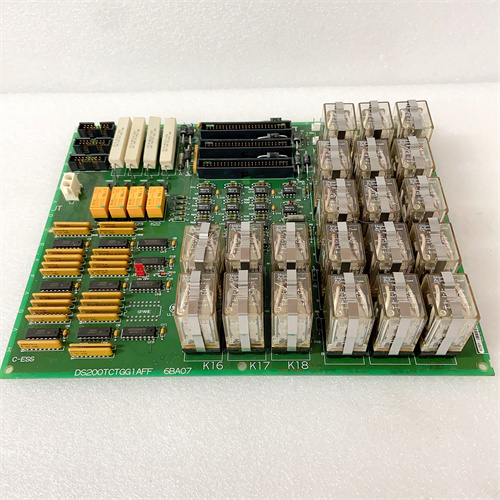
Product Parameters
-
Manufacturer & Series: General Electric (GE), Speedtronic Mark VIe series.
-
Part Number: GE Mark VIe DS200ADCIF1ABA (the “ABA” suffix denotes enhanced sampling rate, improved channel density, and extended diagnostics).
-
Power Supply: +5 VDC (logic) and ±15 VDC (analog circuitry) drawn from the Mark VIe VME64x backplane.
-
Channel Configuration: 32 single-ended or 16 differential analog input channels, software-configurable via ToolboxST.
-
Input Range: Software-selectable: ±10 V, ±5 V, 0-10 V, 0-5 V, or ±20 mA (with external shunt resistor).
-
Resolution: 16-bit SAR ADC (effective resolution: up to 14.5 bits at maximum sampling rate).
-
Sampling Rate: Up to 1 MHz aggregate (32 channels at 31.25 kHz each, or 16 channels at 62.5 kHz each).
-
Input Impedance: >1 MΩ (voltage mode); 250 Ω (current mode with external shunt).
-
Accuracy: ±0.05% of full scale (at 25°C); ±0.15% across full temperature range (-30°C to +65°C).
-
Signal-to-Noise Ratio (SNR): 85 dB typical at 1 kHz input.
-
Total Harmonic Distortion (THD): -80 dB typical.
-
FIFO Buffer: 4 KB onboard FIFO for high-speed data buffering, ensuring no data loss during burst acquisitions.
-
Isolation: 1500 Vrms galvanic isolation between analog inputs and backplane logic.
-
Diagnostics: Over-range/under-range detection, missing channel detection, internal reference monitoring, and temperature monitoring of ADC die.
-
Operating Temperature: -30°C to +65°C (standard range).
-
Mounting & Connectivity: Direct VME backplane insertion; front panel features a 68-pin high-density SCSI-style connector.
Advantages & Features
-
Ultra-High-Speed Data Acquisition: The GE Mark VIe DS200ADCIF1ABA provides aggregate sampling rates up to 1 MHz, far exceeding the ACNAG series (120 Hz max). This makes it the ideal choice for capturing high-frequency transient events such as turbine blade-passing vibrations (up to 10 kHz), startup speed ramps, and rapid load changes where standard analog boards would miss critical data.
-
Flexible Channel Configuration: The GE Mark VIe DS200ADCIF1ABA supports both single-ended (32 channels) and differential (16 channels) input configurations, providing flexibility for different field sensor types. Differential mode offers superior noise rejection for long cable runs or electrically noisy environments, while single-ended mode maximizes channel density.
-
Onboard FIFO Buffering: The 4 KB FIFO buffer on the GE Mark VIe DS200ADCIF1ABA ensures continuous data acquisition even during bus contention or when the main processor is busy with other tasks. This prevents data loss during high-speed burst acquisitions, critical for transient analysis and overspeed detection events.
-
16-Bit SAR ADC with Excellent Dynamic Performance: The SAR architecture provides superior dynamic performance (85 dB SNR, -80 dB THD) compared to delta-sigma ADCs, making the GE Mark VIe DS200ADCIF1ABA better suited for high-frequency AC signals such as vibration and speed sensor outputs.
-
Built-In Diagnostic Monitoring: The board continuously monitors internal reference voltages, ADC temperature, and channel status. The GE Mark VIe DS200ADCIF1ABA automatically flags any anomalies to the main controller, ensuring data integrity and enabling predictive maintenance of the acquisition chain.
-
Seamless Integration with Mark VIe: The GE Mark VIe DS200ADCIF1ABA connects directly to the VME backplane, providing deterministic, zero-latency data transfer to the main processor—essential for real-time control loops requiring fast analog feedback.
-
Backward Compatibility: The GE Mark VIe DS200ADCIF1ABA is pin-compatible with older Mark V high-speed analog boards, allowing easy field upgrades without modifying termination panels.
Application Cases
-
Gas Turbine – High-Speed Vibration Monitoring: A 9FA gas turbine installation used the GE Mark VIe DS200ADCIF1ABA for real-time monitoring of shaft vibrations using piezoelectric accelerometers. With 16 differential channels sampling at 62.5 kHz each, the board captured subsynchronous vibrations (0.5X, 0.8X) and blade-passing frequencies (up to 8 kHz) that slower ACNAG boards would alias or miss. The high-speed data enabled early detection of a developing blade crack, preventing a catastrophic unbalance event.
-
Steam Turbine – Overspeed Trip Validation: A nuclear power plant implemented the GE Mark VIe DS200ADCIF1ABA for overspeed protection system validation. The board sampled three independent speed probes at 100 kHz each, providing precise time-stamped data for 2-out-of-3 voting logic. The high-speed acquisition captured the exact moment of overspeed trip, enabling engineers to verify trip setpoint accuracy within ±0.5 RPM—a level of precision impossible with standard boards.
-
Transient Analysis During Startup: An LNG facility used the GE Mark VIe DS200ADCIF1ABA to capture high-speed data during turbine startup, including speed ramp, exhaust temperature transients, and vibration spectra. The 1 MHz aggregate sampling allowed engineers to identify a critical speed resonance that was causing intermittent high vibration. Armed with this data, the plant adjusted the startup acceleration profile, eliminating the resonance and extending turbine life.
-
Compressor Surge Detection: A petrochemical plant installed the GE Mark VIe DS200ADCIF1ABA on a high-speed centrifugal compressor to detect incipient surge conditions. The board sampled suction/discharge pressure at 50 kHz, capturing pressure oscillations that occurred 50-100 ms before the onset of full surge. This early detection enabled the anti-surge control system to take corrective action before surge developed, preventing equipment damage.
Comparison with Competitors
-
vs. Siemens Simatic ET 200SP HA High-Speed Analog Module: Siemens offers high-speed analog modules with sampling rates up to 200 kHz aggregate, significantly lower than the GE Mark VIe DS200ADCIF1ABA‘s 1 MHz. Siemens also requires separate modules for thermocouples/RTDs, whereas the GE board is optimized for high-speed voltage/current inputs.
-
vs. ABB S800 High-Speed Analog Input Module (AI845-HS): ABB offers high-speed variants with sampling up to 500 kHz aggregate, but with limited channel density (8-12 channels). The GE Mark VIe DS200ADCIF1ABA provides 32 channels (single-ended) or 16 differential channels, offering better density and cost per channel.
-
vs. National Instruments cDAQ with High-Speed Modules: NI offers excellent high-speed data acquisition with sampling rates into MHz, but these are typically used for test and measurement, not continuous turbine control. The GE Mark VIe DS200ADCIF1ABA integrates directly with the Mark VIe real-time control environment, providing deterministic data for control loops, whereas NI systems would require external communication and introduce latency.
-
vs. GE Mark V Equivalent (DS200ADCIF1A – older generation): The GE Mark VIe DS200ADCIF1ABA offers substantial improvements: 1 MHz aggregate vs. 500 kHz, 32 channels vs. 16, 16-bit SAR vs. 14-bit SAR, FIFO buffer (4 KB) vs. none, and extended diagnostics vs. basic. The “ABA” revision also adds software-configurable channel types, eliminating hardware jumpers.
Selection Suggestions
-
Evaluate Sampling Rate Requirements: If your application requires capturing high-frequency signals (vibration up to 10 kHz, speed transients, surge detection), the GE Mark VIe DS200ADCIF1ABA with 1 MHz aggregate is the only Mark VIe board capable of meeting these demands. For slower process monitoring (temperature, pressure, flow), the ACNAG series is more cost-effective.
-
Assess Channel Configuration Needs: If you require maximum channel density (32 channels), use single-ended mode. If your application benefits from noise rejection (long cable runs, high EMI), configure the GE Mark VIe DS200ADCIF1ABA in differential mode (16 channels).
-
Consider Signal Types: The GE Mark VIe DS200ADCIF1ABA is optimized for voltage and current inputs. For thermocouple or RTD inputs, use the ACNAG series which includes onboard CJC and excitation. If you need both high-speed and thermocouple inputs in the same system, consider using both board types.
-
Evaluate FIFO Requirements: If your application involves burst acquisitions or high data rates that may exceed the main processor’s polling rate, the 4 KB FIFO on the GE Mark VIe DS200ADCIF1ABA provides essential buffering. For continuous low-speed applications, the FIFO feature may not be critical.
-
Check System Compatibility: The GE Mark VIe DS200ADCIF1ABA requires ToolboxST software v5.0 or later. The board is physically compatible with all Mark VIe racks.
-
Spare Parts Strategy: The GE Mark VIe DS200ADCIF1ABA is a specialized high-speed board with typical lead times of 6-10 weeks. For critical high-speed monitoring applications, maintain at least one spare board per system.
Precautions
-
ESD Protection: The GE Mark VIe DS200ADCIF1ABA contains sensitive 16-bit SAR ADC and precision analog components. Always use ESD precautions during handling.
-
No Hot-Swapping: This board is strictly non-hot-swappable. Always de-energize the entire Mark VIe rack before insertion or removal to prevent component damage.
-
Input Range Selection: Ensure the input range (software-selectable) matches the field sensor output to prevent over-ranging, which can cause ADC saturation and erroneous data. The ±10 V range is recommended for unknown signals initially.
-
Signal Cable Shielding: For high-speed applications, use properly shielded twisted-pair cables with impedance matching (50 Ω or 75 Ω as appropriate). Ground shields at the sensor end only to avoid ground loops. For differential mode, use twisted-pair cables with a dedicated pair for each signal.
-
Loop Power Supply: The GE Mark VIe DS200ADCIF1ABA does not provide loop power for 4-20 mA transmitters. Use an isolated 24 VDC power supply with appropriate shunt resistors (250 Ω for 4-20 mA to 0-5 V conversion).
-
FIFO Overflow Prevention: Although the GE Mark VIe DS200ADCIF1ABA features a 4 KB FIFO, ensure the main processor polls the board frequently enough to prevent FIFO overflow. For continuous high-speed acquisition (e.g., 1 MHz aggregate), ensure the control program can handle the data rate.
-
Sampling Rate vs. Resolution Trade-off: The effective resolution of the GE Mark VIe DS200ADCIF1ABA decreases at higher sampling rates (approximately 14.5 bits at 1 MHz vs. 15.5 bits at lower rates). Consider this trade-off when selecting sampling rates for your application.
-
Configuration Backup: Before replacing a faulty unit, export configuration via ToolboxST. New boards ship with factory-default settings.
-
Storage Conditions: Store uninstalled boards in original anti-static bags within 10°C to 35°C and humidity below 50%.
-
Firmware Compatibility: Verify firmware revision matches the main processor. The “ABA” variant requires specific firmware—coordinate with GE field service for alignment.
-
Calibration Cycle: Although the GE Mark VIe DS200ADCIF1ABA features internal reference monitoring, GE recommends external calibration every 24 months for full rated accuracy. For critical high-speed applications (overspeed detection, vibration monitoring), consider annual calibration using a traceable signal source. All calibration adjustments are performed via ToolboxST software.
-
High-Speed Data Handling: The high data rate generated by the GE Mark VIe DS200ADCIF1ABA (up to 2 MB/s for 32 channels at 1 MHz) places significant demands on the main processor and DCS data bus. Ensure the control system has adequate processing capacity and bus bandwidth before deploying multiple boards in a single rack.
A-B 1785-L20B
TEL 381-639507-3
SCHNEIDER 140CPU42402
A-B 1756-L62
.jpg)


Reviews
There are no reviews yet.