
Description
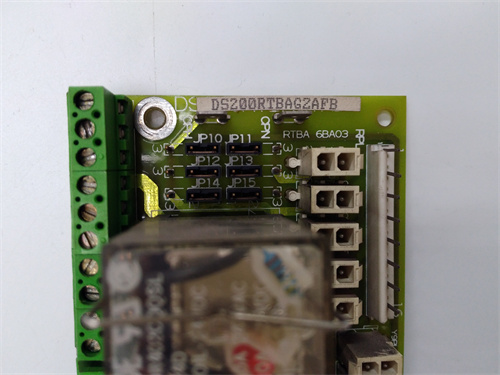
Product Parameters
Manufacturer&Series:General Electric(GE),Speedtronic Mark VIe series.
Part Number:GE Mark VIe DS200AAHAH2A(the”H2A”suffix differentiates it from the H1 variant with improved gain accuracy and expanded filter range).
Power Supply:+5 VDC(logic)and+24 VDC(field excitation)drawn from the Mark VIe VME64x backplane.
Analog Input Channels:6 fully differential,high-impedance(>2 MΩ)input channels,compatible with both passive magnetic speed sensors(MPUs)and active eddy-current displacement probes.
Programmable Gain:Onboard PGA with software-selectable gain settings from 1 to 2000(double the H1 variant’s range),configurable via EEPROM through ToolboxST.
Anti-Aliasing Filter:4th-order active low-pass filter with cutoff frequency programmable from 500 Hz to 25 kHz(expanded upper range compared to the H1),enabling capture of higher-frequency vibration components.
Probe Excitation:Provides regulated-24 VDC and-26.5 VDC for eddy-current probes,with individual short-circuit protection and thermal shutdown per channel.
Isolation:1500 Vrms galvanic isolation between field inputs and backplane logic;surge withstand capability up to 2.5 kV per IEC 61000-4-5.
Sampling Rate:Up to 200 kS/s simultaneously across all 6 channels(twice the speed of the H1 variant),enabling detection of high-frequency subsynchronous vibrations.
Resolution:16-bit ADC(analog-to-digital converter)per channel,providing higher granularity than the 14-bit ADC found in earlier Mark V equivalents.
Operating Temperature:-30°C to+70°C(extended range vs.H1’s+65°C),suitable for outdoor turbine enclosures in extreme climates.
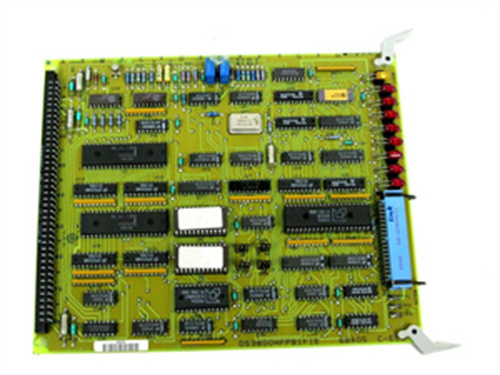
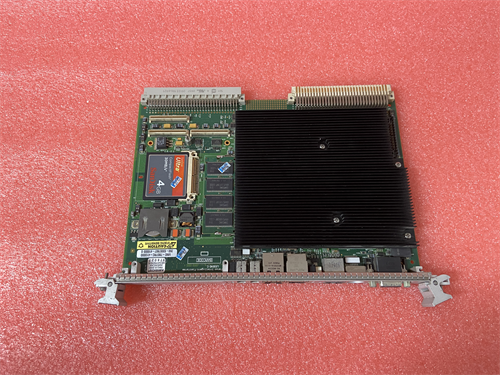
Mounting&Connectivity:Direct VME backplane insertion;front panel 50-pin D-Sub connector with keyed alignment for field signal cables.
Advantages&Features
Enhanced Gain Range for Low-Output Sensors:The GE Mark VIe DS200AAHAH2A offers a programmable gain up to 2000,which is particularly advantageous when working with older or low-sensitivity magnetic pickups that produce signals as low as 50 mV peak-to-peak at startup speeds.This eliminates the need for external preamplifiers,reducing cabinet complexity and potential failure points.
Ultra-High-Speed Simultaneous Sampling:With a 200 kS/s sampling rate across all six channels simultaneously,the GE Mark VIe DS200AAHAH2A captures high-frequency events such as blade-passing vibrations and sub-synchronous resonances that slower boards would alias or miss entirely.This capability is critical for condition monitoring systems(CMS)that require real-time FFT(Fast Fourier Transform)data for predictive maintenance algorithms.
4th-Order Filtering for Superior Signal Integrity:The advanced 4th-order low-pass filter(compared to the 2nd-order filter on the H1)provides steeper roll-off characteristics,effectively eliminating high-frequency noise from switching power supplies and variable frequency drives(VFDs)without attenuating the fundamental vibration frequencies of interest.This ensures cleaner data for accurate trip decisions.
Extended Temperature Range:Rated for operation up to 70°C,the GE Mark VIe DS200AAHAH2A is specifically designed for harsh outdoor turbine installations in desert,tropical,or arctic environments where cabinet cooling may be limited.The board’s thermal management includes improved component selection and enhanced PCB copper weighting for better heat dissipation.
Firmware-Based Configuration–No Hardware Modifications:All gain,filter,and channel enable/disable settings are stored in onboard EEPROM,allowing the GE Mark VIe DS200AAHAH2A to be reconfigured remotely via ToolboxST without opening the cabinet.This significantly reduces maintenance labor and eliminates downtime associated with physical jumper changes.
Comprehensive Online Diagnostics:The board incorporates continuous Built-In Test(BIT)circuitry that monitors probe health,excitation voltage,and channel impedance.If any parameter drifts outside predetermined thresholds,the GE Mark VIe DS200AAHAH2A generates a system alarm and flags the faulty channel to the main processor,enabling condition-based maintenance rather than reactive repairs.
Application Cases
Combined-Cycle Gas Turbine–High-Frequency Vibration Detection:In a 9FA combined-cycle plant,a GE Mark VIe DS200AAHAH2A was installed to monitor both speed(2 channels)and high-frequency blade-passing vibrations(4 channels)on the turbine’s compressor section.During a high-load test,the board’s 200 kS/s sampling rate captured a 4X synchronous vibration component that had previously been masked by aliasing in the slower H1 board.This early detection allowed the engineering team to identify a cracked compressor blade during a scheduled outage,preventing a catastrophic unbalance event.
Steam Turbine Overspeed Trip System–2-out-of-3 Voting:A nuclear power plant’s auxiliary steam turbine employed three GE Mark VIe DS200AAHAH2A boards(each handling 2 speed probes)to achieve a 2-out-of-3 voting logic for overspeed protection.The H2A’s extended temperature rating(70°C)proved essential,as the turbine hall frequently exceeded 55°C during summer peak loads.The board’s 1500V isolation prevented ground-loop interference from the turbine’s high-voltage electro-hydraulic(EHV)system,and the overspeed trip responded within 16 ms,exceeding the nuclear regulatory requirement of 40 ms.
LNG Compressor–Subsynchronous Vibration Analysis:At a large LNG export facility,a centrifugal compressor driven by a 35 MW motor experienced intermittent tripping due to unidentified vibrations.Engineers replaced the older H1 board with the GE Mark VIe DS200AAHAH2A,utilizing its 4th-order filter and 200 kS/s capability to perform detailed spectral analysis.The data revealed a subsynchronous vibration at 0.4X running speed,indicating oil-film whirl in the compressor’s journal bearings.Armed with this information,maintenance adjusted the bearing oil supply pressure and temperature,eliminating the trips and extending compressor runtime by 14 months.
Comparison with Competitors
vs.Siemens Simatic ET 200SP HA Analog Module:Siemens offers high-availability analog modules with good diagnostic features,but they lack the dedicated negative excitation voltage(-24V)required for eddy-current probes used in turbine vibration monitoring.To use Siemens modules with these sensors,external isolated power supplies and signal conditioners are mandatory,which increases cabinet space,wiring,and mean-time-between-failures(MTBF).The GE Mark VIe DS200AAHAH2A integrates all excitation and conditioning functions into a single board,saving valuable rack space and reducing total lifecycle cost.
vs.Honeywell FIM(Field Interface Module)for Experion PKS:Honeywell’s FIM is designed for their proprietary I/O bus and cannot be physically inserted into a GE VME backplane.Users attempting to migrate from GE to Honeywell(or vice versa)would need to replace the entire rack and controller.For existing GE Mark VIe installations,the GE Mark VIe DS200AAHAH2A is the only drop-in replacement that preserves the system’s hard real-time performance(1 ms cycle time)without requiring protocol gateways or custom drivers.
vs.Woodward MicroNet Plus High-Speed Input Module:Woodward offers excellent speed-sensing modules with comparable sampling rates,but their channel density is limited to 4 channels per module,requiring more rack slots for a 6-channel configuration.Additionally,Woodward’s software environment(MicroNet Plus Suite)is entirely different from GE’s ToolboxST,necessitating extensive re-engineering and retraining of maintenance personnel.The GE Mark VIe DS200AAHAH2A retains full backward compatibility with existing Mark VIe control logic,allowing seamless field replacement without software rewrites.
vs.GE Mark V Equivalent(DS200AAHAH1A–older generation):Comparing within the GE lineage,the GE Mark VIe DS200AAHAH2A offers double the gain range(2000 vs.1000),double the sampling rate(200 kS/s vs.100 kS/s),a superior 4th-order filter(vs.2nd-order),and an extended temperature range(70°C vs.65°C).It also replaces fragile physical jumpers with reliable EEPROM-based configuration.For plants still operating legacy Mark V systems,upgrading to the Mark VIe with the H2A board is strongly recommended for obsolescence risk mitigation.
Selection Suggestions
Assess Sensor Sensitivity:Choose the GE Mark VIe DS200AAHAH2A if your magnetic pickups produce low output voltage(50-200 mV peak)or if you require high-frequency vibration analysis up to 10 kHz(with a 25 kHz anti-aliasing filter).For standard applications with high-output sensors(>500 mV)and lower frequency requirements(below 5 kHz),the H1 variant may be more cost-effective.
Evaluate Environmental Conditions:If your turbine cabinet regularly exceeds 65°C(e.g.,outdoor installations in desert regions,poorly ventilated generator compartments),the GE Mark VIe DS200AAHAH2A is the preferred choice due to its 70°C operating temperature rating.For climate-controlled indoor turbine halls,the H1’s 65°C rating may suffice.
Check System Compatibility:The GE Mark VIe DS200AAHAH2A requires ToolboxST software version v5.5 or later to access its expanded gain and filter settings.If you are running an older Mark VIe firmware,consult GE for a compatibility matrix and possible firmware upgrade paths.The board is physically compatible with all Mark VIe racks,but software configuration options vary by revision.
Consider Channel Usage:If you need to monitor more than 6 speed/vibration channels,plan for multiple boards.Each GE Mark VIe DS200AAHAH2A consumes one VME slot,so verify that your rack has sufficient available slots(typical Mark VIe racks support 12 to 20 slots).Also,calculate total+5V and+24V current draw to ensure the rack’s power supply is not overloaded(the H2A consumes approximately 20%more power than the H1 due to its faster ADC).
Spare Parts Strategy:Given the ongoing active production of the Mark VIe series,the GE Mark VIe DS200AAHAH2A remains readily available from GE authorized distributors.However,lead times can vary(typically 4-8 weeks).For critical turbine units,it is advisable to stock at least one spare board per train to minimize downtime in the event of a field failure.
Retrofit Consideration:If you are replacing an older Mark V board(e.g.,DS200AAHAH1A),the GE Mark VIe DS200AAHAH2A is a direct physical replacement in terms of connector pinout and backplane interface.However,note that the Mark V and Mark VIe systems use different software architectures;you cannot simply swap the board without upgrading the entire control system to Mark VIe.
Precautions
ESD Protection:The GE Mark VIe DS200AAHAH2A contains highly sensitive CMOS components and precision ADC devices.Always wear a grounded ESD wrist strap and work on a static-dissipative mat when handling the board.Avoid contact with the gold-plated edge connectors,as contamination can degrade signal quality and lead to intermittent faults.
No Hot-Swapping:This board is strictly non-hot-swappable.Always de-energize the entire Mark VIe rack before inserting or removing the GE Mark VIe DS200AAHAH2A.Hot insertion can cause voltage spikes on the backplane that may damage not only the board itself but also the main processor card and other adjacent modules.
Correct Wiring Polarity:When terminating field sensors to the 50-pin D-Sub connector,verify polarity carefully.For eddy-current probes,reversing the+SIG and-SIG connections will produce an inverted gap-voltage reading,causing the turbine controller to misinterpret shaft axial position or radial displacement.This could result in false trips or,worse,delayed trips during actual overspeed conditions.Always consult the GE Mark VIe termination manual for precise pin assignments.
Configuration Backup:Before removing an existing board for replacement,always use ToolboxST to export the configuration(gain,filter,and channel settings)to a backup file.The GE Mark VIe DS200AAHAH2A ships with factory-default settings,which may not align with your turbine’s specific calibration curves.After installation,load the saved configuration and perform a loop-check using a calibrated signal source to verify all channels read correctly.
Grounding Discipline:Ensure single-point grounding for shield drain wires from field cables—ground at the sensor end only,not at the GE Mark VIe DS200AAHAH2A connector.Grounding both ends creates ground loops that can inject 50/60 Hz hum and high-frequency noise,degrading the board’s specified 100 dB CMRR performance.Use shielded twisted-pair cables for all field connections.
Storage Conditions:If the board is not installed immediately,store it in its original anti-static bag within a temperature-controlled environment(10°C to 35°C)and relative humidity below 50%.Prolonged exposure to high humidity or corrosive atmospheres(e.g.,H₂S,chlorine)can damage the conformal coating and solder joints,even before installation.
Firmware Compatibility Check:When receiving a new GE Mark VIe DS200AAHAH2A,verify that its onboard firmware revision matches the revision expected by your Mark VIe main processor.Mismatched firmware can result in communication errors or unavailability of the expanded gain settings.If needed,work with GE field service to reprogram the board’s firmware prior to installation.
Signal Cable Length Limitations:For optimal performance with eddy-current probes,the cable length between the sensor and the GE Mark VIe DS200AAHAH2A should not exceed 300 meters(for standard coaxial cables).Longer runs may introduce capacitance-induced phase shifts and signal attenuation,affecting measurement accuracy.For applications requiring longer cable runs,consider using a remote preamplifier or active signal driver.



Reviews
There are no reviews yet.