
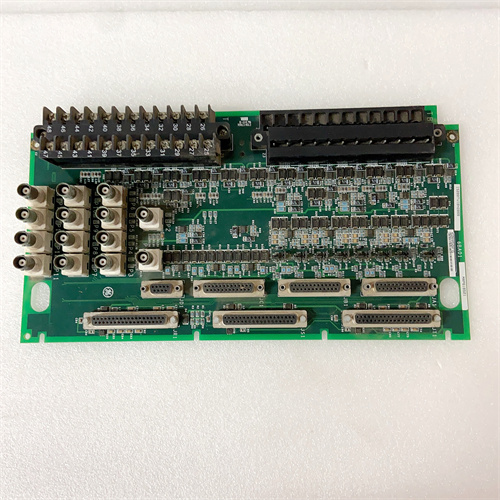
Description
Product Parameters
| Parameter | Specification |
|---|---|
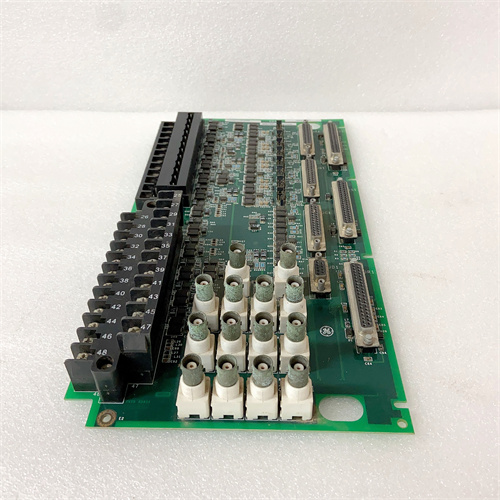
| Model | IS230TCISH7C |
| Manufacturer | GE Energy / Baker Hughes |
| Platform | Mark VIe |
| Type | I/O terminating board (thermocouple/RTD) |
| Compatible Modules | IS220PTCCH1A (thermocouple), IS220PRTDH1A (RTD) |
| Input Channels | Up to 16 thermocouple or 16 RTD (depending on module) |
| CJC Sensor | Integrated high‑accuracy temperature sensor (±0.1°C) |
| CJC Sensor Type | Solid‑state (I²C interface) |
| Terminal Type | Screw‑clamp (pluggable, 2‑piece) |
| Number of Positions | 32 positions (field wiring side) |
| Wire Gauge | 0.2–2.5 mm² (AWG 24–14) |
| Thermocouple Types | J, K, T, E, R, S, B, N (via module configuration) |
| RTD Types | PT100, PT500, PT1000, Ni120, Cu10 (via module configuration) |
| RTD Wiring | 2‑wire, 3‑wire, 4‑wire (selectable) |
| Signal Conditioning | Integrated termination resistors, filter capacitors, CJC sensor |
| Isolation | 1500 V (field‑to‑backplane via module) |
| LED Indicators | None (status via I/O module) |
| Operating Temperature | -40°C to +85°C |
| Storage Temperature | -40°C to +100°C |
| Humidity | 5% to 95% (non‑condensing) |
| Dimensions | Standard Mark VIe terminal board form factor |
| Weight | Approx. 0.4 kg |
| MTBF | > 200,000 hours |
Advantages and Key Features
-
Integrated CJC Sensor – The IS230TCISH7C includes a high‑accuracy (±0.1°C) solid‑state cold junction compensation sensor located on the terminal block, eliminating the need for external CJC references and ensuring accurate thermocouple measurement.
-
Dedicated Temperature Input Optimization – Unlike general‑purpose terminal boards, the IS230TCISH7C is specifically designed for thermocouple and RTD inputs, providing optimal signal conditioning for low‑level millivolt and resistance signals.
-
Versatile Sensor Support – Supports all common thermocouple types (J, K, T, E, R, S, B, N) and RTD types (PT100, PT500, PT1000, Ni120, Cu10) through module configuration.
-
Flexible RTD Wiring – Supports 2‑wire, 3‑wire, and 4‑wire RTD configurations, allowing compensation for lead wire resistance.
-
Pluggable Terminal Design – The IS230TCISH7C features a 2‑piece pluggable terminal block design, simplifying maintenance and module replacement without rewiring.
-
Integrated Signal Conditioning – Provides mounting locations for termination resistors and filter capacitors to match sensor characteristics and reject noise.
-
Wide Temperature Range – Rated for -40°C to +85°C, suitable for outdoor and harsh turbine environments.
-
Flame‑Retardant Housing – UL 94 V‑0 rated material provides safety in the event of electrical faults.
Application Fields and Use Cases
1. Exhaust Gas Temperature (EGT) Monitoring
The IS230TCISH7C connects multiple exhaust gas thermocouples (Type K or N) to the IS220PTCCH1A module, providing critical data for combustion dynamics control, EGT spread protection, and turbine performance optimization. The integrated CJC sensor ensures accurate measurement in high‑temperature turbine environments.
2. Turbine Inlet Temperature
Provides connections for high‑temperature thermocouples (Type R/S/B) for turbine inlet temperature monitoring, with CJC compensation for measurement accuracy.
3. Bearing Temperature Monitoring
RTD sensors (PT100) connect to the IS230TCISH7C for bearing temperature monitoring, with 3‑wire or 4‑wire configurations to compensate for lead resistance.
4. Stator and Rotor Temperature Monitoring
Provides RTD connections for generator stator and rotor temperature monitoring in combined‑cycle power plants.
5. Combustion Chamber Monitoring
Thermocouple connections for individual combustion chamber temperature monitoring, enabling early detection of flame‑out and combustion instability.
6. Retrofit Projects
The IS230TCISH7C is the recommended upgrade from legacy thermocouple/RTD terminal boards (IS200TCISH7C) for Mark VIe upgrades, providing pluggable connections and improved CJC accuracy.
Comparison with Competing Products
| Feature | IS230TCISH7C (GE) | IS230TBTCH1B (GE) | IS200TCISH7C (GE Mark VI) | ABB TU830 + TB845 | Siemens 6ES7 392-1AJ00 + CJC |
|---|---|---|---|---|---|
| Platform | Mark VIe | Mark VIe | Mark VI (VME) | AC 800M | S7-400 |
| Type | Thermocouple/RTD | Universal | Thermocouple/RTD | Terminal unit + CJC | Terminal + external CJC |
| CJC Sensor | Yes (integrated, ±0.1°C) | Optional | Yes (±0.5°C) | Yes (±0.2°C) | External module |
| Thermocouple Types | J, K, T, E, R, S, B, N | Via module | J, K, T, E, R, S, B | J, K, T, R, S, B | J, K, T, R, S, B |
| RTD Support | PT100/500/1000, Ni120, Cu10 | Via module | PT100, Ni120 | PT100, Ni100 | PT100, Ni100 |
| RTD Wiring | 2/3/4‑wire | 2/3/4‑wire | 2/3‑wire | 2/3/4‑wire | 2/3‑wire |
| Pluggable | Yes | Yes | No | Yes | No |
| Temp Range | -40°C to +85°C | -40°C to +85°C | -30°C to +65°C | -25°C to +60°C | 0°C to +60°C |
| MTBF | > 200,000 hrs | > 200,000 hrs | > 150,000 hrs | > 120,000 hrs | > 80,000 hrs |
Key Differentiators: The IS230TCISH7C is a dedicated thermocouple/RTD terminating board with integrated CJC sensor (±0.1°C accuracy). Unlike the universal IS230TBTCH1B, it is specifically optimized for low‑level temperature signals with enhanced noise rejection and CJC compensation. Compared to the legacy IS200TCISH7C, the IS230TCISH7C provides a pluggable design and superior CJC accuracy. Compared to competitors, the IS230TCISH7C offers the widest temperature range and highest CJC accuracy, making it the optimal choice for GE Mark VIe temperature monitoring applications.
Selection Suggestions and Precautions
Selection Criteria
-
Choose the IS230TCISH7C for thermocouple or RTD temperature monitoring applications requiring integrated CJC compensation.
-
For mixed signal types (analog + temperature), consider the IS230TBTCH1B universal terminal block.
-
Verify compatibility with the specific I/O module: IS220PTCCH1A for thermocouples or IS220PRTDH1A for RTDs.
-
Ensure the CJC sensor on the IS230TCISH7C is not exposed to temperature gradients or airflow that could affect measurement accuracy.
Critical Precautions
-
CJC Sensor Placement – The IS230TCISH7C CJC sensor is located on the terminal block. Ensure the terminal block is not exposed to heat sources, direct sunlight, or drafts that could create a temperature difference between the CJC sensor and the thermocouple connection points. Mount the IS230TCISH7C in a stable thermal environment.
-
Thermocouple Wiring – Use the correct thermocouple extension wire (same type as the thermocouple) for all connections to the IS230TCISH7C. Do not use standard copper wire, as this introduces additional junctions and measurement errors. Keep thermocouple wire length consistent for all channels to minimize impedance mismatch.
-
RTD Wiring – For 3‑wire RTD connections, ensure all three wires are of the same gauge and length to maintain lead compensation accuracy. For 4‑wire RTD connections, use separate sense and excitation wires.
-
Shielding – Use shielded thermocouple or RTD cables. Terminate shields at the field device end only, not at the IS230TCISH7C, to prevent ground loops.
-
Grounding – The IS230TCISH7C provides isolation via the I/O module. Do not tie thermocouple shields to the terminal block ground, as this may introduce ground loops and measurement errors.
-
Terminal Connections – Use proper wire stripping length (approximately 7–8 mm). Recommended torque: 0.5–0.6 N·m. Over‑tightening may damage terminals; under‑tightening may cause intermittent connections.
-
CJC Calibration – The IS230TCISH7C is factory‑calibrated. Re‑calibration is generally not required in the field unless specified by your maintenance program or after a module replacement.
-
ESD Handling – Use grounded wrist straps when handling the IS230TCISH7C to prevent static damage.
-
Obsolescence – The IS230TCISH7C is in active production with long‑term support. For future projects requiring additional channels or enhanced CJC accuracy, evaluate the IS230TCISH7D when available. Keep spare boards for critical temperature monitoring applications.
A-B 25B-D010N104
A-B 1732E-IB16M12R
SCHNEIDER 140CPS11420
.jpg)

Reviews
There are no reviews yet.