
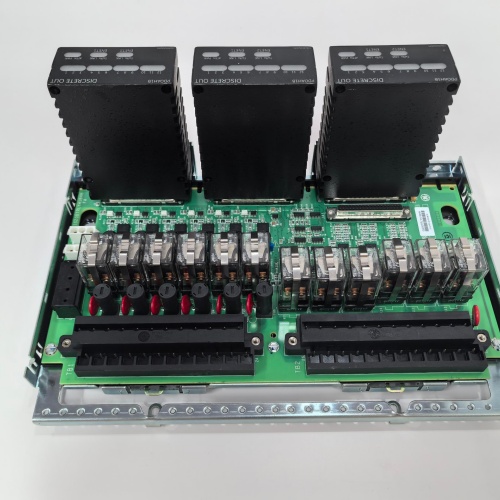
Description
Product Parameters
| Parameter | Specification |
|---|---|
| Model | IS220PVIBH1A |
| Manufacturer | GE Energy / Baker Hughes |
| Platform | Mark VIe |
| Bus Interface | PCI Express (PCIe) via backplane |
| Input Channels | 8 vibration inputs (differential or single‑ended) |
| Sensor Types | Accelerometer (IEPE/charge), Velocity coil, Proximity probe (eddy current) |
| Input Range | ±10 VDC, ±5 VDC, 4–20 mA (software configurable) |
| Input Impedance | > 1 MΩ (voltage mode), 250 Ω (current mode) |
| Frequency Range | 0.5 Hz to 10 kHz |
| Integration | Acceleration → Velocity → Displacement (software selectable) |
| Resolution | 16‑bit |
| Accuracy | ±0.1% of reading or ±0.05% of full scale |
| Filtering | Programmable low‑pass, high‑pass, band‑pass, and notch filters |
| Trend Analysis | Yes (trend values over configurable intervals) |
| Alarm Detection | Configurable alert and danger thresholds |
| Isolation | 1500 V (channel‑to‑backplane) |
| Hot‑Swap Support | Yes |
| LED Indicators | Power, Status (RUN/FAIL), Channel Activity, Alarm Status, Diagnostic Alert |
| Operating Temperature | -30°C to +65°C |
| Storage Temperature | -40°C to +85°C |
| Humidity | 5% to 95% (non‑condensing) |
| Power Consumption | +5 VDC @ 2.5 A |
| Dimensions | Standard Mark VIe module form factor |
| Weight | Approx. 0.6 kg |
| MTBF | > 180,000 hours |
Advantages and Key Features
-
Dedicated Vibration Monitoring – The IS220PVIBH1A is optimized for rotating machinery vibration measurement, providing high‑accuracy input for accelerometers, velocity sensors, and proximity probes used in turbine protection systems.
-
Multi‑Sensor Support – Supports IEPE/charge accelerometers, velocity coils, and eddy current proximity probes, making the IS220PVIBH1A compatible with all common vibration sensors used in GE turbine applications.
-
Flexible Integration – Software‑selectable integration (acceleration → velocity → displacement) enables the IS220PVIBH1A to provide velocity (mm/s) or displacement (µm) outputs directly from acceleration inputs.
-
Advanced Filtering – Programmable low‑pass, high‑pass, band‑pass, and notch filters on the IS220PVIBH1A enable precise frequency selection for different vibration monitoring applications (e.g., sub‑synchronous, 1X, harmonic).
-
Trend Analysis – Built‑in trend analysis capability on the IS220PVIBH1A provides historical vibration data for predictive maintenance and life extension analysis.
-
Configurable Alarm Thresholds – Independent alert and danger thresholds per channel with hysteresis prevent nuisance alarms while ensuring reliable protection.
-
High Accuracy – ±0.1% accuracy ensures precise vibration measurement for critical turbine protection and condition monitoring.
-
Excellent Noise Rejection – High common‑mode rejection and programmable filtering provide reliable measurements in high‑EMI environments.
-
Advanced Diagnostics – Sensor health monitoring (open‑circuit, short‑circuit, signal‑out‑of‑range) with diagnostic alert LEDs enable predictive maintenance and rapid troubleshooting.
-
Hot‑Swap Capability – Can be replaced in a running system without powering down.
Application Fields and Use Cases
1. Shaft Relative Vibration Monitoring
The IS220PVIBH1A monitors shaft relative vibration using eddy current proximity probes (e.g., Bently Nevada 3300 series), providing critical data for bearing health monitoring and rotor stability.
2. Bearing Absolute Vibration Monitoring
Accelerometer inputs on the IS220PVIBH1A provide bearing housing absolute vibration data for ISO 10816 compliance and predictive maintenance.
3. Thrust/Axial Position Monitoring
Proximity probe inputs measure axial shaft position (thrust) for monitoring bearing wear and thrust collar condition.
4. Overspeed and Over‑Vibration Protection
The IS220PVIBH1A provides real‑time vibration amplitude data for 2‑out‑of‑3 voting overspeed and over‑vibration protection systems.
5. Rotor Balancing and Diagnostics
On‑line vibration data from the IS220PVIBH1A enables rotor balancing, resonance identification, and torsional vibration analysis.
6. Predictive Maintenance
Trend analysis data from the IS220PVIBH1A enables early detection of bearing degradation, unbalance, misalignment, and other mechanical faults.
Comparison with Competing Products
| Feature | IS220PVIBH1A (GE) | IS220PSFDH1A (GE) | ABB PM866 + AI880 (AC 800M) | Bently Nevada 3500 |
|---|---|---|---|---|
| Platform | Mark VIe | Mark VIe | AC 800M | Standalone |
| Input Channels | 8 vibration | 8 pulse + 4 strain | 4 analog | Varies |
| Sensor Types | Accel, velocity, proximity | Strain, pulse | Accel, velocity | Proximity, accel |
| Integration | Yes (A→V→D) | N/A | Limited | Yes |
| Filtering | Advanced, programmable | Limited | Standard | Advanced |
| Trend Analysis | Yes | No | Limited | Yes |
| Alarm Detection | Alert/danger | N/A | Alert only | Alert/danger |
| Accuracy | ±0.1% | ±0.05% | ±0.1% | ±0.05% |
| Isolation | 1500 V | 1500 V | 1500 V | N/A |
| Hot‑Swap | Yes | Yes | Yes | Limited |
| MTBF | > 180,000 hrs | > 180,000 hrs | > 120,000 hrs | > 100,000 hrs |
Key Differentiators: The IS220PVIBH1A is the only GE Mark VIe module dedicated specifically to vibration monitoring, offering advanced filtering, integration (acceleration → velocity → displacement), and trend analysis capabilities. Unlike general‑purpose analog modules, the IS220PVIBH1A provides specialized features for rotating machinery protection, including configurable alert/danger alarms and diagnostic capabilities essential for turbine condition monitoring.
Selection Suggestions and Precautions
Selection Criteria
-
Choose the IS220PVIBH1A for dedicated vibration monitoring applications on gas and steam turbines requiring accelerometer, velocity, or proximity probe inputs.
-
For combined pulse/strain and vibration applications, consider the IS220PSFDH1A.
-
For integrated turbine control and vibration monitoring, the IS220PVIBH1A provides seamless integration with the Mark VIe control system.
-
Verify Mark VIe Toolbox version supports the IS220PVIBH1A (v8.0 or higher).
Critical Precautions
-
Sensor Compatibility – Ensure vibration sensors (accelerometers, velocity sensors, proximity probes) are compatible with the IS220PVIBH1A input range (±10 VDC, ±5 VDC, or 4–20 mA). Use appropriate signal conditioners if necessary.
-
Sensor Power (IEPE) – For IEPE accelerometers, the IS220PVIBH1A provides constant current excitation (2–4 mA). Verify sensor compatibility with the module’s current excitation range.
-
Cable Quality – Use high‑quality shielded coaxial or twisted‑pair cables for vibration sensors. Terminate shields at the field device end, not at the IS220PVIBH1A, to prevent ground loops.
-
Cable Length – Maintain appropriate cable lengths for sensor types. Proximity probes typically require cables < 100 meters. Accelerometers with built‑in amplification can be used with longer cables.
-
Integration Selection – Select the correct integration mode (acceleration → velocity → displacement) on the IS220PVIBH1A based on your application. For bearing absolute vibration, use velocity (mm/s). For shaft relative vibration, use displacement (µm).
-
Filter Configuration – Configure filters on the IS220PVIBH1A to reject unwanted frequencies. For turbine vibration monitoring, typical settings are:
-
High‑pass: 1–5 Hz (remove DC drift)
-
Low‑pass: 1–10 kHz (remove high‑frequency noise)
-
Notch filter: 50/60 Hz (remove line frequency interference)
-
-
Alarm Thresholds – Set alert and danger thresholds on the IS220PVIBH1A based on ISO 10816 guidelines or OEM recommendations. Use hysteresis to prevent nuisance alarms during transient operations.
-
Trend Analysis Configuration – Configure trend intervals on the IS220PVIBH1A for predictive maintenance. Typical intervals are 1 hour for trend archives and 1 minute for short‑term monitoring.
-
Grounding – Ensure proper grounding of the IS220PVIBH1A and field devices. Ground loops can introduce noise into low‑level vibration signals. Use isolated sensors or isolation amplifiers if necessary.
-
ESD Handling – Use grounded wrist straps when handling the IS220PVIBH1A to prevent static damage.
-
Hot‑Swap – While the IS220PVIBH1A supports hot‑swap, verify the system is properly configured for live insertion. Check LED status after insertion to confirm initialization.
-
Obsolescence – The IS220PVIBH1A is in active production with long‑term support. For new projects requiring vibration monitoring in Mark VIe systems, the IS220PVIBH1A is the recommended choice. Keep spare units for critical turbine protection applications.
A-B 2711P-T6M5D
A-B 1756-PA75
Schneider BMXAMO0802

Reviews
There are no reviews yet.