
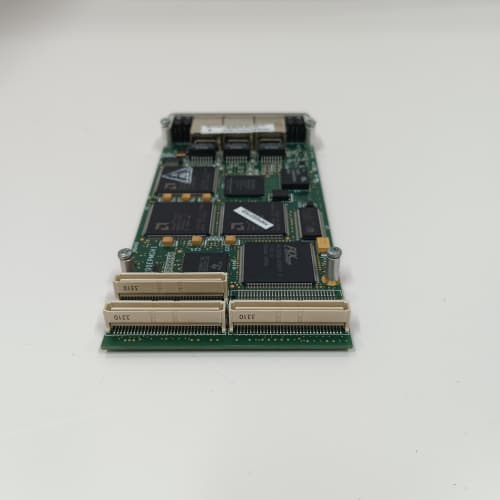
Description
Key Specifications
| Parameter | Specification |
|---|---|
| Input Channels | 16 differential analog input channels |
| Sensor Types Supported | Eddy current proximity probes, accelerometers (IEPE/charge), velocity sensors |
| Input Signal Range | –24 V to +24 V DC (proximity probes); ±10 V AC (accelerometers/velocity) |
| Measurement Parameters | Shaft relative vibration, absolute bearing vibration, shaft position, eccentricity, case expansion, shaft differential expansion |
| Frequency Response | DC to 15 kHz (programmable filters) |
| Resolution | 24-bit ADC |
| Accuracy | ±0.25% of full scale |
| Sample Rate | Up to 40 kHz per channel (simultaneous sampling) |
| Protection Functions | Over-vibration trip, shaft position deviation, rate-of-change detection, trend-based early warning, spectral band alarms |
| Input Protection | Overvoltage (±40 VDC), ESD (IEC Level 4) |
| Isolation | 1500 VDC (channel-to-backplane) |
| Diagnostics | 1000-event fault log with timestamps, waveform snapshots, and FFT snapshots |
| Operating Temp | –30 °C to +75 °C (extended range) |
| Humidity | 5–100% condensing (silicone coating standard) |
| Coating | Thicker silicone conformal coating + enhanced edge encapsulation (UV-traceable) |
| Manufacturing | 120-hour burn-in, 100% X-Ray/AOI, military-grade components, enhanced thermal cycling (–40 to +85 °C, 100 cycles) |
| Power | 15 W (+5 V / +3.3 VDC) |
| Connectors | 48-pin terminal block with gold-plated contacts and captive washer screws |
| Built-in Test | Sensor bias voltage monitoring, open/short detection, signal quality analysis, FFT spectral analysis |
Advantages & Distinctive Features
-
16 High-Density Channels: Maximizes vibration inputs per slot—reduces rack space.
-
Superior Accuracy: ±0.25% full scale ensures precise vibration measurements for critical protection.
-
High Sample Rate: 40 kHz captures high-frequency vibration components (bearing wear, gear mesh, blade pass).
-
Extended Frequency Response: 15 kHz provides wider bandwidth for high-speed machinery.
-
24-Bit Resolution: Improved signal-to-noise ratio for better measurement fidelity.
-
FFT Spectral Analysis: On-board Fast Fourier Transform enables spectral band alarming—alarm on specific frequency bands (1X, 2X, gear mesh) for advanced fault diagnosis.
-
Shaft Differential Expansion: Additional parameter for steam turbine casing expansion monitoring.
-
Trend-Based Early Warning: Monitors long-term vibration trends—alerts before alert/danger levels.
-
Spectral Band Alarms: Configure alarms on specific frequency components for precise fault detection.
-
Thicker Silicone Coating + Enhanced Edge Encapsulation: Provides superior protection against humidity, salt spray, chemicals, and condensing environments—suitable for offshore, Arctic, and chemical plants.
-
Extended Temperature Range: –30 °C to +75 °C operation—suitable for the most extreme environments.
-
Enhanced Thermal Cycling: 100 cycles from –40 °C to +85 °C during manufacturing ensures coating durability under thermal stress.
-
1000-Event Fault Log with waveform and FFT snapshots—enables comprehensive post-event analysis.
-
Gold-Plated Captive Washer Terminals: Corrosion-resistant and vibration-proof connections.
-
Hot-Swappable: No rack power-down for replacement.
-
Direct Retrofit: Replaces all VVIBH1A, H1B, H1C, H1CAA, and H1CAB series boards.
Application Fields
-
Gas turbines: Bearing vibration, shaft displacement, eccentricity, spectral analysis for blade pass and combustion dynamics
-
Steam turbines: Bearing and casing vibration, thrust position, differential expansion
-
Compressors: Centrifugal and axial compressor vibration, surge protection, spectral alarming
-
Generators: Stator end-winding, bearing vibration, torsional vibration
-
Pumps: Critical feedwater and boiler circulation pump vibration
-
Wind turbines: Main bearing and gearbox vibration, spectral analysis for gear mesh
-
Offshore platforms: Salt-spray and condensing environments
-
Arctic installations: Extreme cold (–30 °C) environments with frequent thermal cycling
-
Desert power plants: Extreme heat (+75 °C) environments
-
Chemical processing: Corrosive environments benefiting from silicone coating
-
Nuclear power plants: Safety-critical vibration monitoring
Comparison with “AA”/”AB” and Competitors
| Feature | GE IS200VVIBH1CAC | GE IS200VVIBH1CAB | GE IS200VVIBH1CAA | Bently Nevada 3500 |
|---|---|---|---|---|
| Channels | 16 | 16 | 16 | 4 |
| Accuracy | ±0.25% | ±0.25% | ±0.25% | ±1% |
| Sample Rate | 40 kHz | 40 kHz | 40 kHz | 10 kHz |
| Frequency Response | 15 kHz | 15 kHz | 15 kHz | 5 kHz |
| FFT/Spectral Alarming | Yes | Yes | Yes | Yes (external) |
| Coating Type | Thick silicone + edge | Silicone + edge | Acrylic | Optional |
| Temp Range | –30 to +75 °C | –30 to +75 °C | –25 to +70 °C | 0 to +60 °C |
| Humidity | 5–100% condensing | 5–100% condensing | 5–95% non-condensing | 5–95% |
| Thermal Cycling | 100 cycles (–40 to +85 °C) | Standard | Standard | Standard |
The GE IS200VVIBH1CAC offers the same superior channel density, accuracy, sampling, and spectral analysis as the “AA” and “AB” variants, but with thicker silicone coating and enhanced thermal cycling for maximum durability in extreme environments—making it the ultimate choice for critical vibration monitoring in the world’s harshest conditions.
Selection Guidelines
-
When to choose:
-
Critical vibration monitoring requiring ±0.25% accuracy, 40 kHz sampling, and 16 channels
-
Extreme environments (–30 to +75 °C, condensing, chemical exposure, salt spray)
-
Applications with frequent thermal cycling (turbine start/stop, outdoor cabinets)
-
Applications needing FFT spectral alarming and differential expansion monitoring
-
Maximum reliability (nuclear, critical infrastructure)
-
-
When to choose “CAA” or “CAB” instead: For less extreme environments where acrylic or standard silicone coating suffices—the “CAC” variant is typically the most expensive; select only when extreme thermal cycling and maximum coating thickness are required.
-
Sensor Selection: Proximity probes require ±24 VDC; accelerometers may need IEPE excitation (2–10 mA, programmable).
-
Filtering: Program low-pass filters per channel—1–5 kHz for bearings, up to 15 kHz for gear mesh and blade pass.
-
Spectral Alarms: Configure on 1X, 2X, sidebands, and gear mesh frequencies for advanced fault diagnosis.
-
Alarm/Trip Levels: Per API 670—alert at 50% range, danger at 80%. Use spectral band alarms for frequency-specific protection.
-
Coating Verification: Inspect under UV (365 nm)—thicker silicone coating shows distinct fluorescence; verify enhanced edge encapsulation bead is continuous and visibly thicker than standard variants.
-
Compatibility: Fits all Mark VIe VME64x racks. Requires ControlST v7.0 or higher for full features.
Operational Precautions
-
Wiring: Follow GEH-6860 diagrams—correct polarity and shield grounding essential. Use shielded twisted-pair cables; ground shield at terminal board only.
-
Sensor Bias Voltage Check: For proximity probes, verify bias voltage within –24 V to –4 V via Toolbox ST.
-
Calibration: Factory calibrated—verify against known vibration reference during commissioning.
-
Alarm/Trip Testing: Simulate vibration tests to verify alarm, trip, and spectral band alarm logic.
-
Spectral Alarm Testing: Simulate vibration at specific frequencies to verify spectral band alarming functionality.
-
FFT Baseline: Review FFT data during commissioning to establish baseline spectral signature for each machine.
-
LED Diagnostics: Green = normal; Amber = alert or quality warning; Red = danger/trip. Refer to GEH-6860 for H1C-specific blink codes.
-
Fault Log: Access 1000-event log via Toolbox ST—waveform and FFT snapshots included.
-
Coating Care: Thicker silicone coating provides superior chemical resistance; use GE-approved silicone-safe cleaner. Inspect annually under UV—rework voids with approved silicone coating per GE FSB-MKVIe-112.
-
Hot-Swap: Remove/insert slowly under power—processor auto-recognizes new module.
-
Spare Stock: Maintain 1 spare per 3–4 racks; “CAC” backward-compatible with all VVIB sockets.
-
Annual Verification: Verify channels against known reference; compare baseline spectral signatures.
-
Filter Review: Review filter and spectral alarm settings annually—adjust if machinery conditions change.
-
Firmware Updates: Ensure the GE IS200VVIBH1CAC is in “standby” mode during updates. Use ControlST v7.0 or higher.
-
ESD: Handle by edges only with grounded wrist strap—coating does not protect connectors.
-
Storage: Anti-static bag with desiccant at –40 to +85 °C; rotate every 3 years for coating inspection.
A-B 2090-CSWM1DF-14AA15
ABB 3ASC25H204
SCHNEIDER 140ACI03000



Reviews
There are no reviews yet.