
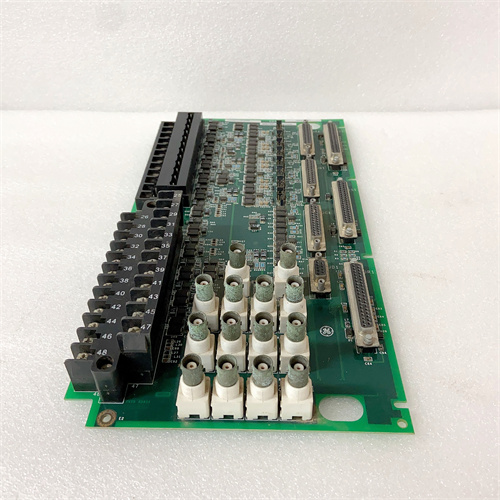
Description
Detailed Technical Specifications
-
Input Channels: 16 differential RTD input channels (versus 12 on H1B series)
-
RTD Types Supported: Pt100 (α = 0.00385), Pt500, Pt1000, Ni120 (configurable via software)
-
Connection Configuration: 2-wire, 3-wire, or 4-wire RTD connection (software-selectable per channel)
-
Measurement Range: –200 °C to +850 °C (Pt100); –200 °C to +600 °C (Pt500/Pt1000)
-
Resolution: 0.05 °C (enhanced over H1B series)
-
Accuracy: ±0.15 °C (typical) — improved significantly over H1B series
-
Sample Rate: 20 Hz (50 ms per channel, sequential scanning) — double the H1B series
-
Excitation Current: Programmable (0.25 mA, 0.5 mA, 1 mA, 2 mA) per channel for optimized sensor performance
-
Input Protection: Overvoltage protection (±35 VDC continuous), enhanced ESD protection (IEC 61000-4-2 Level 4)
-
Input Filtering: Advanced digital filtering (programmable, 4 selectable levels) for improved noise rejection
-
Isolation: 1000 VDC (channel-to-backplane) — improved isolation for enhanced safety
-
Communication: I/O Net (dual Ethernet ports for redundancy, with improved protocol efficiency)
-
Form Factor: 6U VME64x (160 × 233 mm), single-slot width
-
Indicators: Enhanced LED array — individual channel status (green/amber/red) plus module health, communication, and redundant path status
-
Operating Temp: 0 °C to +60 °C (derated above 50 °C)
-
Power Draw: 12 W typical from +5 VDC and +3.3 VDC backplane rails
-
Connectors: Front-panel 32-pin terminal block (screw-type) for RTD field wiring, with enhanced corrosion-resistant gold plating
-
Diagnostic Memory: Non-volatile fault logging — stores last 100 channel events (open/short/out-of-range) with timestamps
Advantages & Distinctive Features
-
Superior Accuracy: ±0.15 °C typical accuracy (versus ±0.3 °C on H1BBA and ±0.5 °C on H1B) ensures exceptional temperature measurement for critical turbine protection and efficiency optimization algorithms.
-
Higher Channel Density: 16 channels (33% more than H1B series) allows more temperature sensors in the same rack space—reducing overall cabinet footprint and cost per channel.
-
Faster Sample Rate: 20 Hz sampling (double the H1B series) provides faster response for dynamic temperature monitoring—critical for protection loops and transient analysis.
-
Expanded RTD Support: Compatibility with Pt500 and Pt1000 sensors offers greater flexibility for applications requiring higher resistance sensors or improved noise immunity.
-
2-Wire Support: Addition of 2-wire mode accommodates simple, short-run installations where lead-wire resistance is negligible.
-
Advanced Filtering: 4-level programmable digital filtering allows precise tuning for noise rejection—from minimal filtering (fastest response) to heavy filtering (maximum noise immunity).
-
Improved Isolation: 1000 VDC channel-to-backplane isolation provides enhanced safety and protection against ground loops and potential faults.
-
Non-Volatile Fault Logging: On-board memory stores fault events with timestamps, enabling remote diagnostics and trend analysis without requiring external data logging.
-
Enhanced Diagnostics: Expanded LED indicators and detailed blink codes for rapid troubleshooting; individual channel health monitoring.
-
Gold-Plated Connectors: Enhanced corrosion resistance ensures reliable connections in high-humidity environments.
-
I/O Net Integration: Seamless communication with the processor board via redundant Ethernet links, ensuring deterministic <1 ms scan cycle integration with protection logic.
-
Hot-Swappable: Supports removal and replacement without powering down the rack—minimizes turbine downtime during maintenance.
-
Retrofit Compatibility: Direct replacement for earlier VRTDH1A, H1B, and H1BBA boards with the same physical footprint—requires firmware update for full feature access.
Application Fields
-
Advanced Gas Turbine Monitoring: Exhaust temperature monitoring with high accuracy for emissions optimization and combustion dynamics analysis.
-
Bearing Temperature Surveillance: Critical bearings on gas and steam turbines—faster sample rate improves early fault detection.
-
Inlet Air Temperature Measurement: Compressor inlet temperature for efficiency calculations and anti-icing control.
-
Generator Stator and Bearing Temperature: Winding and bearing RTDs for generator protection—higher channel count accommodates more sensors.
-
Steam Turbine Shell and Casing: Monitoring differential expansion and thermal stresses.
-
Heat Recovery Steam Generator (HRSG) : Feedwater, superheater, economizer, and superheater outlet temperature—16 channels cover multiple locations.
-
Compressor Stations: Inlet/discharge temperature monitoring for gas compressor performance optimization.
-
Wind Turbine Bearing and Gearbox: Temperature monitoring in wind turbine applications where Pt1000 sensors are preferred.
-
Research & Development: Test cells requiring high-accuracy, fast-sampling temperature data for algorithm validation.
Comparison with Competing Products
| Feature | GE IS200VRTDH1C | Competitor A (Siemens ET200SP RTD) | Competitor B (Woodward MIC-200 RTD) | Competitor C (ABB 800xA RTD) |
|---|---|---|---|---|
| Channels | 16 | 8 | 8 | 12 |
| RTD Support | Pt100/500/1000, Ni120 | Pt100 only | Pt100, Ni120 | Pt100, Ni120 |
| Wiring Modes | 2/3/4-wire | 3-wire only | 3-wire & 4-wire | 3-wire & 4-wire |
| Accuracy | ±0.15 °C | ±0.8 °C | ±0.6 °C | ±0.5 °C |
| Sample Rate | 20 Hz | 10 Hz | 5 Hz | 10 Hz |
| Digital Filtering | 4-level programmable | Basic | None | Basic |
| Excitation Current | 0.25–2 mA (4 options) | Fixed | Programmable | Fixed |
| Isolation | 1000 VDC | None | 250 VDC | 500 VDC |
| Fault Logging | Non-volatile (100 events) | No | No | No |
| Diagnostic Blink Codes | Expanded | No | Limited | Basic |
| Retrofit Compatibility | Direct for VRTDH1A/H1B/H1BBA | N/A | N/A | N/A |
The GE IS200VRTDH1C offers superior accuracy, higher channel density, faster sampling, and expanded RTD support compared to all competitors—making it the definitive choice for demanding turbine temperature monitoring applications.
Selection Guidelines
-
When to choose: Any Mark VIe application requiring high-accuracy RTD temperature measurement—especially beneficial for:
-
Efficiency optimization (emissions monitoring, heat-rate calculations)
-
Dynamic protection loops requiring faster response
-
Applications needing 16+ RTD channels in a single slot
-
Installations using Pt500 or Pt1000 sensors
-
Electrically noisy environments benefiting from advanced filtering
-
-
Upgrade consideration: When upgrading from H1B series, the GE IS200VRTDH1C provides significant performance improvements—but requires ControlST v6.5 or higher to access all features (v6.2 operates in H1B compatibility mode).
-
Sensor Selection: Verify field RTD type and configure appropriately. Pt500/Pt1000 provide better noise immunity but require compatible sensors.
-
Wiring Mode Selection:
-
2-wire: Only for short cable runs (<10 m) with negligible lead resistance (least accurate).
-
3-wire: Standard for most applications (good accuracy, cost-effective).
-
4-wire: Highest accuracy, recommended for critical protection channels.
-
-
Excitation Current Selection:
-
0.25 mA: Minimal self-heating—best for small sensors or high-density installations.
-
0.5 mA: Standard setting for most applications.
-
1 mA: Improved noise immunity (default).
-
2 mA: Maximum noise rejection—use only for large sensors with low self-heating.
-
-
Filtering Level:
-
Level 1 (minimal): Fastest response—best for dynamic temperature changes.
-
Level 2: Standard filtering (default).
-
Level 3: Enhanced filtering—recommended for electrically noisy environments.
-
Level 4 (maximum): Heavy filtering—use where noise is severe (response time increases to 200 ms).
-
-
Compatibility: Fits all Mark VIe VME64x racks. Requires processor board (VPRO series) with I/O Net connectivity and ControlST v6.5 or higher. Direct replacement for VRTDH1A/H1B/H1BBA (firmware update required).
-
Cooling: Passive convection—no special airflow requirements beyond standard cabinet ventilation.
Operational Precautions
-
Wiring Polarity: Follow GE wiring diagrams (GEH-6801)—incorrect polarity results in negative temperature readings. For 3-wire, the sense wire must connect to the correct terminal. For 2-wire, jumper the sense terminals appropriately.
-
Cable Shielding: Use shielded twisted-pair cables for field wiring. Ground the shield at the terminal board end only (single-point grounding) to avoid ground loops. Shield drain wire connected to cabinet earth bus.
-
Channel Configuration: Configure each channel for correct RTD type, wiring mode, excitation current, and filtering level in Toolbox ST before commissioning. The GE IS200VRTDH1C supports per-channel configuration—ensure all settings match field wiring.
-
Diagnostic Interpretation: Channel LED codes:
-
Green = Normal operation
-
Amber = Out-of-range (temperature outside configured limits)
-
Red (steady) = Fault (open circuit or short circuit)
-
Red (blinking) = Calibration error or hardware fault
-
Refer to GEH-6801 (Mark VIe RTD Board LED Code Table) for detailed blink code interpretation.
-
-
Fault Logging: Access the non-volatile fault log via Toolbox ST—review event timestamps to identify intermittent issues (e.g., loose connections, sensor degradation).
-
Calibration: Factory calibrated—no field calibration required. However, perform verification against known temperature reference during commissioning for critical protection channels.
-
Filtering Tuning: Start with Level 2 (standard) and adjust based on observed noise. If readings appear noisy, increase filtering; if response lag is unacceptable, decrease filtering.
-
Hot-Swap Procedure: When replacing a GE IS200VRTDH1C under power, remove and insert slowly to avoid inrush spikes. The processor board automatically recognizes the new module. Ensure firmware compatibility matches other boards in the rack.
-
Spare Stock: Maintain at least one spare GE IS200VRTDH1C per 3–4 active racks. The H1C variant is backward-compatible with all VRTDH1 series sockets, making it the preferred universal spare for RTD applications.
-
Annual Verification: Perform channel-by-channel verification against a known temperature source during scheduled outages. Document drift trends to identify potential sensor degradation. Compare historical fault logs to proactive replace problematic sensors before they cause false trips.
-
Firmware Updates: When updating firmware, ensure the GE IS200VRTDH1C is in “standby” mode (not active scanning) to prevent data corruption. Use ControlST v6.5 or higher for full feature support.
-
Environmental Considerations: Although the board operates at 0–60 °C, derate maximum performance above 50 °C—sample rate may reduce to 10 Hz under extreme thermal stress. Monitor on-board temperature via I/O Net telemetry if available.
BERGER LAHR VRDM 566/50 LNA
BACHMANN AIO288



Reviews
There are no reviews yet.