
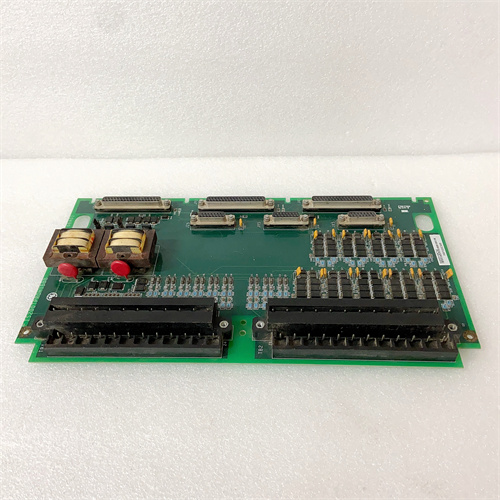
Description
Detailed Technical Specifications
-
Input Channels: 12 differential RTD input channels
-
RTD Types Supported: Pt100 (α = 0.00385), Pt50, Ni120 (configurable via software)
-
Connection Configuration: 3-wire or 4-wire RTD connection (software-selectable per channel)
-
Measurement Range: –200 °C to +850 °C (Pt100)
-
Resolution: 0.1 °C
-
Accuracy: ±0.3 °C (typical)—improved over standard H1B version
-
Sample Rate: 10 Hz (100 ms per channel, sequential scanning)
-
Excitation Current: Programmable (0.5 mA, 1 mA, 2 mA) per channel
-
Input Protection: Overvoltage protection (±30 VDC continuous), enhanced ESD protection (IEC 61000-4-2 Level 4)
-
Input Filtering: Enhanced digital filtering (programmable) for improved noise rejection in electrically noisy environments
-
Isolation: 500 VDC (channel-to-backplane)
-
Communication: I/O Net (dual Ethernet ports for redundancy)
-
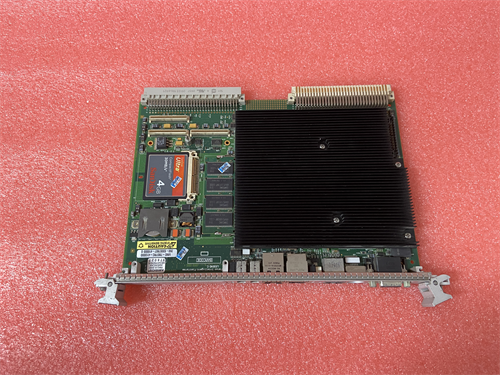
Form Factor: 6U VME64x (160 × 233 mm), single-slot width
-
Indicators: LED for each channel (signal OK / fault), plus module status LED—expanded blink codes for detailed diagnostics
-
Operating Temp: 0 °C to +60 °C
-
Power Draw: 10 W typical from +5 VDC and +3.3 VDC backplane rails
-
Connectors: Front-panel 24-pin terminal block (screw-type) for RTD field wiring, with enhanced corrosion-resistant plating
Advantages & Distinctive Features
-
Enhanced Accuracy: ±0.3 °C typical accuracy (versus ±0.5 °C on standard H1B) ensures superior temperature measurements for critical turbine protection (exhaust gas temperature monitoring, bearing temperature surveillance)—particularly beneficial for efficiency optimization algorithms.
-
Improved Noise Immunity: Enhanced digital filtering with programmable settings allows operators to tune the response for electrically noisy environments (e.g., near VFDs, high-power cables)—reducing false readings without sacrificing response time.
-
Flexible RTD Support: Configurable for Pt100, Pt50, or Ni120 sensors, and supports both 3-wire and 4-wire connections—accommodating various field sensor types and installation practices.
-
Lead-Wire Compensation: Automatic compensation for lead-wire resistance (3-wire and 4-wire modes) eliminates measurement errors caused by long RTD cabling—critical for large turbine installations with sensors located far from the control rack.
-
Programmable Excitation: User-selectable excitation current minimizes self-heating effects in small RTD elements while maintaining adequate signal-to-noise ratio.
-
Expanded Diagnostics: Individual channel LEDs with detailed blink codes indicate specific fault conditions (open circuit, short circuit, out-of-range, or calibration error)—enabling rapid field troubleshooting without external test equipment.
-
Corrosion-Resistant Terminals: Enhanced plating on terminal blocks provides superior protection against oxidation in high-humidity environments.
-
I/O Net Integration: Seamless communication with the processor board via redundant Ethernet links, ensuring deterministic <1 ms scan cycle integration with protection logic.
-
Hot-Swappable: Supports removal and replacement without powering down the rack—minimizes turbine downtime during maintenance.
-
Retrofit Compatibility: Direct replacement for earlier VRTDH1A and VRTDH1B boards with the same physical footprint and connector pinout.
Application Fields
-
Gas Turbine Exhaust Temperature Monitoring: Multiple RTD sensors in the exhaust duct for combustion monitoring and turbine protection—enhanced accuracy improves emissions optimization.
-
Bearing Temperature Surveillance: Critical bearings on gas and steam turbines—over-temperature trip logic relies on accurate RTD inputs.
-
Inlet Air Temperature Measurement: Compressor inlet temperature for efficiency calculations and anti-icing control.
-
Generator Stator and Bearing Temperature: Winding and bearing RTDs for generator protection.
-
Steam Turbine Shell and Casing Temperatures: Monitoring differential expansion and thermal stresses.
-
Heat Recovery Steam Generator (HRSG) : Feedwater, superheater, and economizer temperature measurements.
-
Compressor Stations: Inlet/discharge temperature monitoring for gas compressor performance optimization.
Comparison with Competing Products
| Feature | GE IS200VRTDH1BBA | Competitor A (Siemens ET200SP RTD) | Competitor B (Woodward MIC-200 RTD) |
|---|---|---|---|
| Channels | 12 | 8 | 8 |
| RTD Support | Pt100, Pt50, Ni120 | Pt100 only | Pt100, Ni120 |
| Wiring Modes | 3-wire & 4-wire | 3-wire only | 3-wire & 4-wire |
| Accuracy | ±0.3 °C | ±0.8 °C | ±0.6 °C |
| Digital Filtering | Enhanced (programmable) | Basic | None |
| Excitation Current | Programmable | Fixed | Programmable |
| Scan Rate | 10 Hz | 10 Hz | 5 Hz |
| Channel Isolation | 500 VDC | None | 250 VDC |
| Diagnostic Blink Codes | Yes (expanded) | No | Limited |
| Retrofit Compatibility | Direct for VRTDH1A/H1B | N/A | N/A |
The GE IS200VRTDH1BBA offers superior accuracy, more channels, flexible wiring, and enhanced noise immunity compared to competitors—making it ideal for demanding turbine temperature monitoring applications.
Selection Guidelines
-
When to choose: Any Mark VIe application requiring precise RTD temperature measurement—particularly in electrically noisy environments or where ±0.3 °C accuracy is beneficial (efficiency optimization, emissions monitoring).
-
Sensor Selection: Ensure field RTDs are Pt100 (0.00385 α) unless configured otherwise. Verify lead-wire resistance does not exceed 50 Ω per lead for 3-wire mode.
-
Wiring Mode: Use 3-wire for most applications (cost-effective, good accuracy); use 4-wire for highest accuracy when lead-wire resistance is high or unbalanced.
-
Excitation Current Selection: Use 0.5 mA for small RTDs (minimize self-heating) or 2 mA for improved noise immunity in electrically noisy environments. Default is 1 mA.
-
Digital Filtering Configuration: For electrically noisy environments, enable enhanced filtering in Toolbox ST—this reduces noise-induced errors at the cost of slightly slower response (adjustable from 100 ms to 500 ms per channel).
-
Compatibility: Fits all Mark VIe VME64x racks. Requires processor board (VPRO series) with I/O Net connectivity. Direct replacement for VRTDH1A and VRTDH1B.
-
Cooling: Passive convection—no special airflow requirements beyond standard cabinet ventilation.
-
Firmware: Requires ControlST v6.2 or higher for full enhanced filtering features; v6.0 operates in standard H1B compatibility mode.
Operational Precautions
-
Wiring Polarity: Follow GE wiring diagrams (GEH-6801)—incorrect polarity results in negative temperature readings. For 3-wire, the sense wire must connect to the correct terminal.
-
Cable Shielding: Use shielded twisted-pair cables for field wiring. Ground the shield at the terminal board end only to avoid ground loops. Shield drain wire should be connected to the cabinet earth bus.
-
Channel Configuration: Configure each channel for the correct RTD type, wiring mode, excitation current, and digital filtering level in Toolbox ST before commissioning—incorrect configuration yields inaccurate readings.
-
Diagnostic Interpretation: If a channel LED shows amber (out-of-range) or red (fault), note the blink pattern and refer to the Mark VIe RTD Board LED Code Table (GEH-6801)—common codes: 2 blinks = open circuit, 3 blinks = short circuit, 4 blinks = calibration error, 5 blinks = out-of-range.
-
Calibration: Factory calibrated—no field calibration required. However, verify temperature readings against a known reference (e.g., ice bath) during commissioning for critical protection channels.
-
Digital Filtering Tuning: If readings appear noisy, increase the filtering level in Toolbox ST. Conversely, if response time is critical, use minimal filtering—test during commissioning to find the optimal balance.
-
Hot-Swap Procedure: When replacing a GE IS200VRTDH1BBA under power, remove and insert the board slowly to avoid inrush current spikes. The processor board will automatically recognize the new module and resume scanning.
-
Spare Stock: Maintain at least one spare GE IS200VRTDH1BBA per 3–4 active racks. The “BA” variant is backward-compatible with VRTDH1A/H1B sockets, making it the preferred spare for all RTD applications.
-
Annual Verification: Perform a channel-by-channel verification of RTD readings against a known temperature source during scheduled outages. Document drift trends to identify potential sensor or board degradation before it triggers false trips.
WESTINGHOUSE 1C31227G01
WESTINGHOUSE 1C31227G01
A-B 1756-PA72
GE IC200CPU005



Reviews
There are no reviews yet.