
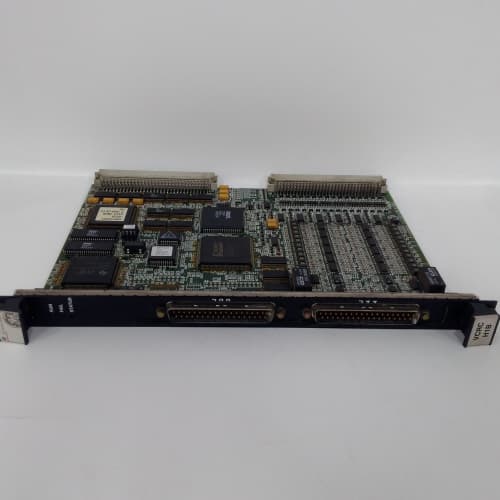
Description
Detailed Technical Specifications
-
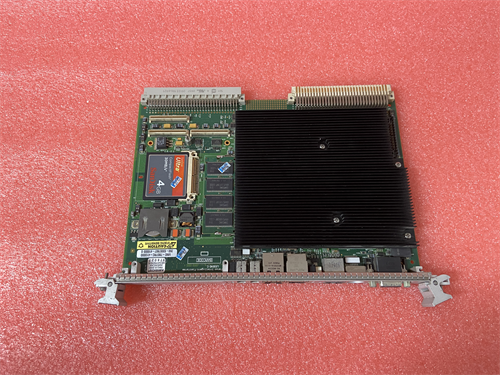
Processor Core: PowerPC 750GL running at 700 MHz, with integrated floating-point unit and enhanced instruction prefetch buffer for deterministic real-time execution.
-
Memory Configuration:
-
256 MB SDRAM (ECC-protected, with improved trace routing for signal integrity).
-
64 MB NOR Flash (updated wear-leveling algorithm for firmware longevity).
-
512 KB non-volatile SRAM with battery-backed retention for critical trip event logs.
-
-
Communication Interfaces:
-
Dual 10/100/1000Base-T Ethernet ports (supporting I/O Net protocol for distributed I/O and CIMPLICITY HMI for operator interface).
-
One RS-232 debug/serial console port (115.2 kbps, with enhanced ESD protection circuitry).
-
-
Physical & Environmental:
-
6U VME64x form factor (160 mm × 233 mm), fully compliant with ANSI/VITA 1-1994 standard.
-
Operating ambient temperature: 0 °C to 60 °C with 200 LFM forced airflow (extended operational margin due to revised heat spreader design).
-
Power draw: 20 W typical from +5 VDC and +3.3 VDC VME backplane rails.
-
-
Battery: Replaceable lithium coin cell (BR2032), with a redesigned holder for improved contact reliability during vibration.
Advantages and Distinctive Features
-
Enhanced Redundancy Logic: The GE IS200VPROH1B supports true hot-standby (primary/secondary) configurations with automatic bumpless transfer. The “H1B” revision introduces faster synchronization handshaking, reducing switchover jitter from 5 ms to under 2 ms—critical for overspeed protection loops.
-
Superior Deterministic Scanning: Through the dedicated I/O Net, this board achieves sub-millisecond scan cycles (<1 ms) for protection-class signals (overspeed, over-temperature, combustion dynamics), outperforming standard industrial PLCs by an order of magnitude.
-
Advanced On-Board Diagnostics: Expanded status LEDs now include separate indicators for FPGA configuration status, Ethernet PHY link quality, and redundant pair heartbeat integrity, enabling rapid root-cause analysis without external test equipment.
-
ControlST Software Ecosystem: Programmed exclusively using GE’s ControlST suite (v6.2 or higher recommended for H1B), which merges IEC 61131-3 ladder logic with high-level C-coded function blocks, allowing complex algorithms like compressor anti-surge and combustor tuning to be deployed with confidence.
Application Fields and Typical Use Cases
-
Power Generation: Primary control for large-frame gas turbines (GE 7F/9F series) and steam turbines in combined-cycle power plants, where the GE IS200VPROH1B manages startup sequencing, load ramping, and emergency shutdown.
-
Oil & Gas: Compressor station control for pipeline booster applications, where anti-surge and load-sharing require deterministic response times under fluctuating inlet conditions.
-
Marine Propulsion: Main engine control for naval and commercial vessel gas turbine systems, with the H1B revision offering improved vibration tolerance for shipboard environments.
-
Critical Infrastructure: Backup generator control in data centers and hospital cogeneration plants, where the GE IS200VPROH1B ensures grid-parallel stability and seamless island-to-grid transition.
In all these scenarios, the board interfaces with terminal boards (e.g., IS200TBCIH for thermocouple inputs, IS200TRTDH for RTD signals, IS200VCMIH for vibration monitoring) via I/O Net, executing protective trips within 5 ms of fault detection.
Comparison with Competing Products
| Feature | GE IS200VPROH1B | Competitor A (Siemens T-3000 CPU) | Competitor B (Woodward MicroNet Plus) |
|---|---|---|---|
| Processor | PowerPC 750GL (700 MHz) | Intel x86 (1 GHz) | PowerPC 604e (400 MHz) |
| Redundancy | Hot-standby, bumpless (<2 ms jitter) | Warm-standby (switchover >50 ms) | Hot-standby, bumpless (5 ms jitter) |
| I/O Scan Cycle | <1 ms (dedicated I/O Net) | 2–5 ms (Profinet IRT) | 1–2 ms (EtherCAT) |
| Programming Environment | ControlST (IEC 61131-3 + C) | TIA Portal (IEC only) | GAP (graphical + ANSI C) |
| Typical Application | Heavy-duty turbines (all frames) | Steam turbines (medium size) | Aero-derivative turbines |
| Vibration Tolerance | Enhanced (H1B revision) | Standard | Standard |
While competitors offer similar cycle times, the GE IS200VPROH1B excels in legacy fleet compatibility—it can be retrofitted into existing Mark VI/V systems without rack re-wiring, and the H1B firmware is backward-compatible with applications written for H1A and H1AC revisions, significantly reducing upgrade engineering costs.
Selection Guidelines and Sourcing Considerations
-
Compatibility Check: Verify that your existing rack backplane is VME64x (not older VME32) and that your power supply module (e.g., IS200EPSMG1 or IS200EPSMG2) can deliver adequate +3.3 V current (minimum 6 A). The H1B revision draws identical power to H1AC but has slightly stricter inrush current requirements.
-
Firmware Version: Ensure the board’s firmware revision (labeled on the top-side EPROM) matches your ControlST software version. Revision H1B requires Toolbox ST v6.2 or above for full feature support; earlier versions will operate in legacy compatibility mode with reduced diagnostics.
-
Battery Condition: For new-old-stock units, replace the lithium battery before commissioning—the H1B’s redesigned holder accepts standard BR2032 cells but requires careful insertion to avoid contact deformation.
-
Environmental Verification: Confirm your cabinet’s cooling capacity, as the GE IS200VPROH1B dissipates 20 W and requires unobstructed airflow across its extended heat spreader. The H1B’s improved thermal interface material provides 15% better heat transfer than the H1AC revision.
-
Spare Stock Strategy: Given the board’s lead time (typically 8–12 weeks for new builds), maintain at least one spare unit per three active turbines. The H1B is the preferred spare because it can replace H1A and H1AC boards directly (same physical footprint and connector pinout), offering forward-compatibility without control logic changes.
Operational Precautions & Maintenance Tips
-
Electrostatic Discharge (ESD): Always handle the GE IS200VPROH1B with a grounded wrist strap—the VME connector pins are ESD-sensitive, and the H1B’s finer-pitch FPGA traces are more susceptible than earlier revisions.
-
Redundancy Testing: During scheduled outages, perform manual primary-to-secondary switchover tests to verify bumpless transfer logic. For H1B units, test both “requested” and “forced” switchover modes to validate the enhanced synchronization handshaking.
-
Firmware Updates: Do not update firmware via the RS-232 port while the unit is in active control mode. Always place the board in “standby” or “offline” state to prevent unexpected trips. The H1B supports secure firmware signing; verify the checksum after each update.
-
Battery Replacement Procedure: Replace the battery within 10 minutes of power-off to preserve SRAM contents. The H1B’s new holder allows tool-free removal, but take care not to bend the retaining clips. Have a service tool ready to reload the application if memory corruption occurs.
-
LED Status Interpretation: Familiarize yourself with the expanded LED array—the “FPGA CFG” LED should be solid green within 3 seconds of power-up; if it flashes amber, a configuration mismatch exists between the board and the backplane’s geographic address settings.
-
Vibration Monitoring: For marine or high-vibration installations, inspect the board’s edge connector retention screws quarterly. The H1B’s enhanced vibration tolerance does not eliminate the need for mechanical securing—use the specified torque (0.6 N·m) to avoid stress fractures.
WESTINGHOUSE 1C31219G01
Bentley 330180-50-00
YASKAWA SGMG-09A2AB
GE IC693ALG222


Reviews
There are no reviews yet.