
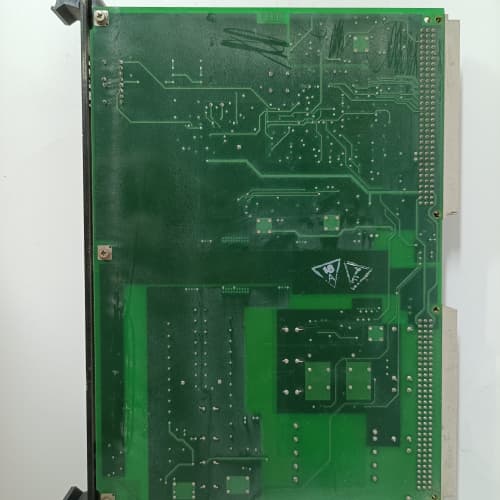
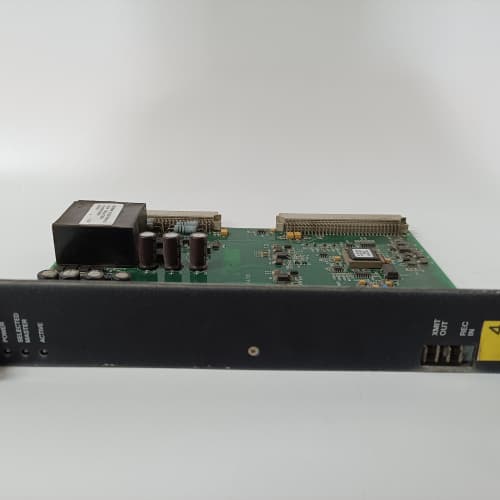
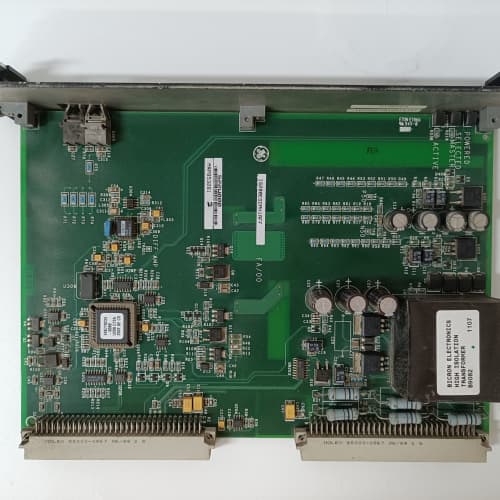
Description
Detailed Technical Specifications
-
Processor Core: PowerPC 750GL running at 700 MHz, with integrated floating-point unit for real-time thermodynamic calculations.
-
Memory Configuration:
-
256 MB SDRAM (ECC-protected) for application execution.
-
64 MB NOR Flash for firmware and user application storage.
-
512 KB non-volatile SRAM backed by an on-board lithium battery for critical trip data retention.
-
-
Communication Interfaces:
-
Dual 10/100/1000Base-T Ethernet ports (supporting I/O Net protocol and CIMPLICITY HMI connectivity).
-
One RS-232 debug/serial console port (115.2 kbps).
-
-
Physical & Environmental:
-
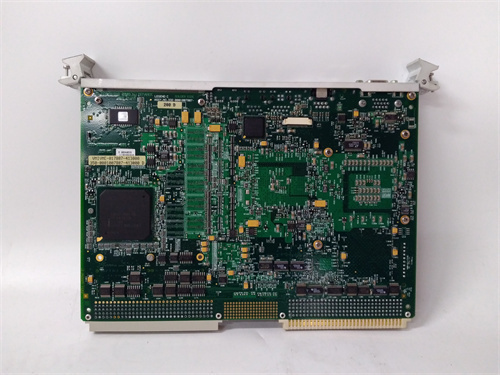
6U VME64x form factor (160 mm x 233 mm).
-
Operating ambient temperature: 0 °C to 60 °C with 200 LFM forced airflow.
-
Power draw: 20 W typical from +5 VDC and +3.3 VDC VME backplane rails.
-
-
Battery: Replaceable lithium coin cell (BR2032), recommended replacement interval of 5 years.
Advantages and Distinctive Features
-
Redundancy Architecture: The GE IS200VPROH1AC supports true hot-standby (primary/secondary) configurations with automatic bumpless transfer, ensuring zero process interruption during failover—a mandatory requirement for turbine emergency shutdown systems.
-
High-Speed Deterministic Scanning: Through the dedicated I/O Net, this board achieves sub-millisecond scan cycles (typically <1 ms) for overspeed and over-temperature protection inputs, surpassing the performance of standard industrial PLCs by an order of magnitude.
-
Integrated Diagnostics: On-board voltage and temperature monitoring, with status LEDs for Ethernet link/activity, processor heartbeat, and redundancy sync status, enabling rapid field troubleshooting.
-
ControlST Software Ecosystem: Programmed exclusively using GE’s ControlST suite, which merges IEC 61131-3 ladder logic with high-level C-coded function blocks—allowing complex algorithms like anti-surge and combustion dynamics control to be deployed seamlessly.
Application Fields and Typical Use Cases
-
Power Generation: Primary control for large-frame gas turbines (e.g., GE 7F/9F series) and steam turbines in combined-cycle plants.
-
Oil & Gas: Compressor station control where anti-surge and load-sharing require deterministic response times.
-
Marine Propulsion: Main engine control for naval and commercial vessel gas turbine systems.
-
Critical Infrastructure: Backup generator control in data centers and hospital cogeneration plants, where the GE IS200VPROH1AC ensures grid-parallel stability.
In all these scenarios, the board interfaces with terminal boards (e.g., IS200TBCIH, IS200TRTDH) via I/O Net to acquire thermocouple, RTD, and 4-20 mA signals, executing protective trips within 5 ms of fault detection.
Comparison with Competing Products
| Feature | GE IS200VPROH1AC | Competitor A (e.g., Siemens T-3000 CPU) | Competitor B (e.g., Woodward MicroNet) |
|---|---|---|---|
| Processor | PowerPC 750GL (700 MHz) | Intel x86 (1 GHz) | PowerPC 604e (400 MHz) |
| Redundancy | Hot-standby, bumpless | Warm-standby (switchover >50 ms) | Hot-standby (bumpless) |
| I/O Scan Cycle | <1 ms (dedicated I/O Net) | 2–5 ms (Profinet IRT) | 1–2 ms (EtherCAT) |
| Programming Environment | ControlST (IEC 61131-3 + C) | TIA Portal (IEC only) | GAP (graphical + C) |
| Typical Application | Heavy-duty turbines | Steam turbines (medium size) | Aero-derivative turbines |
While competitors offer similar cycle times, the GE IS200VPROH1AC excels in legacy fleet compatibility—it can be retrofitted into existing Mark VI/V systems without rack re-wiring, which is a significant cost advantage for plant upgrades.
Selection Guidelines and Sourcing Considerations
-
Compatibility Check: Verify that your existing rack backplane is VME64x (not older VME32) and that your power supply module (e.g., IS200EPSMG) can deliver adequate +3.3 V current (minimum 6 A).
-
Firmware Version: Ensure the board’s firmware revision (printed on the label) matches your ControlST software version. Revision H1AC is compatible with Toolbox ST v6.0 and above.
-
Battery Condition: For new-old-stock units, replace the lithium battery before commissioning to avoid RTC errors.
-
Environmental Verification: Confirm your cabinet’s cooling capacity, as the GE IS200VPROH1AC dissipates significant heat and requires unobstructed airflow across its heat spreader.
Operational Precautions & Maintenance Tips
-
Electrostatic Discharge (ESD): Always handle the GE IS200VPROH1AC with a grounded wrist strap—the VME connector pins are ESD-sensitive and can be damaged by static discharge.
-
Redundancy Testing: During scheduled outages, perform manual primary-to-secondary switchover tests to verify bumpless transfer logic; document the transient response for compliance audits.
-
Firmware Updates: Do not update firmware via the RS-232 port while the unit is in active control mode; always place the board in “standby” or “offline” state to prevent unexpected trips.
-
Battery Replacement Procedure: Replace the battery within 10 minutes of power-off to preserve SRAM contents; have a service tool ready to reload the application if memory corruption occurs.
-
Spare Stock Strategy: Given the board’s lead time (typically 8–12 weeks for new builds), maintain at least one spare unit per three active turbines to minimize downtime from hardware failures.
YASKAWA JAPMC-IO2301-E
SCHNEIDER TSXP572623M
ORIENTAL A4722-9215KM


Reviews
There are no reviews yet.