
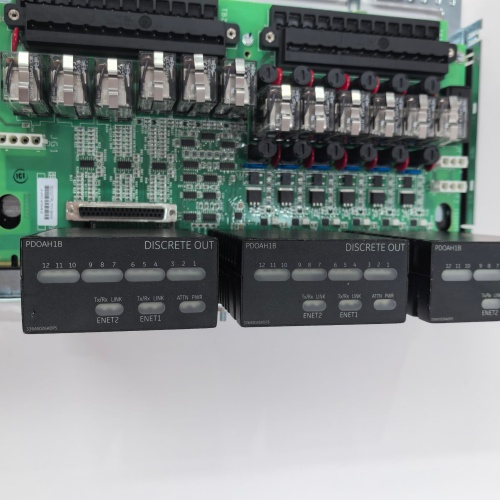
Description
Product Parameters
| Parameter | Specification |
|---|---|
| Brand / Series | GE Mark VIe Speedtronic |
| Model | IS200TREGH1BDB |
| Thermocouple Inputs | 16 redundant pairs (dual channels per measurement point) |
| Total Sensor Connections | 32 thermocouple inputs (configurable as redundant or independent) |
| Thermocouple Types | J, K, T, E, R, S, B (per-channel configurable via GE ToolboxST) |
| Input Range | ±100 mV |
| Cold-Junction Compensation | Dual redundant CJC sensors (accuracy ±0.2°C) — upgraded from ±0.3°C |
| ADC Resolution | 24-bit delta-sigma with programmable sampling rate (2–250 SPS) |
| Accuracy | ±0.03% of reading + ±0.3°C — upgraded from ±0.05% + ±0.5°C |
| Redundancy Logic | Hardware-based comparison and voting (programmable thresholds) |
| Isolation | 2000 VAC (field-to-system) |
| CMRR | >110 dB @ 50/60 Hz |
| Diagnostics | Open-circuit detection, short-circuit detection, dual CJC fault monitoring and auto-failover, channel mismatch detection, sensor drift detection, reference validation, calibration status tracking |
| Status Indication | 16 green LEDs (primary active), 16 green LEDs (redundant active), 16 red LEDs (mismatch fault), 2 red summary fault LEDs, 1 yellow LED (reference/calibration status), 1 blue LED (CJC redundancy active) |
| Calibration Features | Onboard calibration memory with traceable records, software-triggered self-calibration, factory calibration certificate stored onboard |
| Operating Temperature | –40°C to +70°C |
| Storage Temperature | –55°C to +85°C |
| Mounting | VME rack-mount terminal board with front-panel I/O connectors |
| Backplane Interface | VME64x (A24/A32, D16/D32/D64) |
| EMC Compliance | IEC 61000-4 Level 4 |
Advantages & Key Features
-
Redundant Temperature Monitoring: IS200TREGH1BDB provides 16 redundant thermocouple pairs (32 total inputs) with hardware-based comparison and voting logic.
-
High Channel Density: 16 redundant measurement points (32 thermocouple inputs) in a single VME slot.
-
Highest Accuracy: ±0.03% reading + ±0.3°C with dual CJC sensors (±0.2°C) provides the ultimate measurement precision.
-
Dual-Redundant CJC: Two independent cold-junction sensors with automatic cross-validation and failover ensure uninterrupted accuracy.
-
Extended Temperature Range: –40°C to +70°C operation makes IS200TREGH1BDB suitable for extreme environments.
-
Enhanced Isolation: 2000 VAC isolation and >110 dB CMRR provide superior protection.
-
Flexible Configuration: Channels can be configured as redundant pairs or independent single-ended inputs via GE ToolboxST.
-
Advanced Calibration: Onboard calibration memory with traceable records, factory certificate, and software-triggered self-calibration.
-
Comprehensive Diagnostics: Open-circuit, short-circuit, dual CJC auto-failover, channel mismatch, sensor drift, reference validation, and calibration status.
-
ToolboxST Integration: Full configuration, monitoring, diagnostics, and calibration management via GE ToolboxST.
-
Drop-In Replacement: Direct replacement for IS200TREGH1B, IS200TREGH1A, and earlier redundant thermocouple terminal boards.
Application Fields
-
Gas & Steam Turbines (GE Frame 6B/7EA/9E/HA): Exhaust gas temperature (EGT) monitoring with dual-redundant thermocouples.
-
Turbine Inlet Temperature (TIT): Redundant temperature monitoring for critical combustion control.
-
Combined Cycle Plants: Redundant temperature monitoring for HRSG superheaters and reheat sections.
-
Nuclear Power Plants: Critical temperature monitoring with documented calibration and redundancy.
-
Aeroderivative Turbines: Redundant exhaust temperature monitoring.
-
Arctic & Desert Installations: Extreme-environment critical temperature monitoring.
Comparison with Competing Products
| Feature | GE IS200TREGH1BDB | GE IS200TREGH1B | GE IS200TREGH1A | Competitor A (Redundant TC) | Competitor B (Standard TC) |
|---|---|---|---|---|---|
| Redundant Pairs | 16 (32 inputs) | 16 (32 inputs) | 16 (32 inputs) | 8 (16 inputs) | 0 |
| CJC Accuracy | ±0.2°C (dual redundant) | ±0.3°C (dual) | ±0.5°C (single) | ±1.2°C | ±0.5°C |
| TC Accuracy | ±0.03% + ±0.3°C | ±0.05% + ±0.5°C | ±0.1% + ±1°C | ±0.2% + ±2°C | ±0.1% + ±1°C |
| CJC Redundancy | Yes (auto-failover) | Yes | No | No | No |
| Sampling Rate | 2–250 SPS | 2–250 SPS | 4–200 SPS | Fixed | 4–200 SPS |
| Isolation | 2000 VAC | 2000 VAC | 1500 VAC | 1000 VAC | 1000 VAC |
| Operating Temp | –40°C to +70°C | –40°C to +70°C | –30°C to +65°C | 0°C to 50°C | 0°C to 50°C |
| Reference Validation | Yes | Yes | No | No | No |
| Calibration Records | Yes (traceable + certificate) | No | No | No | No |
| Self-Calibration | Yes | No | No | No | No |
| Sensor Drift Detection | Yes | Yes | No | No | No |
Key Advantage: IS200TREGH1BDB delivers 16 redundant thermocouple pairs with the highest accuracy (±0.03% + ±0.3°C), dual-redundant CJC (±0.2°C) with automatic failover, extended –40°C to +70°C temperature range, 2000 VAC isolation, comprehensive diagnostics including sensor drift detection, and advanced calibration management with traceable records and factory certificates—making it the ultimate solution for critical turbine temperature monitoring applications requiring maximum precision, reliability, and regulatory compliance.
Selection Guidelines & Recommendations
-
Redundancy Configuration: Determine measurement points requiring redundant thermocouples—up to 16 redundant pairs.
-
Configuration Mode: Select redundant pair or independent single-ended mode per channel pair in GE ToolboxST.
-
Thermocouple Type: Supports J, K, T, E, R, S, and B.
-
Dual CJC Sensors: Automatic failover—blue LED indicates redundancy is active.
-
Mismatch Thresholds: Program acceptable temperature difference thresholds.
-
Calibration Management: Use GE ToolboxST to review factory calibration certificate and perform self-calibration.
-
Controller Firmware: Requires Mark VIe processor firmware v9.5 or later.
-
Wiring Guidelines: Use shielded thermocouple extension-grade leads with correct polarity.
-
Spare Strategy: Keep one spare per turbine; lead times 8–14 weeks.
-
Retrofit: Direct replacement for IS200TREGH1B and IS200TREGH1A—regenerate configuration in GE ToolboxST.
Important Cautions
-
No Hot-Swap: De-energize rack before insertion/removal.
-
Thermocouple Polarity: Reverse connection produces negative readings—verify polarity.
-
CJC Protection: Do not apply conformal coating or tape over terminal block area.
-
Grounding: Connect AGND to Mark VIe system ground at single star point.
-
Shield Termination: Thermocouple shields ground only at cabinet end.
-
ESD Handling: Use grounded wrist straps; field repair not possible.
-
Temperature Rating: Verify cabinet ambient does not exceed +70°C or fall below –40°C.
-
Reference Validation: Yellow LED indicates reference drift—perform self-calibration or schedule factory recalibration.
-
CJC Redundancy Status: Blue LED flashing indicates one CJC sensor failed—schedule service.
-
Self-Calibration: Perform only when board is de-energized and free from field wiring faults.
-
Calibration Records: Factory certificate stored onboard—do not modify via external tools.
-
Channel Mapping: Verify field wiring maps to correct ToolboxST channel numbers.
SIEMENS 6ES7142-1BD40-0XA0
GE IC200ALG260E
ABB D2D146-AA28-28
A-B 1756-IF8



Reviews
There are no reviews yet.