
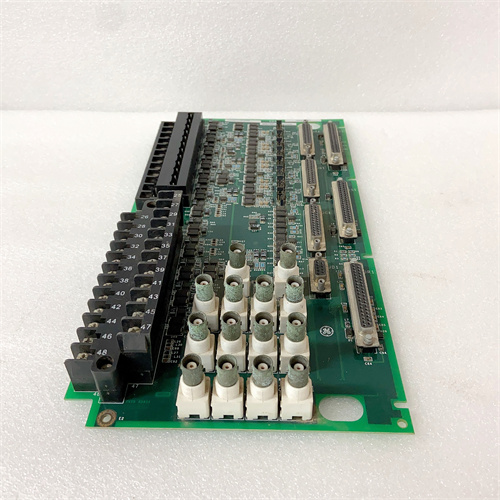
Description
Product Parameters
| Parameter | Specification |
|---|---|
| Brand / Series | GE Mark VIe Speedtronic |
| Model | IS200SCTTG1AAA |
| Input Channels | 24 thermocouple OR 12 RTD (software-selectable per channel) |
| Thermocouple Types | J, K, T, E, R, S, B (per-channel configurable via GE ToolboxST) |
| RTD Types | Pt100 (3-wire or 4-wire), Ni120 |
| Input Range | Thermocouple: ±100 mV; RTD: 0–400 Ω |
| Cold-Junction Compensation | Dual redundant CJC sensors with extended calibration (–40°C to +70°C), accuracy ±0.3°C |
| ADC Resolution | 24-bit delta-sigma with programmable sampling rate (4–200 SPS) |
| Accuracy (Extended Range) | ±0.08% of reading + ±0.8°C (thermocouple) / ±0.3°C (RTD) |
| Isolation | 1500 VAC (field-to-system) |
| Common Mode Rejection | >110 dB @ 50/60 Hz |
| Operating Temperature | –40°C to +70°C (extended range vs. standard –30°C to +65°C) |
| Storage Temperature | –55°C to +85°C |
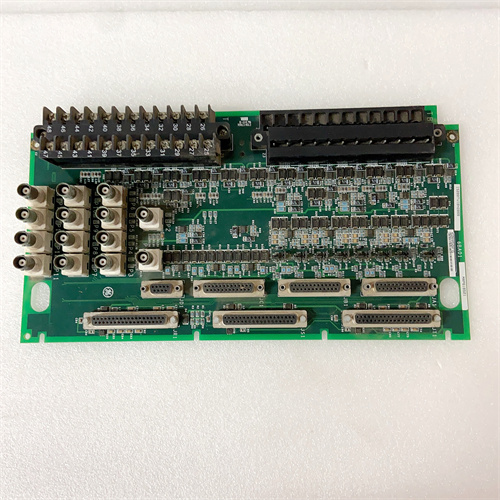
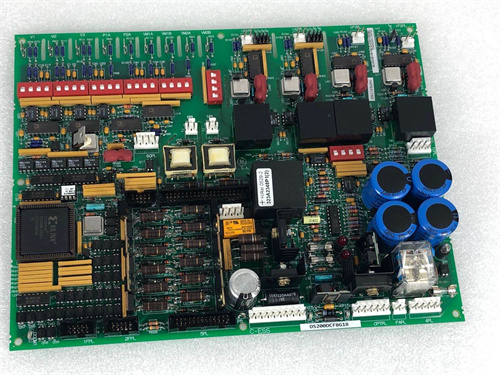
| Mounting Type | VME rack-mount terminal board with 68-pin front I/O connector |
| Built-in Diagnostics | Open-circuit detection, short-circuit detection, CJC redundancy health monitor, per-channel status LEDs, onboard self-test |
Advantages & Key Features
-
Extended Temperature Calibration: The IS200SCTTG1AAA is factory-calibrated over a –40°C to +70°C operating range, making it the preferred choice for arctic, desert, or non-climate-controlled turbine installations. This is a significant upgrade over the standard IS200SCTTG1A, which is limited to –30°C to +65°C.
-
Dual-Redundant Cold-Junction Compensation: Unlike the single CJC sensor on earlier GE terminal boards, IS200SCTTG1AAA incorporates two independent CJC sensors. The Mark VIe controller performs real-time cross-comparison and automatically switches to the healthy sensor if one drifts or fails, ensuring uninterrupted measurement integrity.
-
Enhanced Noise Rejection: With >110 dB CMRR and advanced digital filtering, IS200SCTTG1AAA delivers stable thermocouple readings even in high-voltage switchyard environments, where induced 50/60 Hz noise would corrupt standard PLC analog modules.
-
Per-Channel Software Configurability: Each of the 24 inputs can be independently programmed via GE ToolboxST for thermocouple type, RTD mode, or millivolt range, allowing mixed sensor arrays on a single IS200SCTTG1AAA board—reducing rack space and eliminating the need for multiple terminal block types.
-
Comprehensive Self-Test & Diagnostics: The onboard diagnostics suite includes: open-thermocouple detection, RTD short-circuit detection, CJC sensor health monitoring, and an internal voltage reference self-test. These features enable predictive maintenance and reduce unplanned turbine trips, a key advantage over competing solutions.
-
Backward Compatibility: IS200SCTTG1AAA is a direct mechanical and electrical replacement for legacy GE thermocouple boards such as the IS200STTCH1A and the standard IS200SCTTG1A, requiring no chassis, cable, or connector changes during retrofit.
Application Fields & Use Cases
-
Power Generation (Gas & Steam Turbines): IS200SCTTG1AAA is extensively deployed in GE Frame 6B, 7EA, 9E, and HA-class turbines, particularly in sites with extreme ambient temperature variations. Typical monitoring points include:
-
Exhaust gas temperature (EGT) thermocouple arrays (Type K or N)
-
Turbine inlet temperature (TIT) for combustion monitoring
-
Bearing metal temperature (RTD Pt100)
-
Generator stator winding temperature (RTD)
-
Casing thermal expansion differentials
-
Fuel gas preheat temperature
-
-
Combined Cycle & Cogeneration Plants: Used in heat recovery steam generators (HRSG) for superheater outlet temperature, reheat steam temperature, and economizer inlet monitoring.
-
Oil & Gas Offshore Platforms: Deployed in gas turbine compressor drives where salt-spray and wide temperature swings require the extended –40°C rating of IS200SCTTG1AAA.
-
Aeroderivative Turbines (LM Series): Monitoring engine oil temperature, fuel gas temperature, and exhaust thermocouple arrays in mobile or marine installations where environmental sealing is critical.
-
Nuclear Power Plants: Used in auxiliary turbine systems where strict calibration traceability and extended temperature range are mandated by regulatory requirements.
Comparison with Competing Products
| Feature | GE IS200SCTTG1AAA (Mark VIe) | Competitor A (Emerson 8CH TC Module) | Competitor B (Siemens 8CH TC Module) | Competitor C (Yokogawa RTD/TC Module) |
|---|---|---|---|---|
| Maximum Channels | 24 TC or 12 RTD per board | 8 TC (fixed) | 8 TC (fixed) | 16 TC or 8 RTD |
| Sensor Mixing | Any mix per channel (software) | Fixed per module | Fixed per module | Fixed per module |
| ADC Resolution | 24-bit delta-sigma | 16-bit SAR | 16-bit sigma-delta | 24-bit delta-sigma |
| Cold-Junction Accuracy | ±0.3°C (dual redundant) | ±1.2°C (single) | ±1.0°C (single) | ±0.5°C (single) |
| Operating Temp Range | –40°C to +70°C | 0°C to 60°C | 0°C to 60°C | –20°C to +65°C |
| Open/Short Detection | Per-channel, hardware-triggered | Software-polled | Software-polled | Hardware-triggered |
| Isolation | 1500 VAC optical | 1000 VAC | 500 VDC | 1500 VAC |
| CJC Redundancy | Yes (dual sensors with auto-switch) | No | No | No |
| Rack Space Efficiency | High (24 channels in 1 slot) | Medium | Medium | Medium |
Key Advantage: IS200SCTTG1AAA outperforms all competitors in channel density, environmental operating range, and CJC redundancy. Its dual-redundant cold-junction compensation is unique to GE Mark VIe and provides a measurable reliability improvement in critical turbine exhaust temperature monitoring—where a single CJC failure could otherwise cause inaccurate readings and potential trip events.
Selection Guidelines & Recommendations
-
Verify Environmental Requirements: If your turbine control cabinet operates in ambient temperatures below –30°C or above +65°C, IS200SCTTG1AAA is the mandatory choice. The standard IS200SCTTG1A will not meet accuracy specifications outside its rated range. For indoor, climate-controlled environments, the standard variant may suffice.
-
Confirm Sensor Type and Wiring: IS200SCTTG1AAA supports both thermocouples and RTDs, but wiring differs. For thermocouples, use extension-grade leads with correct polarity; for RTDs, ensure 3-wire (two current-carrying wires + one sense) or 4-wire connections per the terminal block labeling on IS200SCTTG1AAA.
-
Controller Firmware Compatibility: Verify that your Mark VIe main processor (e.g., IS420UCSBH1A or IS420UCSCH1A) is running firmware v7.2 or later. Earlier firmware versions do not recognize the extended calibration tables and dual-CJC redundancy logic specific to IS200SCTTG1AAA; they will default to standard IS200SCTTG1A behavior, losing the extended temperature accuracy.
-
ToolboxST Configuration: When configuring IS200SCTTG1AAA in GE ToolboxST, ensure you select the correct hardware revision from the module catalog. The system will automatically enable the extended calibration and CJC redundancy features. Verify that each channel’s sensor type is set correctly before downloading the configuration to the Mark VIe controller.
-
Cable Selection: Use GE-supplied shielded twisted-pair cables (e.g., IS200CABLE series) between IS200SCTTG1AAA and the field sensors. Maintain shield grounding only at the Mark VIe cabinet end to prevent ground loops, which degrade the >110 dB CMRR specification.
-
Spare Parts Strategy: For critical power plants operating in extreme climates, maintain at least two spare IS200SCTTG1AAA units per turbine. Production lead times for this extended-temperature variant can extend to 12–16 weeks due to specialized calibration processes at GE facilities.
-
Retrofit Consideration: If replacing an older IS200STTCH1A or IS200SCTTG1A with IS200SCTTG1AAA, the physical mounting and cable connectors are identical. However, you must regenerate the I/O configuration file in ToolboxST, as the channel mapping and calibration coefficients differ. Do not simply swap boards without updating the software.
Important Cautions
-
No Hot-Swap: IS200SCTTG1AAA is not hot-swappable. Always de-energize the Mark VIe rack before inserting or removing the board. Hot-swapping can damage the 24-bit ADC front-end and the dual CJC sensors, requiring factory recalibration.
-
Thermocouple Polarity: Reverse connection of thermocouple leads will produce a negative temperature reading. While this does not damage IS200SCTTG1AAA, the Mark VIe system may interpret the negative value as a sensor fault and trigger a false alarm. Always verify polarity against the terminal block silkscreen.
-
RTD Lead-Wire Compensation: For 3-wire RTDs, ensure both current-carrying leads are of identical gauge and length. IS200SCTTG1AAA assumes lead resistance is balanced; mismatched leads introduce a systematic offset error that increases with temperature.
-
CJC Sensor Protection: The dual cold-junction sensors are located on the terminal block of IS200SCTTG1AAA. Do not apply conformal coating, electrical tape, or cable tie wraps over the terminal block area, as this insulates the CJC sensors and invalidates the ±0.3°C compensation accuracy.
-
Grounding Practice: The board’s analog ground (AGND) must connect to the Mark VIe system ground at a single star point. Multiple ground paths introduce 50/60 Hz noise and degrade the >110 dB CMRR. Never connect AGND directly to the turbine chassis without going through the cabinet’s designated ground bar.
-
Firmware and Calibration Lock: IS200SCTTG1AAA contains factory-programmed calibration coefficients stored in onboard EEPROM. Do not attempt to update or modify the firmware via GE ToolboxST—the board is locked at the factory. Unauthorized modifications will render IS200SCTTG1AAA inoperable and require return to a GE service center for re-calibration at significant cost.
-
ESD Handling: Although IS200SCTTG1AAA has enhanced ESD protection (up to 8 kV contact discharge), always wear grounded wrist straps during handling. The onboard 24-bit ADC is sensitive to static discharge, and field-level repair is not possible due to the conformal coating applied to the board.
-
Thermal Gradient Avoidance: Install IS200SCTTG1AAA away from high-heat dissipating modules (e.g., power supplies or high-current output boards) in the Mark VIe rack. A temperature gradient across the terminal block exceeding 2°C will reduce CJC accuracy, even with the dual sensors.
This completes the technical analysis for IS200SCTTG1AAA. If you have further questions about installation, wiring diagrams, or ToolboxST configuration for this extended-temperature board, feel free to ask.
A-B 1756-IF16
Schneider TSXETG100
GE IC200ALG264G
GE IC200ALG264


Reviews
There are no reviews yet.