
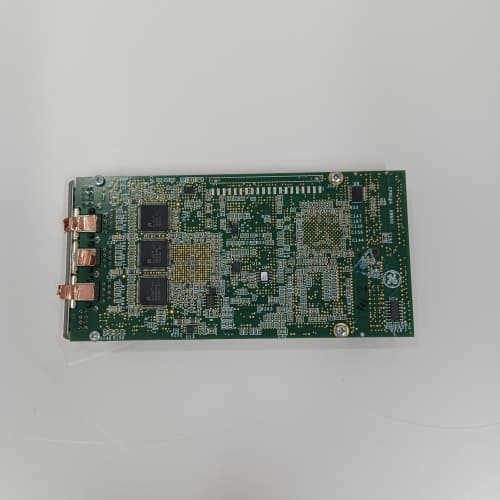
Description
Technical Specifications
| Parameter | Specification |
|---|---|
| Manufacturer | General Electric |
| Model | IS200ECTBG1ABB |
| Series | Mark VI / Speedtronic™ |
| Board Type | Enhanced Communications Terminal Bus Gateway |
| Terminal Bus Interfaces | 2× terminal bus ports (dedicated GE protocol) |
| Supported Protocols | GE proprietary terminal bus protocol, GE Speedtronic™ communication standards |
| Data Transfer Rate | Up to 10 Mbps (depending on configuration) |
| Onboard Processing | Standard processor with terminal bus protocol firmware |
| Terminal Equipment Support | Terminal boards, I/O termination racks, expansion chassis |
| Communication Modes | Master/Slave (gateway to terminal equipment) |
| Network Redundancy | Optional dual-bus redundancy for critical terminal bus networks |
| Backplane Interface | VME bus (P1/P2 connectors) |
| Power Requirements | +5V DC / 2.0A, ±15V DC / 0.4A |
| Operating Temperature | -30°C to +65°C |
| Storage Temperature | -40°C to +85°C |
| MTBF | > 120,000 hours |
| Suffix Meaning | “ABB” = specific firmware/configuration variant for terminal bus optimization |
Advantages and Key Features
Dedicated Terminal Bus Gateway: The IS200ECTBG1ABB provides a dedicated, optimized interface between the Mark VI VME backplane and terminal bus networks, ensuring reliable communication with terminal boards and I/O termination equipment.
Terminal Bus Protocol Optimization: The “ABB” firmware on the IS200ECTBG1ABB includes pre-configured settings for specific terminal bus architectures, reducing commissioning time and ensuring optimal performance.
Reliable Communication with Terminal Equipment: The IS200ECTBG1ABB enables robust communication with turbine-specific terminal boards, ensuring accurate data exchange between field I/O and the control system.
Redundancy Support: Supports dual-bus redundancy configurations on the IS200ECTBG1ABB, ensuring continuous communication with terminal equipment even if one bus path fails.
Comprehensive Diagnostics: Onboard diagnostics include link status monitoring, terminal node status, communication error counting, and protocol-specific diagnostics, all reported to the main DSP processor.
Application Fields and Case Studies
The IS200ECTBG1ABB is used in GE gas and steam turbine installations where terminal bus communication is required, facilities with distributed I/O termination boards located separate from the main control rack, and systems requiring connection to expansion chassis or remote terminal equipment. In a 500 MW power plant, the IS200ECTBG1ABB was deployed to interface the Mark VI control system with multiple terminal boards distributed throughout the turbine building. The board handled real-time data exchange with over 200 I/O points across 8 terminal boards. The “ABB” firmware on the IS200ECTBG1ABB was pre-configured for the site’s specific terminal bus architecture, reducing commissioning time by 2 days. When a terminal bus cable fault occurred, the redundant bus configuration on the IS200ECTBG1ABB ensured uninterrupted communication.
Comparison with Competing Products
| Dimension | IS200ECTBG1ABB | IS200EBRGH2ABA | IS200EBACG2ABA | Generic Terminal Gateway |
|---|---|---|---|---|
| Primary Function | Terminal bus gateway | Remote I/O gateway | Fieldbus gateway | Non-native |
| Protocol Support | GE terminal bus (dedicated) | GE remote I/O protocol | Profibus DP, DeviceNet, Modbus RTU | Various |
| Terminal Equipment Support | Direct (optimized) | Indirect | Indirect | Requires adaptation |
| VME Integration | Direct (Mark VI native) | Direct (Mark VI native) | Direct (Mark VI native) | External |
| Redundancy Support | Yes (dual-bus) | Yes (dual-bus) | Yes (dual-bus) | Limited |
| Diagnostics | Comprehensive + terminal-specific | Comprehensive + node-specific | Comprehensive + device-specific | Basic |
The IS200ECTBG1ABB offers superior terminal bus integration and direct VME backplane connection compared to generic terminal gateways. It is specifically optimized for GE terminal equipment, ensuring reliable and deterministic communication.
Selection Recommendations
Choose the IS200ECTBG1ABB when your Mark VI installation requires communication with terminal boards or I/O termination equipment via the terminal bus. Select it over the IS200EBRGH2ABA when your primary requirement is terminal bus communication rather than remote I/O expansion. Deploy redundant IS200ECTBG1ABB boards for critical terminal bus networks requiring high availability. Verify that your terminal boards are compatible with the IS200ECTBG1ABB protocol before commissioning. Ensure the “ABB” firmware preload matches your specific terminal bus architecture. For fieldbus device integration, the IS200EBACG2ABA is more appropriate.
Precautions and Important Notes
Always use ESD-safe handling procedures when installing the IS200ECTBG1ABB. Verify terminal bus cable quality and termination to ensure reliable communication. Configure the IS200ECTBG1ABB with correct protocol and addressing settings. Verify that the preloaded “ABB” firmware supports your specific terminal board types. Never interrupt firmware updates on the IS200ECTBG1ABB. When using redundant terminal bus configurations, connect each bus to separate communication paths. The IS200ECTBG1ABB draws 2.0A (+5V) – verify rack power supply capacity. Document all terminal bus network settings and node configurations before board replacement. Store spare boards in anti-static packaging and rotate inventory every 24 months. Do not mix IS200ECTBG1ABB with other bus gateway variants in redundant pairs without verifying identical firmware. Consult GE engineering when integrating the IS200ECTBG1ABB with non-standard terminal equipment. Allow the IS200ECTBG1ABB to complete its boot sequence (approximately 30 seconds) before relying on terminal bus communication. Verify that terminal bus network cabling does not exceed maximum recommended length. Ensure that all terminal boards are properly terminated and addressed before commissioning. The IS200ECTBG1ABB is designed specifically for GE terminal bus protocols – do not attempt to connect incompatible fieldbus equipment.
PHOENIX IB STME 24 AI 4/SF-2754383
ABB RMIO-11C
Motorola MVME147SA-1
.jpg)

Reviews
There are no reviews yet.