
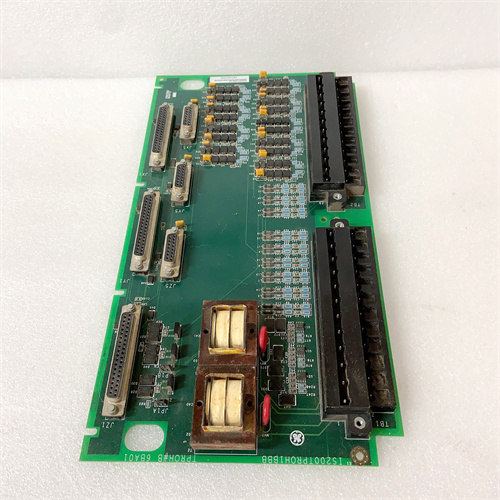
Description
Technical Specifications
| Parameter | Specification |
|---|---|
| Manufacturer | General Electric |
| Model | IS200DVIBH1B |
| Series | Mark VI / Speedtronic™ |
| Board Type | Digital Vibration Input (DVIB) |
| Input Channels | 8 isolated vibration inputs |
| Supported Sensor Types | Accelerometers (IEPE/charge), proximity probes (eddy current) |
| Input Range | ±10V (software configurable) |
| Resolution | 16-bit ADC per channel |
| Frequency Range | 0.5 Hz to 10 kHz (software selectable filtering) |
| Integration Options | Displacement (μm), Velocity (mm/s), Acceleration (g) – software selectable |
| Signal Conditioning | Built-in IEPE excitation (4 mA constant current) |
| Filtering | Low-pass, high-pass, and band-pass (software configurable) |
| Update Rate | 10 ms per channel (sequential) |
| Isolation | Channel-to-channel and channel-to-backplane: 1500V RMS |
| Power Requirements | +5V DC / 2.5A, ±15V DC / 0.5A |
| Operating Temperature | -30°C to +65°C |
| Revision Note | “B” revision indicates enhanced filtering and improved signal processing |
Advantages and Key Features
Integrated IEPE Excitation: The IS200DVIBH1B provides built-in constant current excitation (4 mA) for IEPE accelerometers, eliminating the need for external signal conditioners.
Software-Selectable Integration: Each channel on the IS200DVIBH1B can be independently configured to output displacement, velocity, or acceleration, providing flexibility for different monitoring requirements.
Advanced Filtering Capabilities: Features programmable low-pass, high-pass, and band-pass filters with cutoff frequencies adjustable from 0.5 Hz to 10 kHz, allowing optimization for specific turbine vibration frequencies.
Comprehensive Diagnostics: The IS200DVIBH1B includes sensor fault detection (open-circuit, short-circuit), signal range validation, and DC bias monitoring with fault reporting to the main DSP processor.
Real-Time Vibration Monitoring: With a 10 ms update rate, the IS200DVIBH1B captures transient vibration events critical for turbine trip protection and predictive maintenance.
Application Fields and Case Studies
The IS200DVIBH1B is used in GE gas and steam turbines for shaft relative vibration monitoring (using proximity probes), bearing absolute vibration monitoring (using accelerometers), turbine casing vibration measurement, and compressor surge detection. In a 500 MW combined-cycle plant, multiple IS200DVIBH1B boards were deployed to monitor shaft vibration on both gas and steam turbines. During a startup transient, the IS200DVIBH1B detected a sudden increase in 1X synchronous vibration on the gas turbine shaft, allowing operators to perform a controlled shutdown before reaching critical levels. The board’s built-in integration allowed direct readout of displacement (μm) without external calculation.
Comparison with Competing Products
| Dimension | IS200DVIBH1B | Siemens SM 341 (Vibration) | Bentley Nevada 3500 (Discrete) | ABB VIB-8 |
|---|---|---|---|---|
| Input Channels | 8 | 4 | 1 per module | 8 |
| Sensor Types | IEPE/Proximity | IEPE only | Proximity only | IEPE/Proximity |
| Integration Options | Displacement/Velocity/Acceleration | Velocity/Acceleration | Displacement only | Displacement/Velocity/Acceleration |
| Filtering | Programmable 0.5 Hz – 10 kHz | Fixed | Fixed | Programmable |
| Excitation | 4 mA built-in | External required | External required | 4 mA built-in |
| Update Rate | 10 ms | 20 ms | 5 ms | 15 ms |
| Diagnostics | Open + short + bias | Limited | Basic | Open + short |
The IS200DVIBH1B offers superior channel density, flexible sensor support, and programmable filtering compared to Siemens alternatives. While Bentley Nevada specializes in vibration monitoring, the IS200DVIBH1B integrates directly into the Mark VI system without additional rack hardware.
Selection Recommendations
Choose the IS200DVIBH1B for all Mark VI turbine installations requiring vibration monitoring of shafts and bearings. Select the appropriate sensor type (accelerometer or proximity probe) based on your application – proximity probes for shaft relative motion, accelerometers for bearing absolute vibration. Deploy multiple IS200DVIBH1B boards to cover all vibration measurement points (typically 2–4 probes per bearing). For critical turbines, use redundant IS200DVIBH1B boards with sensors wired to both boards for full fault tolerance. Verify sensor compatibility and excitation requirements before commissioning.
Precautions and Important Notes
Always use ESD-safe handling procedures when installing the IS200DVIBH1B. Use properly shielded coaxial or twisted-pair cables for vibration sensor wiring to minimize electrical noise. Ensure correct sensor wiring configuration (IEPE vs. proximity) to avoid damage. Verify that the excitation current (4 mA) is appropriate for your IEPE sensors. Configure filters appropriately to avoid aliasing – set anti-aliasing filters below the Nyquist frequency. Allow the IS200DVIBH1B to stabilize for 30 minutes after power-up before relying on vibration readings. When replacing a board, transfer channel configuration settings (sensor type, integration mode, filter settings) using ToolboxST. Do not mix IS200DVIBH1B with earlier revisions in redundant pairs without verifying identical configuration. Store spare boards in anti-static packaging and rotate inventory every 24 months. Consult GE engineering when using the IS200DVIBH1B with non-standard sensors or in high-frequency applications.
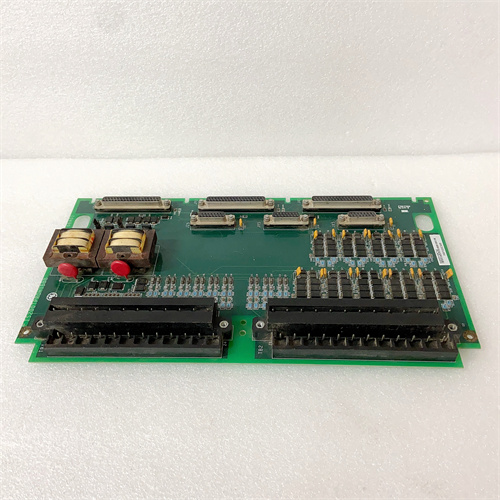
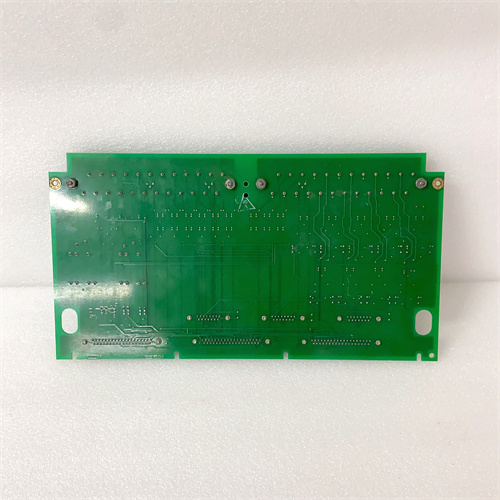
” 1C31234G01
A-B 1756-CNB/E
A-B 1756-OF8


Reviews
There are no reviews yet.