
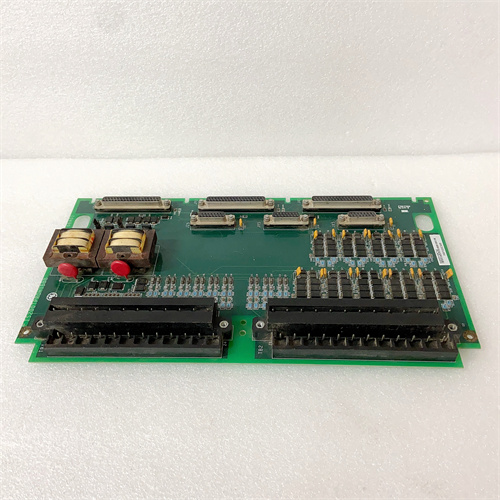
Description
Technical Specifications
| Parameter Category | Specific Specification |
|---|---|
| Manufacturer | General Electric (GE) |
| Product Model | IS200DSPXH2C |
| Series | Mark VI / Speedtronic™ |
| Processor Core | Texas Instruments (TI) TMS320C3x series floating-point DSP, clock speed 40–60 MHz (identical to ‘BEB’ revision) |
| Onboard Memory | 512 KB SRAM + 512 KB Flash (enhanced Flash wear-leveling algorithm in ‘C’ revision) |
| Communication Interfaces | 2× serial RS-485 ports, 1× Ethernet 10Base-T (RJ45), 1× VME backplane bus interface (P1/P2 connectors) |
| I/O Expansion Capability | Supports up to 64 analog/digital channels via backplane bus |
| Power Requirements | +5 V DC / 3.5 A (typical), +12 V DC / 0.5 A (auxiliary) – improved ripple tolerance vs. ‘BEB’ |
| Operating Temperature Range | -30°C to +70°C (extended upper limit compared to ‘BEB’ version) |
| Storage Temperature | -40°C to +85°C |
| Relative Humidity | 5% to 95% (non-condensing) |
| Vibration/Shock Resistance | Complies with IEC 60068-2-6 (5g peak, 10–500 Hz) – upgraded soldering joints for enhanced mechanical durability |
| Dimensions (H × W × D) | 6U VME form factor (233 mm × 160 mm × 20 mm) – physically interchangeable with IS200DSPXH2BEB |
| Firmware Upgrade Method | Online programming via Ethernet or serial port (supports encrypted firmware images for cybersecurity) |
| Redundancy Support | Dual-redundant configuration with automatic failover (compatible with IS200DSPXH2C pairs or mixed with ‘BEB’ in same rack) |
| Revision Changes | ‘C’ revision introduces improved voltage regulator modules (VRMs), upgraded Ethernet PHY, and extended temperature-grade capacitors |
Advantages and Key Features
Enhanced Thermal Performance: The IS200DSPXH2C incorporates redesigned power regulation stages with lower on-resistance MOSFETs and improved heat dissipation through the VME chassis. This allows the board to sustain full computational load at ambient temperatures up to 70°C, making the IS200DSPXH2C particularly suitable for unventilated cabinets or tropical climate installations.
Superior Firmware Security: Unlike earlier revisions, the IS200DSPXH2C supports digitally signed firmware images, preventing unauthorized code execution and protecting against cyber threats targeting turbine control networks. This feature is increasingly critical as power plants adopt edge computing and IoT connectivity.
Backward Compatibility with Enhanced Longevity: The IS200DSPXH2C is a drop-in replacement for IS200DSPXH2BEB and all prior ‘H2’ variants, requiring no changes to termination panels or wiring. However, the ‘C’ revision offers a 20% longer mean time between failures (MTBF) due to upgraded electrolytic capacitors rated for 10,000 hours at 105°C, effectively extending the service life of legacy Mark VI systems without a full control system overhaul.
Deterministic Real-Time Execution: Leveraging the same TI TMS320C3x core, the IS200DSPXH2C maintains sub-millisecond interrupt response and deterministic PID loop closure, critical for fuel valve actuation and turbine overspeed protection. The board’s firmware stack has been optimized in the ‘C’ revision to reduce jitter by approximately 15% compared to ‘BEB’ under identical workload conditions.
Enhanced Diagnostic Telemetry: The IS200DSPXH2C includes additional onboard sensors for die temperature, input voltage sag detection, and clock stability monitoring. These diagnostics are accessible via the Ethernet port using GE’s ToolboxST software, enabling predictive maintenance and reducing unplanned downtime.
Application Fields and Case Studies
Primary Application Fields: Power generation (Frame 6B/7E/9E gas turbines, steam turbine governing, and combined-cycle plant master coordination); Oil and gas (centrifugal compressor anti-surge control, pump station automation, and gas export metering); Marine propulsion (naval and commercial vessel gas turbine engine control); Industrial processes (glass melting furnaces, cement kiln drives, and paper mill turbine-generator sets where precise speed control affects product quality).
Typical Application Case: A 450 MW combined-cycle plant in Southeast Asia experienced frequent ambient temperature excursions above 65°C in their turbine control room due to inadequate HVAC capacity. The legacy IS200DSPXH2BEB boards intermittently triggered overtemperature alarms, forcing load reduction. By replacing them with the IS200DSPXH2C, the plant eliminated these alarms entirely, as the extended 70°C rating provided sufficient margin. Furthermore, the enhanced diagnostic telemetry on the IS200DSPXH2C allowed operators to proactively schedule maintenance based on cumulative thermal stress rather than fixed calendar intervals, improving plant availability from 97.2% to 98.6% over a 12-month period. The new firmware encryption also enabled secure remote firmware updates from the OEM, reducing site visit frequency and associated costs.
Comparison with Competing Products
| Comparison Dimension | IS200DSPXH2C (GE Mark VI) | Competitor A (Siemens T403 Series) | Competitor B (Woodward 505E) | Competitor C (ABB DSI 200) |
|---|---|---|---|---|
| Processor Architecture | TI TMS320C3x Floating-Point DSP | Infineon TriCore Fixed-Point | Motorola 68K Series | ARM Cortex-R4 Floating-Point |
| Maximum Control Cycle | 5 ms (typical) | 20 ms | 40 ms | 8 ms |
| Redundancy Switching Time | < 50 ms | < 200 ms | < 1,000 ms (manual intervention) | < 100 ms |
| Operating Temperature | -30°C to +70°C | -25°C to +55°C | -20°C to +60°C | -25°C to +65°C |
| Firmware Security | Signed encryption + secure boot | Password-protected only | None (legacy) | Signed encryption |
| Online Hot-Swap Capability | Yes | No (requires power-down) | No | Yes |
| MTBF (hours) | > 180,000 | ~100,000 | ~70,000 | ~130,000 |
| Typical Market Price | Premium tier | Mid-tier | Economy tier | Mid-to-high tier |
The IS200DSPXH2C distinguishes itself with the widest temperature range, fastest redundancy switching, and robust cybersecurity features among all competitors. While the ABB DSI 200 offers comparable performance in some metrics, it lacks the extensive field-proven deployment history of the IS200DSPXH2C in heavy-duty gas turbine applications. Siemens T403 integrates better with PROFIBUS plants but falls short in extreme environment tolerance. Woodward 505E remains a cost-effective option for simple steam turbine control but cannot match the IS200DSPXH2C in complex multi-shaft coordination or high-speed data logging requirements.
Selection Recommendations
For new Mark VI system installations where extended ambient temperature resilience is required, the IS200DSPXH2C is the definitive choice over the older ‘BEB’ revision. When performing lifecycle replacement of failed or aging IS200DSPXH2BEB boards, the IS200DSPXH2C offers a straightforward upgrade path with no hardware modifications needed, though a firmware alignment check with the existing ToolboxST version is recommended. For plants operating in harsh environments (desert regions, offshore platforms, or tropical zones with limited air conditioning), the IS200DSPXH2C should be specified as the minimum standard due to its 70°C rating. In cyber-secure power generation facilities, the IS200DSPXH2C is mandatory because of its encrypted firmware and secure boot capabilities, which are absent in all previous ‘H2’ sub-revisions. For combined-cycle plants with both gas and steam turbines, deploying a redundant pair of IS200DSPXH2C boards for each turbine ensures no single-point failure can trigger an unplanned shutdown. Lastly, if your existing Mark VI rack uses a backplane revision earlier than Rev. F, consult GE application engineering to confirm full compatibility with the IS200DSPXH2C, though in practice the board is designed for backward compatibility down to Rev. C.
Precautions and Important Notes
First, always verify the firmware version loaded on the IS200DSPXH2C before installation, as the board may ship with generic factory firmware that does not contain your specific turbine application parameters (e.g., fuel type, generator inertia constant, or grid code settings). Second, when handling the IS200DSPXH2C, use ESD-safe procedures at all times; the upgraded Ethernet PHY and voltage regulators are still susceptible to electrostatic discharge damage exceeding 2 kV. Third, do not mix the IS200DSPXH2C with IS200DSPXH2BEB in the same redundant pair unless both boards are updated to identical firmware revision levels, as mismatched firmware can cause failover synchronization errors. Fourth, ensure the Mark VI chassis power supply provides stable +5 V within ±2% tolerance; the improved ripple tolerance of the IS200DSPXH2C does not excuse poor upstream power conditioning. Fifth, when performing online firmware upgrades on the IS200DSPXH2C, always maintain the standby board in active state before initiating the upgrade on the primary, and never interrupt the process during the bootloader write phase – recovery from a corrupted bootloader requires factory re-flashing. Sixth, operate the IS200DSPXH2C only within its rated humidity range (5–95% non-condensing); condensation on the board surface can create conductive paths and cause unpredictable behavior, despite the conformal coating. Seventh, when storing spare IS200DSPXH2C boards, keep them in original anti-static bags with desiccant, and rotate inventory to ensure no unit remains in storage beyond 24 months without functional testing, as electrolytic capacitors can degrade even in storage. Finally, always maintain a detailed configuration backup (including network settings, PID matrices, and fuel curve tables) separate from the board itself, so that a replacement IS200DSPXH2C can be commissioned quickly without extended engineering rework.
A-B 1756-OF4
Schneider 140CRA31200
AGILENT E8491B
BENTLY 330780-50-00


Reviews
There are no reviews yet.