
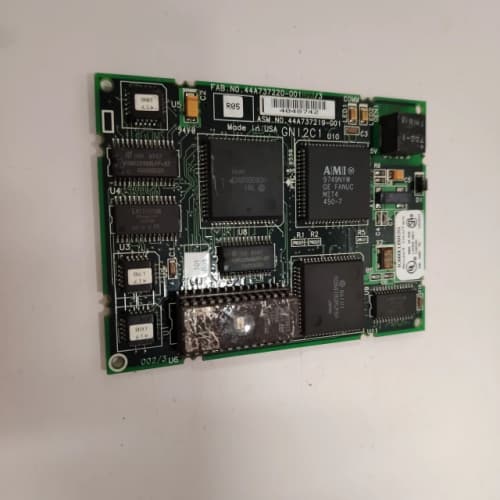
Description
Product Overview and Description
The GE IC660BBD025 is a specialized I/O module from the GE (General Electric, now part of Emerson) Series 90-30 PLC family, specifically designed for the Genius distributed I/O system. This module is a 32-point, 24V DC sinking digital output block. Its primary function is to act as a remote actuator interface, receiving commands from a central Series 90-70 or 90-30 PLC (via a Genius bus controller module) and switching 24V DC power to field devices such as solenoid valves, indicator lamps, relay coils, and motor starters. The GE IC660BBD025 exemplifies the distributed I/O architecture of the Genius system, allowing control signals to be delivered directly to the machine or process area, thereby reducing wiring costs and central cabinet size. The integration of this module into a Genius network provides a reliable and deterministic method for controlling a large number of discrete outputs from a centralized logic solver.
Product Parameters and Specifications
-
Product Type: Genius Distributed I/O Block – 32-Point Sinking Digital Output
-
Manufacturer Part Number (MPN): IC660BBD025
-
Brand: GE (Emerson, formerly GE Fanuc)
-
Series: Series 90-30 Genius I/O
-
I/O Type: 32 points, all configured as sinking digital outputs.
-
Output Specifications:
-
Voltage: 24V DC nominal.
-
Type: Sinking (the module switches the negative/ground side of the load; the positive side is connected to the external +24V DC supply).
-
Current Rating per Point: Typically 0.5A.
-
Maximum Current per Module/Group: A specified total current limit for all points combined.
-
-
Isolation: Group or module-level isolation between the logic/communication side and the field power side.
-
Communication: Interfaces via the Genius serial bus. Requires a Genius bus controller (e.g., IC693BEM331) in the central PLC rack.
-
Field Power Supply: Requires an external, user-supplied 24V DC power source to power the connected loads. This supply is separate from the module’s internal logic power derived from the Genius bus.
-
Status Indicators: LEDs for communication (COMM), power (PWR), and per-point output status (ON).
-
Diagnostics: Provides diagnostic feedback to the PLC via the Genius network for faults such as short circuits or power loss.
-
Mounting: Designed for DIN rail mounting.
-
Termination: Uses removable screw terminal blocks for easy wiring.
Key Advantages and Features
The key advantage of the GE IC660BBD025 is its high point density (32 outputs) in a single, compact block, which maximizes space efficiency in distributed panels. Its integration into the deterministic Genius bus ensures fast, reliable communication with the master PLC, suitable for real-time control. The module’s design simplifies wiring: all commons are typically tied together internally, reducing terminal connections. The clear per-point and module status LEDs enable quick visual diagnostics during operation and troubleshooting. The robust design is suitable for industrial environments, offering good noise immunity. As part of the extensive Genius I/O system, it offers a proven and reliable solution for expanding the output capacity of Series 90-30 and 90-70 PLCs across large facilities.
Application Scenarios and Use Cases
This output block is used in industrial applications requiring a large number of discrete control points close to the actuators. Common use cases include:
-
Material Handling Systems: Controlling solenoid valves for pneumatic diverters, gates, and stops on large conveyor networks.
-
Packaging Machinery: Operating valves, clutches, and actuators on filling and sealing machines.
-
Automated Assembly Lines: Driving actuators, presses, and welding gun controls.
-
Process Skids: Controlling motorized valves and pumps on skid-mounted units in water treatment or chemical injection.
In these scenarios, multiple GE IC660BBD025 blocks might be deployed across a plant, all communicating back to a single central PLC via the single twisted-pair Genius bus cable, dramatically reducing wiring complexity.
Comparison with Competing Products
The GE IC660BBD025 competes with other distributed I/O blocks from manufacturers like Siemens (ET 200L) or Rockwell Automation (Point I/O/ Flex I/O). Its primary differentiator is its use of the proprietary Genius bus protocol, which was a key feature of GE’s PLC systems. Compared to modern Ethernet-based I/O (e.g., PROFINET, EtherNet/IP), the Genius bus is an older, serial technology but offers deterministic performance and a simple, daisy-chain topology. Within the GE ecosystem, it was the standard solution for distributed discrete I/O. For new installations, modern Ethernet I/O is preferred, but the IC660BBD025 remains vital for maintaining and expanding existing Genius-based systems.
Selection Guidelines and Important Notes
Selection Advice:
-
Confirm System Architecture: Ensure you have a Series 90-30 or 90-70 PLC with a Genius bus controller module to communicate with the IC660BBD025.
-
Calculate Load Current: Sum the current draw of all devices to be connected. Ensure the total does not exceed the module’s overall current rating, and that each point’s 0.5A limit is respected. Use interposing relays for higher current loads.
-
Plan Field Power: You must provide a separate, adequately sized 24V DC power supply for the output loads. This supply’s negative terminal connects to the module’s output terminals, and its positive terminal connects directly to the loads.
-
Understand Sinking Logic: Remember this is a sinking output. The wiring topology is: PLC Command ON -> Module internally connects the output terminal to common -> Current flows from the external +24V supply, through the load, into the output terminal, to common, completing the circuit.
Important Precautions:
-
External Fusing: It is essential to protect each output circuit with an appropriately rated external fuse (e.g., 0.75A or 1A). The module itself may not have sufficient built-in protection against short circuits.
-
Flyback Diodes for Inductive Loads: Always connect a flyback diode (1N400x series) across the coils of DC solenoids, relays, or contactors to suppress voltage spikes that can damage the output transistors.
-
Grounding: Properly ground the external 24V DC power supply and the Genius block’s chassis as per the manual to avoid noise issues.
-
Genius Bus Termination: The Genius bus network must be properly terminated at both physical ends with terminating resistors to ensure reliable communication.
-
Address Setting: Each Genius block, including the IC660BBD025, must have a unique hardware address set via the rotary switches on the module. Duplicate addresses will cause bus faults.
-
Do Not Hot-Wire: Avoid connecting or disconnecting field wiring while power is applied to the external 24V DC supply or the Genius bus.
1C31113G05 PLC
DSQC377B
6SL3225-0BE33-0AA0 PLC
8939-HN
TCLLMUX2-32PTMUX PLC
SGDH-30DE-OY PLC
2711P-T6C20D8
2711-T5A5L1 PLC
2711PC-T6C20D PLCDCS


Reviews
There are no reviews yet.