
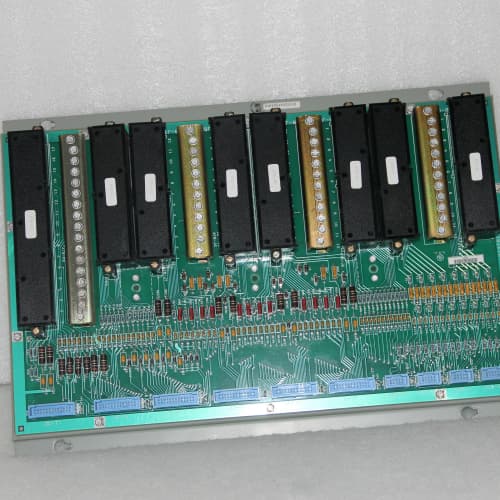
Description
Parameters
| Parameter | Specification |
|---|---|
| Digital Input Channels | 8, optically isolated |
| Digital Output Channels | 8, solid-state (MOSFET/thyristor) |
| Digital Input Voltage | 0–250VAC/VDC (threshold: 24V min for ON) |
| Digital Output Voltage | 24–250VAC/VDC (sourcing or sinking, configurable per channel) |
| Output Current per Channel | 2A continuous; 5A surge (1s) |
| Total Output Current | 8A (max) |
| Serial Ports | 2x RS-232/RS-485 (software selectable, DB9) |
| Serial Baud Rate | 300–115200 bps |
| Serial Protocols | Modbus RTU (master/slave), DNP3 (outstation), GE proprietary (Mark VIe data link) |
| Input Debounce | Programmable: 0.1ms–100ms |
| Input Wetting Current | 5–20mA (programmable per channel) |
| Diagnostics | Open-wire detection, short-circuit detection, over-temperature, communication errors, input state readback |
| Protection | Short-circuit protection (current limit), thermal shutdown (95°C), transient suppression (MOV + TVS) |
| Update Rate | 1ms (digital I/O); 10ms (serial data, typical) |
| Isolation | 2500Vrms (digital I/O to backplane); 1500Vrms (serial ports to backplane); 500VDC (serial to I/O) |
| Power Supply | 5VDC (backplane), 450mA; 24VDC aux (I/O and wetting), 400mA + output load |
| Operating Temp | -40°C to +70°C |
| Mounting | 6U VME Eurocard, 160mm depth |
| Certifications | UL, CSA, ATEX Zone 2, SIL 1 capable |
Advantages & Features
-
Combined Functionality – The GE DS4815COMC replaces a digital I/O module and a serial communication module, saving two rack slots and reducing system cost in applications with limited I/O and device communication needs.
-
High-Voltage Digital I/O – The GE DS4815COMC directly interfaces with 125VDC and 240VAC field circuits, eliminating external relays for most applications.
-
Configurable Serial Protocols – The GE DS4815COMC supports Modbus RTU, DNP3, and GE proprietary protocols, providing flexibility for connecting to gas chromatographs, flow computers, VFDs, or smart instrumentation.
-
Isolation Between I/O and Communication – The GE DS4815COMC provides 500VDC isolation between the serial ports and digital I/O sections, preventing ground loops and noise coupling between field circuits and communication devices.
-
Programmable Input Wetting – Per-channel wetting current (5–20mA) ensures reliable dry contact switching for limit switches and auxiliary contacts.
-
Diagnostic Coverage – Continuous monitoring detects open-load, short-circuit, and communication errors, with fault reporting to the Mark VIe controller within one scan cycle.
Application Cases
-
Turbine Auxiliary System Interface – The GE DS4815COMC communicates with a gas chromatograph via Modbus RTU (RS-485) for fuel gas composition data, while simultaneously monitoring valve position switches and controlling solenoid valves.
-
Compressor Control with VFDs – In a gas compressor station, the GE DS4815COMC reads pressure switch status (8 inputs), controls anti-surge valves (8 outputs), and communicates with two VFDs via Modbus RTU for speed setpoints and feedback.
-
Water Treatment Plant Interface – The GE DS4815COMC monitors pump status, controls chemical dosing valves, and communicates with a flow computer via RS-232 for totalized flow data.
-
Generator Hydrogen Monitoring – The GE DS4815COMC reads hydrogen purity monitor alarms, controls purge valves, and communicates with a hydrogen gas analyzer via Modbus RTU.
Competitor Comparison
| Feature | GE DS4815COMC | Siemens 6ES7151-1AA06 + CP | ABB CI801 + DI/DO | Rockwell 1734-AENT + serial |
|---|---|---|---|---|
| Combined I/O + Serial in 1 slot | Yes | No (separate modules) | No (separate modules) | No (separate modules) |
| Digital Inputs | 8 | 8 (separate) | 8 (separate) | 8 (separate) |
| Digital Outputs | 8 | 8 (separate) | 8 (separate) | 8 (separate) |
| Serial Ports | 2 (RS-232/RS-485) | 1 (via CP) | 1 (via CI) | 1 (via adapter) |
| Protocols | Modbus, DNP3, GE | Modbus, Profibus | Modbus, Profibus | Modbus, EtherNet/IP |
| I/O Voltage Range | 24–250VAC/VDC | 24–240VAC/VDC | 24–250VDC | 24–240VAC/VDC |
| SIL Rating | SIL 1 | SIL 1 | SIL 2 | SIL 1 |
| Slot Count | 1 | 3–4 | 3 | 3–4 |
The GE DS4815COMC is the only module offering combined digital I/O and dual serial communication in a single slot, significantly reducing footprint and wiring complexity in auxiliary system applications.
Selection Suggestions
-
Select the GE DS4815COMC when your application requires modest digital I/O (8 in, 8 out) and one or two serial device connections within a single Mark VIe rack slot. It is ideal for turbine auxiliaries, compressor stations, and small skid interfaces.
-
If you need more than 8 inputs or outputs, use the DS4815CHGA or DS4815CHGB for high-density I/O and add a separate DS3860NPSM or DS3860HUMB for communication.
-
Choose between RS-232 and RS-485 per port via software configuration. RS-232 is recommended for short-distance (<15m) point-to-point connections; RS-485 is preferred for longer distances (up to 1200m) or multi-drop networks.
-
For SIL 2 safety applications, the GE DS4815COMC is not rated SIL 2 — use separate safety-rated modules.
-
Verify the communication protocol of your field device. The GE DS4815COMC supports Modbus RTU (most common) and DNP3 (utility applications).
-
Pair with matching terminal block TB500-HV for digital I/O connections and standard DB9 cables for serial ports.
Precautions
-
Serial Wiring (RS-485) – Use twisted-pair shielded cable with 120Ω termination resistors at both ends of the bus. The GE DS4815COMC includes selectable termination (via software). Set the correct parity, baud rate, and data bits to match the field device.
-
Serial Wiring (RS-232) – Cable length must not exceed 15m. Use proper handshaking lines (RTS/CTS) if required by the field device. Standard 3-wire (TX, RX, GND) is sufficient for most applications.
-
Port Isolation – The serial ports are not isolated from each other — both share a common ground. For fully isolated multi-drop networks, use external isolators.
-
Output Grouping – Unlike the DS4815CHGB, the GE DS4815COMC outputs share a common return. All outputs must be powered from the same voltage source.
-
Output Current Limit – Total output current is limited to 8A (combined across 8 channels). Ensure the total load does not exceed this limit.
-
Wetting Current – For dry contact inputs, enable wetting current (5–20mA) to ensure reliable switching. Set the current high enough to overcome contact oxidation but low enough to avoid contact welding.
-
Mixed Serial Protocols – Both serial ports can run different protocols simultaneously (e.g., Port 1 = Modbus RTU, Port 2 = DNP3), but each port can only support one protocol at a time.
-
Power Supply – The GE DS4815COMC draws 450mA from 5V plus output load current. Ensure the power supply module has sufficient capacity (5V and 24V aux).
-
Firmware – The GE DS4815COMC requires Mark VIe controller firmware v7.5 or higher for full serial protocol support.
-
ESD Handling – Use ESD-safe practices when handling the GE DS4815COMC. Serial ports and output stages are sensitive to electrostatic discharge.
MVI56-MCM
A-B 1746-A10
MFMA452D5V3
EMERSON KJ4001X1-CJ1
.jpg)

Reviews
There are no reviews yet.