
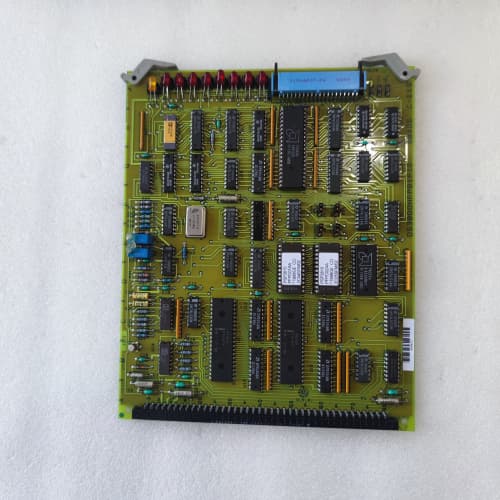
Description
Parameters
| Parameter | Specification |
|---|---|
| Function | Bus master for remote I/O nodes |
| Supported Protocol | GE High-Speed Process Bus (HSPB) |
| Communication Ports | 2x 100BASE-FX (fiber optic, duplex SC connector); 2x RJ45 (copper, 100BASE-TX, for local commissioning) |
| Maximum Nodes | 128 remote I/O nodes per bus segment |
| Bus Redundancy | Dual-ring topology (auto-healing), or dual-star (active/standby) |
| Scan Cycle | Configurable: 1ms, 2ms, 5ms, 10ms (deterministic) |
| Data Throughput | 100Mbps sustained |
| Fiber Optic Distance | Up to 2km (multimode, 62.5/125μm); up to 20km (single-mode, optional) |
| Timestamp Resolution | 1µs (internal); synchronized to master clock |
| Diagnostics | Link status, node health, data integrity (CRC), bus error counters, watchdog timers |
| Node Capacity | Up to 1024 I/O points per node (max 32,000 total points per bus) |
| Redundancy | Supports dual-bus configuration (bumpless failover <1ms) |
| Power Supply | 5VDC (backplane), 800mA; 24VDC aux, 150mA |
| Operating Temp | -40°C to +70°C |
| Mounting | 6U VME Eurocard, 160mm depth |
| Certifications | UL, CSA, ATEX Zone 2, SIL 2 capable |
Advantages & Features
-
High-Speed Deterministic Bus – The GE DS3860HPIB provides a guaranteed 1ms scan cycle, ensuring remote I/O data is available to the Mark VIe controller with predictable latency — critical for turbine control loops.
-
Fiber Optic Noise Immunity – 100BASE-FX fiber ports eliminate electrical noise pickup and ground loops, making the GE DS3860HPIB ideal for high-EMI environments (generator halls, VFD rooms) and long-distance installations.
-
Dual-Ring Auto-Healing Topology – The GE DS3860HPIB supports dual-ring topologies: if a cable break occurs, the ring automatically reconfigures within 50ms, maintaining communication to all nodes without data loss.
-
High Node Capacity – Supports up to 128 remote nodes and 32,000 I/O points per bus segment, enabling large distributed control systems with a single GE DS3860HPIB.
-
Integrated Time-Stamping – All remote I/O data is time-stamped with 1µs resolution when received by the GE DS3860HPIB, enabling precise sequence-of-events logging across distributed racks.
-
Redundant Operation – Two GE DS3860HPIB modules can operate in active/standby configuration; if the primary fails, the backup assumes bus control within <1ms.
Application Cases
-
Distributed Turbine I/O – In a large combined-cycle plant, a GE DS3860HPIB connects a Mark VIe controller to 8 remote I/O racks located near the turbine, HRSG, and generator, reducing cabling costs by 70% compared to hardwired I/O.
-
Offshore Platform I/O Distribution – The GE DS3860HPIB communicates with 16 remote I/O nodes via fiber optic cables (1.5km distance) across an offshore platform, connecting sensors and actuators in explosion-proof zones to a central Mark VIe cabinet.
-
VFD Drive Interface – The GE DS3860HPIB connects to 12 remote VFD I/O nodes via a dual-ring fiber network, providing deterministic 1ms scan for speed control and feedback loops in a multi-drive compressor application.
-
Test Cell Expansion – A gas turbine test cell uses a GE DS3860HPIB to connect 10 remote data acquisition racks (1,200 total channels), streaming high-speed analog data to the Mark VIe controller for real-time performance analysis.
Competitor Comparison
| Feature | GE DS3860HPIB | Siemens IM153-2 (Profibus) | ABB CI862 (Fiber) | Rockwell 1756-CNB2 (ControlNet) |
|---|---|---|---|---|
| Protocol | HSPB (proprietary) | Profibus DP | AF100 (proprietary) | ControlNet |
| Physical Media | Fiber (100BASE-FX) + Copper | Copper (RS-485) | Fiber + Copper | Copper (BNC) |
| Max Distance | 2km (MM), 20km (SM) | 1.2km (with repeaters) | 2km | 1km |
| Max Nodes | 128 | 126 | 64 | 99 |
| Scan Cycle | 1ms deterministic | 10ms typical | 5ms typical | 5–100ms |
| Redundancy | Dual-ring auto-healing | Manual switchover | Manual switchover | Dual-redundant (manual) |
| Time-stamping | 1µs | Not supported | 1ms | 10ms |
| SIL Rating | SIL 2 | SIL 1 | SIL 2 | SIL 1 |
| Fiber Option | Built-in (standard) | External converter required | Built-in | External converter required |
The GE DS3860HPIB offers the fastest deterministic scan (1ms), longest fiber distance (20km), and dual-ring auto-healing redundancy — features not matched by Siemens, ABB, or Rockwell solutions.
Selection Suggestions
-
Choose the GE DS3860HPIB when you need to connect remote I/O racks to a Mark VIe controller with deterministic high-speed scanning (1ms) and noise-immune fiber optic links.
-
If your remote I/O distance is <100m and EMI is not a concern, the copper-only DS3860HPIB-C variant offers lower cost. The GE DS3860HPIB with fiber is recommended for all new installations.
-
For systems with >128 nodes, use multiple GE DS3860HPIB modules on separate bus segments. Each Mark VIe rack can host up to 2 HPIB modules.
-
For SIL 2 safety applications, configure two GE DS3860HPIB modules in active/standby redundancy with automatic bumpless transfer.
-
Ensure all remote nodes support the HSPB protocol. Third-party remote I/O may require a protocol converter (e.g., Modbus to HSPB gateway).
-
Pair the GE DS3860HPIB with fiber optic cables (62.5/125μm multimode for distances <2km; single-mode for >2km) and ST or SC connectors as specified.
Precautions
-
Fiber Optic Cable Handling – Fiber cables are fragile. Do not bend below the manufacturer’s minimum bend radius (typically 30mm). Use cable management trays and avoid sharp edges. Keep connectors clean using lint-free wipes and isopropyl alcohol.
-
Cable Loss Budget – The GE DS3860HPIB transmit power is -5dBm (MM) and 0dBm (SM); receiver sensitivity is -20dBm. Ensure total cable loss (including connectors and splices) is <15dB for multimode and <20dB for single-mode.
-
Ring Topology Break Recovery – In dual-ring mode, the GE DS3860HPIB detects breaks and reconfigures within 50ms. However, transient communication interruptions may occur — design control logic to tolerate 1–2 missed scans.
-
Bus Node Addressing – Each remote node must have a unique address (1–128). Do not duplicate addresses on the GE DS3860HPIB bus. Use the configuration tool to verify address assignments before commissioning.
-
Termination – In star or daisy-chain topologies, terminate unused fiber ports with dust caps only — no electrical termination is required for fiber. For copper ports, use 100Ω termination only if specified.
-
Redundancy Mode – In active/standby configuration, both GE DS3860HPIB modules must have identical firmware and configuration. Test failover during commissioning by physically disconnecting the active module’s fiber link.
-
Power Supply Capacity – The GE DS3860HPIB draws 800mA from 5V — among the highest in the Mark VIe family. Ensure total 5V current across all modules does not exceed the power supply rating (5A for DS3820EPSA).
-
Bus Loading – With 128 nodes and maximum data throughput, the GE DS3860HPIB bus utilization may exceed 80%. Monitor bus utilization via diagnostics and reduce non-critical data updates to maintain margin.
-
Firmware Version – The GE DS3860HPIB firmware must match the Mark VIe controller firmware version. A mismatch will cause “Module Mismatch” errors and prevent bus scanning.
-
Calibration – The GE DS3860HPIB does not require field calibration. However, periodic testing of the fiber link (e.g., using an optical power meter) is recommended every 12 months to detect connector contamination or cable degradation.
-
ESD Handling – The front-panel fiber connectors and copper ports are ESD-sensitive. Use ESD-safe practices when handling the GE DS3860HPIB outside the rack.
A-B 1747-BA
A-B 1756-TBCH
MVI56-MCM

Reviews
There are no reviews yet.