
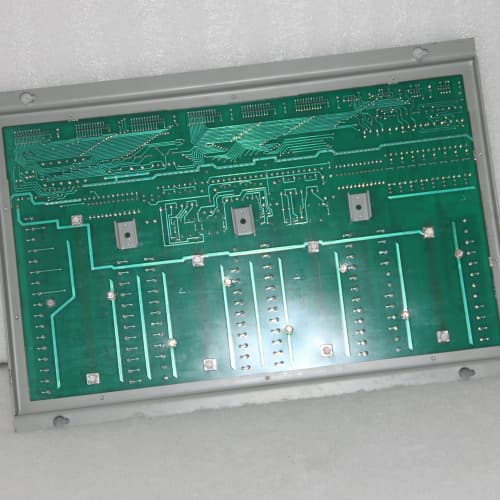
Description
Parameters
| Parameter | Specification |
|---|---|
| Communication Ports | 2x 10/100/1000BASE-T Ethernet (RJ45); 2x RS-232/485 (DB9); 1x CAN 2.0B (DB9) |
| Protocols Supported | Modbus TCP (client/server), Modbus RTU (master/slave), Profibus DP (master), CANopen (master), OPC UA (server/client), DNP3, IEC 61850 |
| Data Points | Up to 2000 (read/write configurable) |
| Update Rate | Configurable: 10ms–60s per data group |
| Ethernet Redundancy | Dual ports with PRP (Parallel Redundancy Protocol) or RSTP (Rapid Spanning Tree) |
| Serial Baud Rate | 300–115200 bps (auto-detect) |
| Protocol Conversion | Any-to-any mapping (e.g., Modbus to OPC UA) |
| Security | HTTPS, TLS 1.2, SNMPv3, user authentication, access control lists |
| Diagnostics | Link status, protocol errors, data integrity checks, watchdog timers |
| Memory | 512MB SDRAM, 128MB Flash (configuration storage) |
| Power Supply | 5VDC (backplane), 1.5A; 24VDC aux, 200mA |
| Operating Temp | -40°C to +70°C |
| Mounting | 6U VME Eurocard, 160mm depth |
| Certifications | UL, CSA, ATEX Zone 2, CE, DNV GL |
Advantages & Features
-
Multi-Protocol Gateway – The GE DS38600HUMB eliminates the need for separate protocol converters, reducing cabinet space, wiring, and cost. A single module handles communication with DCS (Modbus TCP), VFDs (Profibus), and I/O devices (CANopen) simultaneously.
-
High Data Capacity – With support for 2000 data points, the GE DS38600HUMB can handle entire turbine control systems, mapping all critical parameters to plant SCADA without overloading the Mark VIe controller.
-
Redundant Communication – Dual Ethernet ports with PRP/RSTP ensure the GE DS38600HUMB maintains connectivity even if one network path fails, critical for remote monitoring and dispatch.
-
OPC UA Native Support – The GE DS38600HUMB acts as an OPC UA server, providing secure, standardized data access to plant management systems without requiring additional middleware.
-
Configurable Data Mapping – The GE DS38600HUMB allows flexible mapping between Mark VIe internal data tags and external protocol addresses, enabling seamless integration with legacy systems.
-
Cybersecurity Ready – TLS encryption, user authentication, and access control lists protect the GE DS38600HUMB from unauthorized access, meeting NERC CIP requirements for power plant networks.
Application Cases
-
Plant DCS Integration – The GE DS38600HUMB connects a Mark VIe turbine control system to a Honeywell DCS via Modbus TCP, mapping 500 turbine parameters (speed, temperature, vibration, valve positions) for centralized monitoring.
-
Remote SCADA Communication – In an offshore platform, the GE DS38600HUMB uses OPC UA to transmit turbine data to onshore SCADA via satellite link, with PRP redundancy ensuring continuous operation during network switches.
-
VFD Control Interface – The GE DS38600HUMB communicates with 12 variable-frequency drives via Profibus DP, sending speed setpoints and receiving feedback signals, all coordinated through the Mark VIe controller.
-
Third-Party Sensor Integration – CANopen-connected condition monitoring sensors send vibration and temperature data to the Mark VIe controller through the GE DS38600HUMB, eliminating the need for separate I/O modules.
Competitor Comparison
| Feature | GE DS38600HUMB | Siemens 6ES7158-0AD01 | ABB CI855 | Rockwell 1756-EN2T |
|---|---|---|---|---|
| Protocols | 6+ (Modbus, Profibus, CANopen, OPC UA, etc.) | 2-3 (Profibus, Modbus) | 2-3 (Modbus, Profibus) | 2 (EtherNet/IP, Modbus) |
| Ethernet Ports | 2 (redundant) | 2 (redundant) | 2 (redundant) | 2 (redundant) |
| Serial Ports | 2 (RS-232/485) | 1 (RS-485) | 1 (RS-485) | 0 |
| CAN Support | Yes | No | No | No |
| OPC UA | Yes (server/client) | No | No | No |
| Data Points | 2000 | 500 | 1000 | 500 |
| Security | TLS 1.2, SNMPv3, ACL | TLS 1.0 | TLS 1.0 | TLS 1.2 |
| DNV GL Marine | Yes | Optional | Yes | No |
The GE DS38600HUMB offers the broadest protocol support and highest data capacity, with unique CAN and OPC UA capabilities that competitors lack. It is the most versatile bus interface module in its class.
Selection Suggestions
-
Select the GE DS38600HUMB if your Mark VIe system needs to communicate with multiple fieldbus protocols (e.g., Modbus to DCS, Profibus to drives, CANopen to sensors) using a single module.
-
If you only need Modbus TCP communication, consider the lower-cost DS38600MB variant — the GE DS38600HUMB is over-specified for simple Modbus-only applications.
-
Verify the data point count: 2000 points is sufficient for most turbine control systems. For very large systems (>2000 points), use multiple GE DS38600HUMB modules or configure data filtering to reduce the number of mapped points.
-
For cybersecurity-sensitive installations, enable TLS encryption and configure access control lists on the GE DS38600HUMB to restrict access to authorized IP addresses only.
-
Ensure the Mark VIe controller firmware is v7.0 or higher for full protocol support.
-
For marine applications, order the GE DS38600HUMB with DNV GL certification (standard on this model).
Precautions
-
Network Segmentation – Place the GE DS38600HUMB on a dedicated control network segment, separate from office IT networks, to prevent unauthorized access and reduce network congestion.
-
Firewall Configuration – If the GE DS38600HUMB communicates across firewalls, ensure ports are open for the required protocols (Modbus TCP: 502; OPC UA: 4840; Profinet: 34962–34964). Consult the GE communication guide for complete port lists.
-
Serial Wiring – For RS-485 connections, use twisted-pair shielded cable with termination resistors (120Ω) at both ends. The GE DS38600HUMB provides selectable termination via DIP switches. For RS-232, cable length must not exceed 15m.
-
CAN Bus Termination – For CANopen, terminate the bus with 120Ω resistors at both ends of the cable. The GE DS38600HUMB includes built-in termination that can be enabled via software.
-
Protocol Conflict – Do not configure the GE DS38600HUMB to run both Modbus and Profibus on the same physical port — each protocol requires dedicated hardware or port assignment. The module’s two Ethernet ports and two serial ports can run different protocols simultaneously, but each port is limited to one active protocol at a time.
-
Data Mapping Complexity – Plan the data mapping carefully. The GE DS38600HUMB supports up to 2000 points, but each point must be individually configured. Use GE’s configuration tool (Toolbox) to import/export CSV templates for large systems.
-
Firmware Updates – The GE DS38600HUMB firmware can be updated via the Ethernet port. Always backup the current configuration before updating, as some updates may reset the data mapping to default.
-
CPU Load – High-frequency polling (e.g., 10ms updates for 2000 points) may increase the GE DS38600HUMB CPU utilization above 80%. Monitor CPU load via diagnostics and reduce update frequency for non-critical data to maintain margin.
-
Power Supply – The GE DS38600HUMB draws 1.5A from 5V backplane. Ensure the power supply module (e.g., DS3820EPSA) has sufficient 5V capacity for all modules in the rack — total 5V current must not exceed 5A. High-power modules like the GE DS38600HUMB may require derating in high-temperature environments
A-B 1747CPUԿ
A-B 1747-L542ϵ и ӣ ͷ
A-B 1756-L61ϵ и




Reviews
There are no reviews yet.