
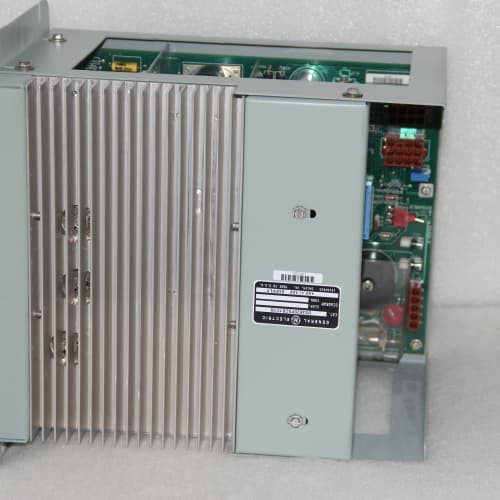
Description
Parameters
| Parameter | Specification |
|---|---|
| Input Channels | 3, differential RTD inputs |
| Supported Sensors | Pt100 (α=0.00385/0.00392), Pt1000, Ni100, Ni120, Cu10 |
| Wiring Configuration | 2-wire, 3-wire, or 4-wire (software selectable per channel) |
| Temperature Range | -200°C to +850°C (Pt100) |
| ADC Resolution | 24-bit Sigma-Delta |
| Accuracy | ±0.1°C at 0°C (4-wire); ±0.15°C (3-wire); ±0.3°C (2-wire) |
| Excitation Current | 0.5mA, 1mA, 2mA (programmable per channel) |
| Lead-Wire Compensation | Automatic (3-wire/4-wire) |
| Sample Rate | 10Hz–100Hz (software selectable) |
| Input Protection | ±30V continuous, ESD protection (15kV) |
| Diagnostics | Open-circuit detection, short-circuit detection, out-of-range, excitation current monitor |
| Isolation | 1500Vrms channel-to-backplane; 500VDC channel-to-channel |
| Power Supply | 5VDC (backplane), 200mA; 24VDC aux, 50mA |
| Operating Temp | -40°C to +70°C |
| Mounting | 6U VME Eurocard, 160mm depth |
| Certifications | UL, CSA, ATEX Zone 2, SIL 2 capable |
Advantages & Features
-
High Precision – The GE DS3845LT3 provides 24-bit resolution and ±0.1°C accuracy, making it suitable for turbine bearing temperature monitoring where a few degrees of error can trigger nuisance trips or miss critical overtemperature events.
-
3-Wire/4-Wire Support – Automatic lead-wire resistance compensation eliminates measurement errors caused by long cable runs (up to 300m) and temperature-induced resistance changes in the wiring. The GE DS3845LT3 calculates and compensates for lead resistance on each channel independently.
-
Flexible Sensor Support – The GE DS3845LT3 supports multiple RTD types, allowing mixed sensor types (Pt100 and Pt1000) on different channels of the same module.
-
Cryogenic Optimization – The -LT3 variant includes enhanced linearization for temperatures below -100°C, making it the preferred choice for LNG compressor bearing monitoring and cryogenic pump applications.
-
Comprehensive Diagnostics – Continuous open/short detection and out-of-range alarms ensure faulty sensors are identified before causing process upsets. The GE DS3845LT3 also monitors excitation current to detect partial wiring faults.
-
Fast Update Option – Configurable scan rates down to 10ms (100Hz) allow the GE DS3845LT3 to be used in fast temperature monitoring loops, such as gas turbine exhaust temperature tracking.
Application Cases
-
Turbine Bearing Metal Temperature – A single GE DS3845LT3 monitors three journal bearing temperatures in a steam turbine (Pt100, 3-wire), providing high-accuracy data for thermal growth calculation and vibration compensation.
-
Generator Stator Winding Temperature – Monitors three RTD sensors embedded in the generator stator coils, with the GE DS3845LT3 detecting over-temperature conditions that could lead to insulation failure.
-
Gas Turbine Inlet Air Temperature – The GE DS3845LT3 measures inlet air temperature using Pt1000 RTDs, providing the controller with accurate data for combustion optimization and IGV scheduling.
-
Compressor Discharge Temperature – In LNG pipeline compressors, the GE DS3845LT3 monitors discharge temperatures with 4-wire Pt100 sensors, achieving ±0.1°C accuracy for efficient surge control.
Competitor Comparison
| Feature | GE DS3845LT3 | Siemens 6ES7331-7PF01 | ABB AI810 (RTD) | Rockwell 1756-IT6I |
|---|---|---|---|---|
| Channels | 3 (RTD only) | 8 (mixed TC/RTD) | 8 (mixed) | 6 (TC only) |
| RTD Types | Pt100, Pt1000, Ni, Cu | Pt100, Ni | Pt100, Ni | Pt100 (external) |
| Accuracy (Pt100) | ±0.1°C | ±0.2°C | ±0.15°C | ±0.2°C |
| Lead-Wire Comp | 2/3/4-wire auto | 2/3-wire auto | 3/4-wire auto | 2-wire only |
| Excitation Current | Programmable | Fixed (1mA) | Programmable | Fixed |
| Scan Rate | 10ms–1s | 50ms–1s | 20ms–1s | 100ms–1s |
| Cryogenic Support | Yes (to -200°C) | No (limited -100°C) | No (limited -100°C) | No |
| SIL Rating | SIL 2 | SIL 1 | SIL 2 | SIL 1 |
| Isolation | 1500V | 500V | 2500V | 500V |
The GE DS3845LT3 offers superior accuracy (±0.1°C) and cryogenic capability compared to competitors. Siemens and Rockwell have lower accuracy and limited RTD support; ABB offers SIL 2 but lacks cryogenic optimization.
Selection Suggestions
-
Choose the GE DS3845LT3 for 3 critical RTD temperature points where high accuracy (±0.1°C) and cryogenic capability are required. For more than 3 RTD channels, use multiple GE DS3845LT3 modules or consider the DS3845LT8 variant (8-channel).
-
Select the 4-wire configuration for maximum accuracy (±0.1°C) over long cable runs (>50m). Use 3-wire for standard installations (accuracy ±0.15°C). Avoid 2-wire unless the cable is very short (<5m) and accuracy is less critical.
-
Verify your RTD type before ordering. The GE DS3845LT3 supports most common types, but custom sensor curves (e.g., special Ni alloys) require factory configuration.
-
For SIL 2 safety loops, the GE DS3845LT3 can be used with external voting logic (e.g., 2-out-of-3) and periodic proof-testing.
-
Pair with matching terminal block TB300-RTD (with dedicated RTD connections) for reliable field wiring.
Precautions
-
Lead-Wire Selection – Use twisted-pair shielded cable with low resistance (<0.1Ω/m) for 3-wire/4-wire connections. For 3-wire, all three leads must have identical resistance (match within 0.1Ω) for proper compensation. The GE DS3845LT3 cannot compensate for unequal lead resistance.
-
Shield Grounding – Connect the cable shield to the module’s common terminal at the module end only. Grounding both ends creates ground loops and injects 50/60Hz noise into the measurement.
-
Excitation Current Self-Heating – Higher excitation current (2mA) reduces noise but causes self-heating in the RTD. For small RTDs, use 0.5mA to keep self-heating below 0.05°C. The GE DS3845LT3 allows per-channel current selection.
-
Cable Capacitance – Long cables (>100m) with high capacitance can cause settling time errors. The GE DS3845LT3 includes a programmable settling delay (10–100ms) to compensate — increase settling time for long cable runs.
-
Sensor Type Consistency – Do not mix 2-wire, 3-wire, and 4-wire RTDs on the same GE DS3845LT3 if scanning at high speed (>50Hz), as different settling requirements may cause crosstalk. Configure all channels with the same wiring type for best performance.
-
Input Overvoltage – The GE DS3845LT3 is protected to ±30V, but accidental connection of 24V DC to the RTD input will not damage the module but may saturate the input for several seconds. Install fuses or current limiters if accidental contact is likely in the field.
-
Calibration Interval – Factory calibration is valid for 24 months. For ISO 17025 compliance, recalibrate the GE DS3845LT3 using a precision decade box (0.1% accuracy) and follow GE service procedure GET-12345. Field calibration of the GE DS3845LT3 requires a certified temperature simulator.
-
RTD Break Detection – The GE DS3845LT3 detects open-circuit by forcing a small current and measuring the resulting voltage. This diagnostic works even during normal measurement but may report false open-circuit if the RTD lead resistance exceeds 100Ω. For very long cables, increase the open-circuit threshold via software.
-
Ambient Temperature Effect – The GE DS3845LT3 has a built-in temperature sensor for reference junction compensation. Ensure the module is installed away from heat sources (power supplies, high-power output modules) to avoid thermal gradient errors.
A-B 1746-IB32/OB32
A-B 1747-BA
A-B 1746-NI8ϵ и


Reviews
There are no reviews yet.