
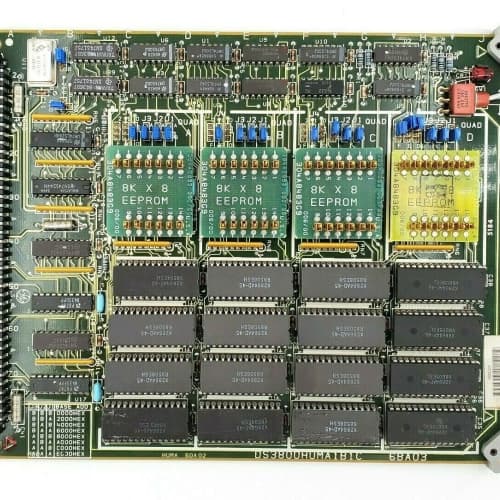
Description
Key Parameters
-
Channels: 4 isolated analog inputs
-
Sensor Type: NTC thermistor (10kΩ, 100kΩ, custom curves) or PTC thermistor (silicon, platinum‑based) – software‑configurable per channel
-
Resolution: 24‑bit ADC
-
Accuracy: ±0.05°C (25°C); ±0.25°C over –40°C to +85°C
-
Excitation Current: Software‑selectable 0.1 mA, 0.5 mA, 1 mA (per channel)
-
Measurement Range: –40°C to +150°C (depending on thermistor type)
-
Linearization: Built‑in (Steinhart‑Hart equation) – provides direct temperature readout in °C or °F
-
Custom Sensor Support: User‑programmable R‑T curves (up to 64 points per channel)
-
EMC/Noise Rejection: Enhanced CMRR > 120 dB, built‑in 50/60 Hz digital filtering
-
Diagnostics: Open‑circuit detection, short‑circuit detection, over‑range/under‑range, signal‑loss detection, per‑channel LED status
-
Isolation: 1500 V RMS (field‑to‑backplane); 500 V RMS between channels (per‑channel isolation)
-
Sampling Rate: Up to 50 Hz per channel (with 50/60 Hz noise rejection)
-
Terminal Type: Screw‑type – per suffix “A”
-
Operating Temperature: –40°C to +85°C (extended range)
-
Power: 24 V DC backplane power, ≤4 W (plus external field supply)
Advantages
-
Extended temperature range – operates reliably in extreme ambient conditions (up to +85°C); ideal for outdoor, desert, or unheated enclosures.
-
Enhanced EMI protection – CMRR > 120 dB; ideal for installations near VFDs, inverters, and high‑power switching equipment.
-
Direct thermistor support – eliminates external signal conditioners; reduces panel space and cost.
-
Built‑in linearization – Steinhart‑Hart equation provides direct temperature readout; no scaling required.
-
Custom sensor curves – supports user‑programmable R‑T curves for custom thermistors.
-
24‑bit resolution – provides superior measurement fidelity.
-
Per‑channel isolation – 500 V between channels; prevents ground loops and cross‑channel interference.
-
Software‑configurable per channel – sensor type and excitation current independently settable.
-
Open/short detection – detects broken wires or sensor shorts instantly.
-
Enhanced diagnostics – includes signal‑loss detection for proactive maintenance.
-
Hot‑swappable – replace without rack power‑down.
-
Wide measurement range – –40°C to +150°C covers most HVAC, medical, and automotive applications.
Applications
-
Oil & gas – pipeline and compressor temperature monitoring with thermistors in desert or arctic locations
-
Outdoor power substations – transformer and busbar temperature monitoring in direct sunlight or extreme cold
-
Steel mills & foundries – motor winding and bearing temperature monitoring near high‑heat zones
-
Wind turbines – nacelle and gearbox temperature monitoring with extended temperature rating
-
Marine & offshore – engine room temperature monitoring in high‑temperature environments
-
HVAC systems – duct, return air, and room temperature monitoring with NTC thermistors
-
Automotive – battery pack and motor temperature monitoring under hood
-
Laboratory equipment – environmental chambers and incubators
Competitor Comparison
| Feature | DS3820STCA | DS3820STBB1A1A (Spring, Standard Temp) | External Thermistor Amplifier + AI Module |
|---|---|---|---|
| Channels | 4 | 4 | 1 per amplifier |
| Operating Temp | –40°C to +85°C | –40°C to +70°C | –25°C to +70°C |
| EMC Protection | Enhanced (CMRR > 120 dB) | Standard | Basic |
| Sensor Direct | Yes | Yes | No |
| Built‑in Linearization | Yes (Steinhart‑Hart) | Yes | External |
| Custom Sensor Support | Yes (user‑programmable) | Yes | No |
| Resolution | 24‑bit | 24‑bit | 16‑bit |
| Terminal Type | Screw‑type | Spring‑clamp | Screw‑type |
| Cost per channel | Low | Low | High |
The DS3820STCA is the extended‑temperature, EMI‑hardened thermistor input module – offering four channels with built‑in linearization, custom sensor curve support, and per‑channel isolation, rated for operation up to +85°C. Compared to the spring‑clamp DS3820STBB1A1A, it offers a wider operating range and superior EMI protection – critical for harsh industrial environments – with traditional screw‑terminal wiring. Against external thermistor amplifiers, it saves significant panel space, reduces wiring, and lowers total installed cost. For thermistor‑based temperature monitoring in extreme temperatures and high‑EMI environments, the DS3820STCA delivers the most rugged and reliable solution.
Selection Tips
-
Choose DS3820STCA when you need to measure thermistor temperature sensors (NTC or PTC) with high precision, direct temperature readout, enhanced EMI protection, and extended temperature operation (–40°C to +85°C).
-
Ideal for oil & gas, outdoor substations, steel mills, wind turbines, marine, and automotive applications.
-
Verify the thermistor type (NTC or PTC) and nominal resistance (10kΩ, 100kΩ, etc.) – software‑configurable per channel.
-
For custom thermistors, use the user‑programmable R‑T curve feature – supports up to 64 points per channel.
-
Note the slight accuracy reduction at extreme temperatures (±0.25°C vs ±0.2°C for standard range) – a trade‑off for extended operation.
-
For 2‑wire sensors, lead resistance adds error – use short leads or calibrate to compensate.
-
Not suitable for RTDs or thermocouples – use dedicated modules for those sensor types.
-
Ensure your PLC/DCS can handle the temperature data format from DS3820STCA.
Precautions
-
Temperature derating: At sustained +85°C ambient, ensure adequate airflow – the DS3820STCA dissipates up to 4 W and may require forced cooling in dense racks.
-
Lead resistance: Thermistors are typically 2‑wire; lead resistance directly adds error – keep leads as short as possible or calibrate to compensate.
-
Excitation current: Higher currents (1 mA) produce self‑heating errors – use 0.1 mA or 0.5 mA for sensitive thermistors.
-
Custom curve programming: When programming custom R‑T curves, ensure accurate data points (minimum 16 points recommended for ±0.1°C accuracy).
-
Wiring: Use shielded twisted‑pair cables; ground shield at module end only. Enhanced EMI protection requires proper grounding to achieve >120 dB CMRR.
-
Sensor type selection: Each channel must be configured for NTC or PTC – ensure correct selection before operation.
-
Signal‑loss detection: Requires minimum sensor impedance – very low‑impedance sensors may not trigger detection.
-
Power sequencing: Apply backplane power before field power.
-
Calibration: Perform periodic calibration using precision resistors or calibrated thermistors – extended temperature operation may accelerate drift.
-
Spare: Keep one spare DS3820STCA for critical thermistor loops – the extended‑temperature variant may have longer lead times.
A-B 1747-L542ϵ и һ
TRICONEX 3721ά
TRICONEX 3503Eά
.jpg)


Reviews
There are no reviews yet.