
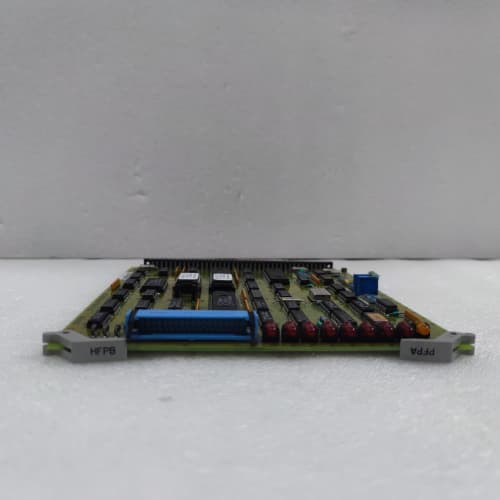
Description
Key Parameters
-
Channels: 4 isolated analog inputs
-
Sensor Type: Pt100 (2‑wire, 3‑wire, or 4‑wire – software‑configurable per channel)
-
Resolution: 24‑bit ADC
-
Accuracy: ±0.05°C (Pt100, 25°C); ±0.2°C over –40°C to +70°C
-
Excitation Current: Software‑selectable 0.1 mA, 0.5 mA, 1 mA (per channel)
-
Excitation Power: Line‑powered (AC/DC wide‑range input, 85–265 V AC or 110–300 V DC) – eliminates need for separate 24 V DC field supply for sensors
-
Lead Resistance Compensation: Automatic for 3‑wire and 4‑wire configurations
-
Measurement Range: –200°C to +850°C
-
Sampling Rate: Up to 50 Hz per channel (with 50/60 Hz noise rejection)
-
Diagnostics: Open‑circuit detection, short‑circuit detection, over‑range/under‑range, signal‑loss detection, per‑channel LED status
-
Isolation: 1500 V RMS (field‑to‑backplane); 500 V RMS between channels (per‑channel isolation)
-
Terminal Type: Spring‑clamp (tool‑free, vibration‑resistant) – per suffix “B1A”
-
Power: 85–265 V AC / 110–300 V DC (internal power supply) – consumes ≤6 W
-
Operating Temperature: –40°C to +70°C
Advantages
-
Pre‑configured – fixed terminal configuration; reduces setup time and engineering effort.
-
Spring‑clamp terminals – tool‑free push‑in wiring; reduces installation time; highly resistant to vibration loosening – critical for transportation, marine, and heavy industrial applications.
-
Line‑powered excitation – directly powered from AC/DC mains; eliminates the need for a dedicated 24 V DC field supply for sensors, simplifying wiring and reducing panel cost.
-
Long‑distance capability – line‑powered excitation provides stable drive current unaffected by cable voltage drop; ideal for sensors located far from the control panel.
-
Premium accuracy – ±0.05°C; high precision for demanding applications.
-
24‑bit resolution – provides superior measurement fidelity.
-
Per‑channel isolation – 500 V between channels; prevents ground loops and cross‑channel interference.
-
Automatic lead compensation – for 3‑wire/4‑wire RTDs, cancels lead resistance errors for accurate temperature readings.
-
Software‑configurable per channel – wire configuration and excitation current independently settable.
-
Built‑in linearization – provides direct temperature readout in °C or °F; no scaling required.
-
Enhanced diagnostics – includes signal‑loss detection for proactive maintenance.
-
Open/short detection – detects broken wires or sensor shorts instantly.
-
Hot‑swappable – replace without rack power‑down.
-
Wide measurement range – –200°C to +850°C covers most industrial applications.
Applications
-
Transportation & rail – remote bearing and motor temperature monitoring with vibration‑resistant wiring
-
Marine & offshore – engine room and deck temperature monitoring with long cable runs and spring‑clamp terminals
-
Oil & gas – wellhead and pipeline temperature monitoring with long cable runs in remote locations
-
Water/wastewater – remote pump station and lift station temperature monitoring
-
Mining – remote equipment temperature monitoring in high‑vibration environments
-
Power generation – substation and transformer temperature monitoring
-
HVAC – building‑wide temperature monitoring with distributed sensors
-
Chemical processing – tank and vessel temperature monitoring in large plants
Competitor Comparison
| Feature | DS3820PSLB1A | DS3820PSLB (Configurable Spring Line‑Powered) | Standard Pt100 Module (16‑bit, 10 Hz, 24 V) |
|---|---|---|---|
| Channels | 4 | 4 | 4 |
| Resolution | 24‑bit | 24‑bit | 16‑bit |
| Accuracy | ±0.05°C | ±0.05°C | ±0.1°C |
| Max Sampling Rate | 50 Hz | 50 Hz | 10 Hz |
| Excitation Power | Line‑powered (AC/DC) | Line‑powered | 24 V DC only |
| Terminal Type | Spring‑clamp | Spring‑clamp | Screw‑type |
| Vibration Resistance | High | High | Medium |
| Configuration | Fixed (suffix) | Software‑configurable | Software‑configurable |
| Setup Time | Instant | Moderate | Moderate |
| Cost | High | High | Low |
The DS3820PSLB1A is the fixed‑configuration, spring‑clamp, line‑powered Pt100 input module for long‑distance applications in high‑vibration environments. Compared to the configurable DS3820PSLB, it offers plug‑and‑play simplicity while maintaining the same line‑powered excitation, ±0.05°C accuracy, and 50 Hz sampling. Against standard 24 V‑powered Pt100 modules, it eliminates the need for a separate field supply, maintains stable excitation over long cable runs, and adds vibration‑resistant wiring. For remote temperature monitoring in large facilities with distributed sensors and significant vibration, the DS3820PSLB1A delivers the most reliable, robust, and deployment‑ready solution.
Selection Tips
-
Choose DS3820PSLB1A when your Pt100 sensors are located far from the control panel (long cable runs) OR when a separate 24 V DC field supply is unavailable, combined with vibration‑resistant spring‑clamp wiring and plug‑and‑play simplicity.
-
Ideal for pipeline monitoring, remote tanks, outdoor installations, transportation, marine, and mining applications.
-
Verify the wire configuration (2‑wire, 3‑wire, or 4‑wire) – software‑configurable per channel.
-
Confirm spring‑clamp terminals accept your wire gauge (typically 0.2–2.5 mm² / 24–14 AWG) and consider using ferrules for stranded wire.
-
Confirm the terminal configuration (1A) matches your panel wiring requirements.
-
For 2‑wire sensors, lead resistance adds error – use 3‑wire or 4‑wire for accurate measurements.
-
Not suitable for Pt1000, Ni RTDs, or thermocouples – use dedicated modules.
-
Ensure your PLC/DCS can handle the data format from DS3820PSLB1A.
Precautions
-
Wire preparation: Use only solid or stranded wire with proper ferrule termination – bare stranded wire may not make reliable contact in spring‑clamp terminals.
-
Wire insertion: Insert wire fully into the spring‑clamp opening until it stops; pull gently to verify secure connection.
-
Line power connection: The DS3820PSLB1A requires 85–265 V AC or 110–300 V DC mains power – ensure proper fuse and overcurrent protection on the supply line.
-
Power consumption: The module consumes up to 6 W; ensure adequate cooling in dense racks.
-
Lead resistance: For 2‑wire sensors, lead resistance directly adds error – use 3‑wire or 4‑wire for accurate measurements. The DS3820PSLB1A compensates for 3‑wire/4‑wire automatically.
-
Excitation current: Higher currents (1 mA) produce self‑heating errors in small Pt100 elements – use 0.1 mA or 0.5 mA for sensitive sensors.
-
Wiring: Use shielded twisted‑pair cables; ground shield at module end only. For 4‑wire, use separate pairs for excitation and sense leads.
-
Signal‑loss detection: Requires minimum sensor impedance – very low‑impedance sensors may not trigger detection.
-
Power sequencing: Apply mains power before backplane power to avoid power‑up transients.
-
Calibration: Perform periodic calibration using precision resistors to maintain accuracy.
-
Spare: Keep one spare DS3820PSLB1A for critical remote temperature loops – the fixed configuration is typically stocked for quick replacement. Also stock replacement ferrules for spring‑clamp terminals.
BENTLY 288055-01
A-B 1756-DNB
SCHNEIDER 140ϵ еĸ

Reviews
There are no reviews yet.