
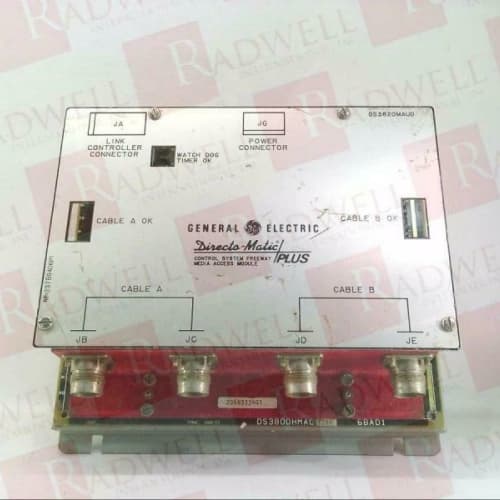
Description
Key Parameters
-
Channels: 4 differential analog inputs
-
Input Type: Strain gauge / load cell / bridge sensor (quarter, half, full bridge)
-
Bridge Excitation: Integrated 5 V or 10 V DC (software-selectable per channel, up to 30 mA per channel)
-
Resolution: 24-bit ADC
-
Accuracy: ±0.02% of full scale (25°C); ±0.06% over –40°C to +70°C
-
Input Range: ±10 mV, ±20 mV, ±50 mV, ±100 mV (software-selectable per channel)
-
Input Impedance: >10 MΩ
-
Sampling Rate: Up to 100 Hz per channel
-
Diagnostics: Open-wire detection (excitation and signal), over-range/under-range detection, short-circuit protection (excitation)
-
Isolation: 1500 V RMS (field-to-backplane); 500 V RMS between channels
-
Power: 24 V DC backplane power, ≤4 W (including excitation load)
-
Operating Temperature: –40°C to +70°C
-
Terminals: Screw-type (suffix-dependent)
Advantages
-
Integrated bridge excitation – eliminates external power supplies for load cells and strain gauges; reduces wiring and panel space.
-
24-bit resolution – provides precise measurements for demanding weighing and force applications.
-
Software-configurable bridge types – supports quarter, half, and full bridge configurations without hardware changes.
-
Selectable excitation voltage – 5 V or 10 V per channel to match sensor requirements.
-
Open-wire detection – detects broken excitation or signal wires for proactive maintenance.
-
Per-channel diagnostics – over-range, under-range, and short-circuit detection.
-
Hot-swappable – replace without rack power-down.
-
High input impedance – >10 MΩ minimizes loading errors on bridge sensors.
-
Wide sensor support – supports most common strain gauge and load cell types.
Applications
-
Weighing systems – tank, silo, hopper, and conveyor belt scales
-
Force measurement – press force monitoring, tension/compression testing
-
Torque measurement – rotational torque monitoring in motors and drivetrains
-
Pressure measurement – bridge-type pressure transducers
-
Material testing – tensile and compressive strength testing machines
-
Automotive testing – component force and strain analysis
-
Aerospace – structural load monitoring and fatigue testing
Competitor Comparison
| Feature | DS3820MSAB | External Load Cell Amplifier + AI Module | Competitor Bridge Input Module |
|---|---|---|---|
| Channels | 4 | 1 per amplifier | 4 |
| Resolution | 24-bit | 16-bit | 24-bit |
| Integrated Excitation | Yes (5/10 V, 30 mA/ch) | Yes (external) | Yes |
| Bridge Configuration | Software (quarter/half/full) | Hardware (jumpers) | Software |
| Open-Wire Detection | Yes (excitation + signal) | No | Optional |
| Panel Space | Compact | Large | Compact |
| Cost per channel | Low | High (amplifier + module) | High |
The DS3820MSAB is the integrated bridge input module – combining excitation, signal conditioning, and 24-bit ADC in a single slot. Compared to external load cell amplifiers with standard analog inputs, it saves significant panel space, reduces wiring, and lowers total installed cost (4 channels in one module vs. 4 separate amplifiers + AI module). Against competitor bridge modules, the DS3820MSAB offers superior diagnostics (open-wire detection on both excitation and signal lines) and software bridge configurability at a competitive price. For weighing and force measurement applications, the DS3820MSAB delivers the most comprehensive and cost-effective solution.
Selection Tips
-
Choose DS3820MSAB when you need to measure strain gauges, load cells, or bridge sensors with high precision and integrated excitation.
-
Ideal for weighing systems, force monitoring, torque measurement, and material testing.
-
Verify the bridge type (quarter, half, full) matches your sensor – software-configurable per channel.
-
Check the excitation voltage (5 V or 10 V) required by your sensors – software-selectable per channel.
-
Verify total excitation current does not exceed 30 mA per channel and 120 mA total per module.
-
Not suitable for thermocouples or standard 4–20 mA sensors – use dedicated TC or analog input modules.
-
Ensure your PLC/DCS can handle 24-bit data resolution from the DS3820MSAB.
Precautions
-
Excitation current: Do not exceed 30 mA per channel (total 120 mA per module). Higher current may cause excitation voltage droop or overheating.
-
Bridge wiring: Use shielded twisted-pair cables for bridge connections (excitation + and -, signal + and -). Ground shield at module end only.
-
Kelvin (4-wire) sensing: For full bridge sensors, use 4-wire connection to compensate for lead resistance – the DS3820MSAB supports this configuration.
-
Quarter bridge: For quarter bridge configurations, ensure proper completion resistors are used (internal or external).
-
Wiring: Keep bridge signal wiring away from power cables and VFDs to avoid noise.
-
Open-wire detection: Requires minimum sensor impedance – very low-impedance sensors may not trigger detection.
-
Grounding: Maintain single-point grounding to avoid ground loops affecting bridge measurements.
-
Power sequencing: Apply backplane power before field power.
-
Calibration: Perform periodic calibration using precision shunt resistors or calibrated load cells to maintain accuracy.
-
Spare: Keep one spare DS3820MSAB for critical weighing applications – the specialized bridge input feature set may have longer lead times.
SEW MPB51A055-503-00
FOXBORO FBM242( ¼ ӣ
FOXBORO FBM207C( ¼ ӣ

Reviews
There are no reviews yet.