
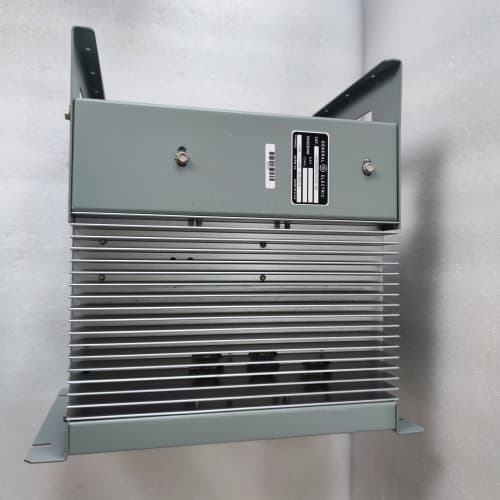
Description
Parameters
| Parameter | Specification |
|---|---|
| Function | System clock generator, bus arbiter, data concentrator |
| Clock Accuracy | ±50ppm (crystal); ±1ppm with external GPS/IRIG-B input |
| Synchronization | IEEE 1588 PTP, IRIG-B, or 1PPS input (optional) |
| Bus Protocol | Mark VIe proprietary high-speed serial backplane (1Gbps) |
| Data Throughput | 100Mbps sustained; 1Gbps burst |
| Scan Cycle | Configurable: 1ms, 2ms, 5ms, 10ms, 20ms, 50ms, 100ms |
| Supported Modules | Up to 16 I/O modules per bus segment |
| Timestamp Resolution | 1µs (internal); 100ns with external sync |
| Diagnostics | Bus error counters, module health status, communication timeouts |
| Redundancy | Supports dual-rack configuration (primary/backup) with bumpless transfer |
| Memory | 256MB SDRAM, 64MB Flash (firmware storage) |
| Power Supply | 5VDC (from backplane), 2A max; 24VDC (aux), 200mA |
| Operating Temp | -40°C to +70°C |
| Mounting | 6U VME Eurocard, 160mm depth |
| Certifications | UL, CSA, ATEX Zone 2, SIL 2 (with redundant configuration) |
Advantages & Features
-
Precision System Clock – The GE DS3820MSAB provides a stable, high-accuracy timebase that ensures all I/O modules in the rack sample and update simultaneously. With external synchronization (IRIG-B or GPS), the GE DS3820MSAB can achieve <1µs skew across multiple racks.
-
Deterministic Bus Arbitration – The GE DS3820MSAB manages all backplane traffic with guaranteed bandwidth for time-critical data (e.g., turbine trip signals), preventing congestion from less critical communications.
-
Integrated Diagnostics – The GE DS3820MSAB continuously monitors bus health, module presence, and communication errors. All diagnostics are accessible via the Mark VIe Toolbox or controller interface, enabling rapid fault identification.
-
Redundant Operation – Two GE DS3820MSAB modules can be installed in a dual-rack configuration. If the primary fails, the backup assumes control within one scan cycle (≤1ms) with no data loss.
-
Flexible Scan Configuration – The GE DS3820MSAB allows per-module scan rate assignment, so fast loops (fuel control, 1ms) and slow loops (temperature monitoring, 100ms) can coexist in the same rack without interference.
-
Time-Stamped Data – All I/O data passing through the GE DS3820MSAB is time-stamped with 1µs resolution, enabling detailed sequence-of-events recording and post-event analysis for turbine overspeed or trip investigations.
Application Cases
-
Single-Rack Gas Turbine Control – A single GE DS3820MSAB in a Mark VIe cabinet manages 12 I/O modules (vibration, thermocouple, analog output, digital I/O) for a 7FA gas turbine, coordinating all loops at 5ms scan rate with deterministic data delivery.
-
Multi-Rack Steam Turbine System – Four racks (one controller + three I/O expansion racks) are synchronized by two GE DS3820MSAB modules (redundant) using IRIG-B time reference, ensuring all valve position feedback and temperature data are aligned for accurate thermal stress calculations.
-
Combined-Cycle Plant with GPS Synchronization – The GE DS3820MSAB receives GPS 1PPS signal to synchronize six Mark VIe racks across the plant, enabling precise alignment of turbine and HRSG data for performance analysis.
-
Offshore Platform Distributed Control – Dual GE DS3820MSAB modules in redundant racks provide bumpless failover during platform power transfers, ensuring continuous turbine control with no process interruption.
Competitor Comparison
| Feature | GE DS3820MSAB | Siemens 6ES7153-1AA03 (IM153) | ABB CI854 (Commu) | Rockwell 1756-CNB (ControlNet) |
|---|---|---|---|---|
| Function | Master sync + bus arbiter | Profibus DP master | Communication interface | ControlNet bridge |
| Clock Accuracy | ±50ppm (±1ppm with ext) | ±100ppm | ±50ppm | ±100ppm |
| External Sync | IRIG-B, GPS, 1PPS | No | No | No |
| Timestamp Resolution | 1µs | N/A (module only) | 1ms | 10ms |
| Scan Cycle | 1ms–100ms (per module) | Fixed (depends on bus) | 10ms typical | 5–100ms |
| Redundancy | Bumpless (<1ms) | Manual switchover | Manual switchover | Manual switchover |
| Bus Speed | 1Gbps | 12Mbps (Profibus) | 100Mbps | 5Mbps |
| SIL Rating | SIL 2 (redundant) | SIL 1 | SIL 2 | SIL 1 |
The GE DS3820MSAB outperforms competitors with its high-speed bus (1Gbps), sub-microsecond timestamping, external sync capability, and sub-1ms redundant switchover. Siemens and Rockwell use slower fieldbus protocols and lack precision timing features.
Selection Suggestions
-
Every Mark VIe rack must have one GE DS3820MSAB installed in the first slot of the chassis. It is not optional — the system will not boot without it.
-
For critical applications (turbine control), install two GE DS3820MSAB modules in two separate racks with a redundant controller configuration. The backup rack takes over automatically on primary failure.
-
If your plant has GPS or IRIG-B time sources, connect them to the GE DS3820MSAB for plant-wide synchronization. This improves sequence-of-events logging and simplifies troubleshooting.
-
Select the scan cycle for each module carefully. Fast I/O (vibration trip, overspeed) should use 1–2ms; temperature and pressure loops use 5–10ms; slow processes (valve stroke counting) use 50–100ms. The GE DS3820MSAB supports mixed scan rates per slot.
-
Do not exceed 16 I/O modules per GE DS3820MSAB bus segment. For larger systems, use multiple racks with separate MSAB modules.
-
Pair the GE DS3820MSAB with the controller module (e.g., DS3820CN or DS3820CP) via dedicated inter-rack fiber or copper links for expansion cabinets.
Precautions
-
Slot Position – The GE DS3820MSAB must be installed in slot 1 (leftmost) of the Mark VIe chassis. Installing in any other slot will prevent bus initialization.
-
Bus Termination – The backplane automatically terminates the bus when the GE DS3820MSAB is present. Do not add external terminators or remove the module while the rack is powered — this will corrupt bus traffic and may cause I/O data loss.
-
External Sync Wiring – IRIG-B or GPS signals must use shielded twisted-pair cable with impedance 50–100Ω. Connect shield to chassis ground at the GE DS3820MSAB end only. Signal level must be TTL or RS-422 (software selectable).
-
Firmware Mismatch – The GE DS3820MSAB firmware must match the controller firmware version. A mismatch will cause “Module Mismatch” errors and I/O scanning to halt. Always upgrade both when performing system updates.
-
Redundancy Switchover – In redundant configurations, both GE DS3820MSAB modules must have identical firmware and configuration. Test switchover during commissioning by manually removing the primary — verify backup takes control within 1ms and all outputs remain stable.
-
Diagnostic Polling – The GE DS3820MSAB continuously polls all I/O modules. If a module fails to respond, the MSAB retries 3 times then flags it as “unavailable” and stops scanning that slot. This prevents bus lockup but may delay fault reporting — configure alarm delays per application.
-
Memory Usage – The GE DS3820MSAB stores up to 10,000 event records in Flash. If the log fills, older entries are overwritten. For long-term archiving, offload logs to the controller or DCS periodically.
-
Power Considerations – The GE DS3820MSAB draws 2A from the 5V backplane supply. Ensure the power supply module (e.g., DS3820EPSA) has sufficient 5V capacity for all modules in the rack — total 5V current must not exceed 5A.
-
Temperature – The GE DS3820MSAB runs warm (typically 45–50°C) due to high-speed bus processing. Ensure 15mm clearance above and below for airflow; do not block ventilation holes on the front panel.
NI PXI-1031
A-B 1771-WF
A-B 1771-WG



Reviews
There are no reviews yet.