
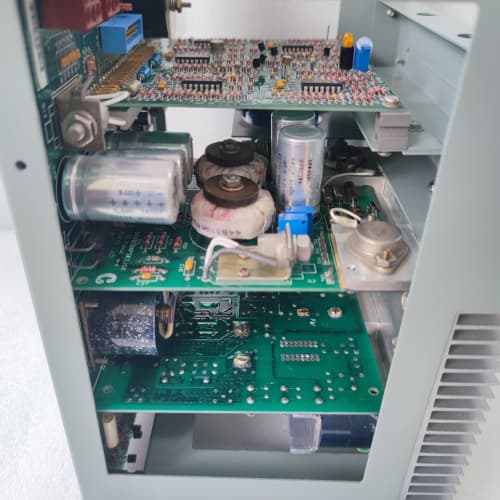
Description
Key Parameters
-
Channels: 4 analog inputs + 2 analog outputs (total 6 channels)
-
Input Types: 4–20 mA, 0–10 V, ±10 V (software-configurable per channel)
-
Input Resolution: 16-bit ADC
-
Input Accuracy: ±0.12% of full scale (25°C); ±0.35% over –40°C to +85°C
-
Input Impedance: >1 MΩ (voltage), 250 Ω (current)
-
Output Types: 4–20 mA or 0–10 V (software-configurable per channel)
-
Output Resolution: 16-bit DAC
-
Output Accuracy: ±0.12% of full scale (25°C); ±0.35% over –40°C to +85°C
-
Output Load: 0–10 V: min 1 kΩ; 4–20 mA: max 600 Ω
-
Diagnostics: Per-channel open-wire detection (inputs/outputs), short-circuit protection (outputs), over-range/under-range detection (inputs), signal-loss detection
-
Fail-Safe Output States: Software-configurable per channel (hold last value, go to min, go to max, or user-defined preset) on communication loss
-
Isolation: 1500 V RMS (field-to-backplane); 500 V RMS between channels
-
Operating Temperature: –40°C to +85°C (extended range)
-
Power: 24 V DC backplane power, ≤4.5 W (plus external field supply for outputs)
-
Terminals: Screw-type (suffix-dependent)
Advantages
-
Extended temperature range – operates reliably in extreme ambient conditions (up to +85°C); ideal for outdoor, desert, or unheated enclosures.
-
Mixed I/O capability – 4 inputs + 2 outputs in one slot; saves rack space and reduces module count.
-
Software-configurable I/O – each input and output independently set for current or voltage; eliminates hardware jumpers.
-
Enhanced diagnostics – includes signal-loss detection for proactive maintenance.
-
High 16-bit resolution – precise control and measurement for demanding applications.
-
Per-channel diagnostics – open-wire and short-circuit detection.
-
Output fail-safe – software-defined output states on communication loss.
-
Hot-swappable – replace without rack power-down.
-
Optical isolation – protects backplane from field transients.
Applications
-
Oil & gas pipelines – monitoring pressure/temperature (inputs) and controlling valves (outputs) in desert or arctic locations
-
Outdoor power substations – process monitoring and control in direct sunlight or extreme cold
-
Steel mills & foundries – mixed I/O near high-heat zones
-
Wind turbines – pitch and yaw control with extended temperature rating
-
Marine & offshore – engine room monitoring and control in high-temperature environments
-
Compact control panels – where space is limited and mixed I/O is required
-
PID control loops – reading process variables and driving actuators in a single module
-
Test stands – monitoring sensors and controlling actuators in harsh environments
Competitor Comparison
| Feature | DS3820MAUD | DS3820MAUC (Standard Temp) | Separate AI + AO Modules (4 AI + 2 AO) |
|---|---|---|---|
| I/O Mix | 4 AI + 2 AO | 4 AI + 2 AO | 4 AI + 2 AO (2 modules) |
| Operating Temp | –40°C to +85°C | –40°C to +70°C | –25°C to +70°C |
| Resolution | 16-bit | 16-bit | 16-bit |
| Diagnostics | Enhanced (signal-loss) | Full | Full |
| Slots Required | 1 | 1 | 2 |
| Panel Space | Small | Small | Large |
| Cost | Mid-high | Mid | High |
The DS3820MAUD is the extended-temperature, enhanced-diagnostics variant of the mixed I/O family. Compared to the standard DS3820MAUC, it offers a wider operating range (up to +85°C) and additional diagnostic capabilities – critical for harsh environments. Against separate AI and AO modules, the DS3820MAUD saves one rack slot, reduces panel space, and lowers total installed cost, while adding extended temperature capability. For applications requiring mixed analog I/O in extreme conditions with high reliability, the DS3820MAUD delivers the most comprehensive and ruggedized solution.
Selection Tips
-
Choose DS3820MAUD when you need a balanced mix of analog inputs and outputs (4 AI + 2 AO) in a single slot with extended temperature operation and enhanced diagnostics.
-
Ideal for oil & gas, outdoor substations, steel mills, wind turbines, and marine applications.
-
Verify the input and output types match your field devices – each channel independently configurable for current or voltage.
-
Consider the output fail-safe behavior – configure each output channel for the safe state on communication loss.
-
Note the slight accuracy reduction at extreme temperatures (±0.35% vs ±0.3% for standard range) – a trade-off for extended operation.
-
Not suitable for high-channel-count applications – use dedicated AI or AO modules for larger I/O counts.
-
Ensure your PLC/DCS can handle the mixed I/O data structure from the DS3820MAUD.
Precautions
-
Temperature derating: At sustained +85°C ambient, ensure adequate airflow – the DS3820MAUD dissipates up to 4.5 W and may require forced cooling in dense racks.
-
Input wiring: For current inputs (4–20 mA), ensure the loop is powered externally or through the module.
-
Output load: For 0–10 V outputs, minimum load is 1 kΩ; for 4–20 mA, maximum loop resistance is 600 Ω.
-
Inductive loads: Use external flyback diodes for inductive output loads.
-
Wiring: Keep analog wiring separated from power and digital signals to avoid noise.
-
Fail-safe testing: Test output fail-safe behavior during commissioning – confirm outputs go to the desired state on communication loss.
-
Open-wire detection: Requires minimum load current – very high-impedance inputs may not trigger detection.
-
Grounding: Maintain proper grounding to avoid ground loops affecting input accuracy.
-
Power: Requires external 24 V field supply for outputs – ensure supply capacity.
-
Calibration: Perform periodic calibration using precision sources/meters – extended temperature operation may accelerate drift.
-
Spare: Keep one spare DS3820MAUD for critical mixed-I/O applications – extended-temperature modules typically have longer lead times.
A-B 1747-BA
A-B 1756-L64 L65ϵ и ӣ ͷ
A-B 1746-NI8ϵ и
.jpg)

Reviews
There are no reviews yet.