
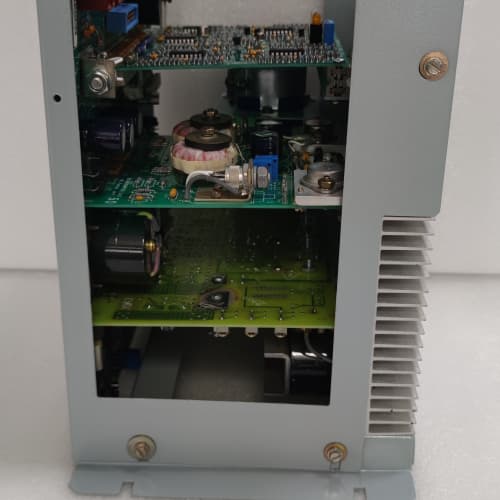
Description
Key Parameters
-
Channels: 8 digital inputs + 8 mirrored discrete outputs
-
Input Type: 24 V DC (sourcing/sinking configurable)
-
Input Current: 4–8 mA per channel
-
Input Impedance: >5 kΩ
-
Isolation: 1500 V RMS (field-to-backplane); 500 V RMS between channels
-
On-state Threshold: ≥15 V DC
-
Off-state Threshold: ≤5 V DC
-
Minimum Detectable Pulse Width: 1 ms (captures very short pulses)
-
COS Latching: Per-channel latch – holds state change until manually or automatically reset (software-configurable)
-
Mirrored Outputs: 8 discrete outputs (24 V DC, 0.5 A per channel) – mirror input states or latch status; configurable per channel
-
Diagnostics: Per-channel LED status (input and output), output short-circuit protection
-
Input Filtering: Software-selectable 0.5–50 ms debounce
-
Terminal Type: Fixed screw-type (per suffix “1A1A”)
-
Power: 24 V DC backplane power, ≤4 W (plus external field supply for inputs and outputs)
-
Operating Temperature: –40°C to +70°C
Advantages
-
Integrated mirrored outputs – per-channel discrete outputs mirror input states or latch status; drives external indicators, relays, or alarms without additional output modules.
-
Pulse-capture capability – detects pulses as short as 1 ms; standard modules typically miss pulses shorter than the PLC scan cycle.
-
COS latching output – holds state changes until reset; ideal for first-fault indication and persistent alarm annunciation.
-
Change-of-State (COS) detection – captures every state transition; reduces PLC CPU load by only reporting changes.
-
Pre-configured – fixed screw-type terminal configuration; reduces setup time.
-
Per-channel filtering – independently configurable 0.5–50 ms debounce; eliminates false triggers from contact bounce.
-
Optical isolation – protects backplane from field transients and ground loops.
-
Hot-swappable – replace without rack power-down.
-
High channel density – 8 inputs + 8 outputs in a single slot; saves rack space.
Applications
-
Fault diagnostics with local annunciation – capturing momentary alarm contacts and driving local indicator lights or horns
-
First-fault detection with output indication – capturing the first event in a cascade of alarms and providing local output for maintenance teams
-
Pushbutton monitoring with local control – detecting brief operator pushbutton presses and driving output for control or feedback
-
Emergency stop (E-stop) monitoring – capturing momentary E-stop activations with local annunciation for safety logging
-
Conveyor systems – detecting brief product jams or photoeye interruptions with local output for alarm or counter
-
Packaging machinery – capturing short-duration sensor pulses and driving local outputs for cycle monitoring
-
Manufacturing – machine cycle monitoring with event sequencing, persistent fault annunciation, and local output indication
Competitor Comparison
| Feature | DS3820DPMI1A1A | DS3820DPAA (Pulse/latch, no output) | Standard DI + separate DO module |
|---|---|---|---|
| Pulse Capture (1 ms) | Yes | Yes | No (scan-dependent) |
| COS Latching | Yes (per channel) | Yes (per channel) | No |
| Mirrored Outputs | Yes (8 integrated) | No | Yes (external module required) |
| Channel Density | 8 DI + 8 DO in 1 slot | 8 DI in 1 slot | 8 DI + 8 DO in 2 slots |
| Panel Space | Compact | Compact | Large (2 modules) |
| Cost (total installed) | Low | Low | High (2 modules + wiring) |
| Best Use Case | Pulse capture + latching + local output | Pulse capture + latching only | General I/O |
The DS3820DPMI1A1A is the pulse-capture/latching variant with integrated mirrored outputs. Compared to the basic DS3820DPAA, it adds 8 discrete outputs for local annunciation or control – eliminating the need for a separate output module. Against a standard DI + DO module combination, the DS3820DPMI1A1A saves rack space, reduces wiring complexity, and lowers total installed cost. For applications requiring both event capture and local output indication, the DS3820DPMI1A1A delivers the most compact and cost-effective solution.
Selection Tips
-
Choose DS3820DPMI1A1A when you need to capture short-duration pulses (≥1 ms) AND provide local output annunciation or control.
-
Ideal for fault diagnostics, momentary alarm detection, first-fault indication with indicator lights, and local control applications.
-
Verify the input voltage matches your field devices – accepts 24 V DC only.
-
Confirm the output rating (24 V DC, 0.5 A per channel) is sufficient for your loads (lights, relays, small solenoids).
-
Consider the latching reset method – software reset (via PLC) or manual reset – configurable per channel.
-
Not suitable for AC input signals – use the DS3820C12A family for 120 V AC inputs.
-
Ensure your PLC/DCS can receive and process latch reset commands and output status.
Precautions
-
Pulse duration: Captures pulses ≥1 ms with filtering disabled. Enabling filtering increases minimum detectable pulse width.
-
Output current: Do not exceed 0.5 A per output – use external relays for higher loads. Outputs include short-circuit protection, but extended overload may damage the module.
-
Latching behavior: The latch holds the state change until reset. Configure reset mechanism carefully – automatic reset may clear alarms before operator acknowledgment.
-
Filtering: Longer filter settings (50 ms) improve noise immunity but may miss short pulses – use minimal filtering for pulse-capture applications.
-
Wiring: Use shielded cables for inputs in high-EMI areas. Keep output wiring separate from input wiring to avoid crosstalk.
-
Power: Requires external 24 V field supply for both inputs and outputs. Ensure power supply capacity for output loads.
-
Power sequencing: Apply backplane power before field power to avoid false events during startup.
-
No event buffer: Does not store historical events – the latch provides current status only.
-
Spare: Keep one spare DS3820DPMI1A1A for critical pulse-capture applications – the combined feature set may have longer lead times.
SIEMENS 6ES7195-1BE00-0XA0
ABB CMA120 3DDE300400
A-B 1747-L542ϵ и һ



Reviews
There are no reviews yet.