
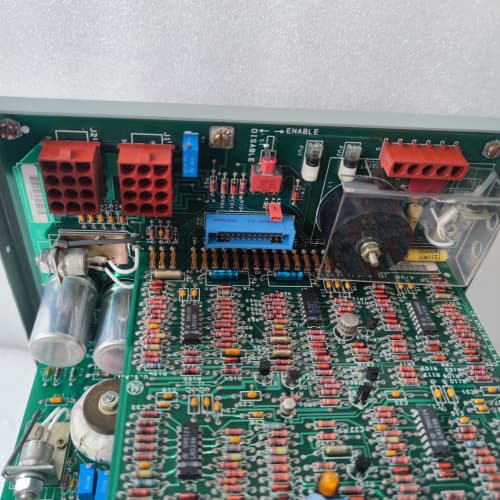
Description
Key Parameters
-
Channels: 8 digital inputs
-
Input Type: 24 V DC (sourcing/sinking configurable)
-
Input Current: 4–8 mA per channel
-
Input Impedance: >5 kΩ
-
Isolation: 1500 V RMS (channel-to-backplane); 500 V RMS between channels
-
On-state Threshold: ≥15 V DC
-
Off-state Threshold: ≤5 V DC
-
Minimum Detectable Pulse Width: 1 ms (captures very short pulses)
-
COS Latching: Per-channel latch – holds state change until manually or automatically reset (software-configurable)
-
Diagnostics: Per-channel LED status, input short-circuit protection
-
Input Filtering: Software-selectable 0.5–50 ms debounce
-
Power: 24 V DC backplane power, ≤2 W (plus external field supply)
-
Operating Temperature: –40°C to +70°C
Advantages
-
Pulse-capture capability – detects pulses as short as 1 ms; standard modules typically miss pulses shorter than the PLC scan cycle.
-
COS latching output – holds state changes until reset; ideal for first-fault indication and persistent alarm annunciation.
-
Change-of-State (COS) detection – captures every state transition; reduces PLC CPU load by only reporting changes.
-
Per-channel filtering – independently configurable 0.5–50 ms debounce; eliminates false triggers from contact bounce.
-
Optical isolation – protects backplane from field transients and ground loops.
-
Hot-swappable – replace without rack power-down.
-
High channel density – 8 channels in a single slot; saves rack space.
-
Compact and cost-effective – focuses on pulse capture and latching without the complexity of full SOE time-stamping.
Applications
-
Fault diagnostics – capturing momentary alarm contacts (e.g., over-temperature trips, pressure spikes) that may be too short for standard inputs
-
First-fault detection – capturing the first event in a cascade of alarms (e.g., motor tripping due to high temperature)
-
Pushbutton monitoring – detecting brief operator pushbutton presses for start/stop commands
-
Emergency stop (E-stop) monitoring – capturing momentary E-stop activations for safety logging
-
Conveyor systems – detecting brief product jams or photoeye interruptions
-
Packaging machinery – capturing short-duration sensor pulses for cycle monitoring
-
Manufacturing – machine cycle monitoring with event sequencing and persistent fault annunciation
Competitor Comparison
| Feature | DS3820DPAA | Standard 24 V Digital Input Module | DS3820DIMA (SOE with time-stamping) |
|---|---|---|---|
| Pulse Capture (1 ms) | Yes | No (scan-dependent) | Yes |
| COS Latching | Yes (per channel) | No | No |
| Time-Stamping | No | No | Yes (1 ms resolution) |
| Event Buffer | No | No | Yes (256 events) |
| Cost | Low | Very low | Mid |
| Best Use Case | Pulse capture + latching | Basic monitoring | Full SOE recording |
The DS3820DPAA is the pulse-capture/latching variant of the digital input family. Compared to standard digital input modules, it adds the ability to capture very short pulses (1 ms) and latching outputs – critical for applications where momentary events would otherwise be missed. Against the full-featured DS3820DIMA SOE module, the DS3820DPAA offers a lower-cost solution for applications requiring pulse detection and latching but not full time-stamped event logging. For diagnostic and first-fault applications, the DS3820DPAA delivers essential functionality without unnecessary cost.
Selection Tips
-
Choose DS3820DPAA when you need to capture short-duration pulses (≥1 ms) that standard modules would miss.
-
Ideal for fault diagnostics, momentary alarm detection, and first-fault indication.
-
Verify the input voltage matches your field devices – accepts 24 V DC only.
-
Consider the latching reset method – software reset (via PLC) or manual reset – configurable per channel.
-
Not suitable for AC input signals – use the DS3820C12A family for 120 V AC inputs.
-
If you also require time-stamping and event logging, consider the DS3820DIMA SOE module instead.
-
Ensure your PLC/DCS can receive and process latch reset commands.
Precautions
-
Pulse duration: The DS3820DPAA captures pulses ≥1 ms with filtering disabled. Enabling filtering will increase the minimum detectable pulse width – match to your application requirements.
-
Latching behavior: The latch holds the state change until reset. Configure the reset mechanism carefully – automatic reset may clear alarms before operator acknowledgment; manual reset ensures operator visibility.
-
Filtering: Longer filter settings (50 ms) improve noise immunity but may miss short pulses – use minimal filtering for pulse-capture applications.
-
Wiring: Use shielded cables for inputs in high-EMI areas.
-
Power sequencing: Apply backplane power before field power to avoid false events during startup.
-
No event buffer: The DS3820DPAA does not store historical events – the latch provides current status only. For event logging, consider SOE modules.
-
Spare: Keep one spare DS3820DPAA for critical pulse-capture applications – the unique feature set may have longer lead times.
TRLC0NEX 3625
HONEYWELL ˿
A-B 1746-NI8ϵ и


Reviews
There are no reviews yet.