
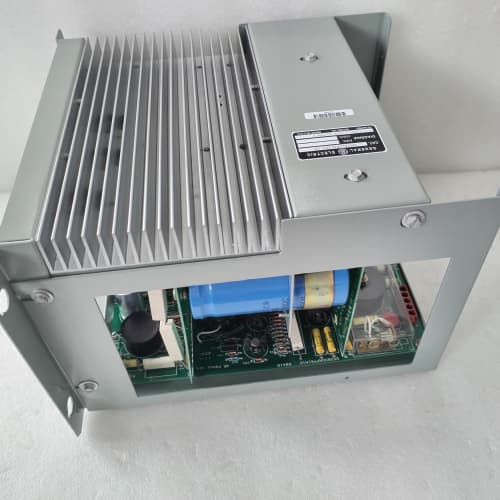
Description
Key Parameters
-
Channels: 8 differential, individually configurable
-
Sensor Types: J, K, T, E, R, S, B, N thermocouples; ±10 mV, ±20 mV, ±50 mV, ±100 mV
-
Cold-Junction Compensation: Built-in per channel with automatic compensation
-
Resolution: 16-bit ADC
-
Accuracy: ±0.05% of reading + ±0.5°C (K-type, 25°C); ±1.0°C over –40°C to +70°C
-
Averaging Functions: Group averaging (user-selectable groups of 2–8 channels), min/max per group, rate-of-change per channel
-
Update Rate: Configurable averaging period (100 ms to 60 s)
-
Isolation: 1500 V RMS field-to-logic (group isolated)
-
Power: 24 V DC, ≤6 W
-
Diagnostics: Open-circuit detection (burnout), over/under-range, CJC sensor fault, watchdog timer
-
CMRR: >100 dB
Advantages
-
On-board averaging – calculates average temperature for channel groups; reduces PLC/DCS programming complexity and CPU load.
-
Min/max tracking – automatically logs highest and lowest values per group for alarm and trend analysis.
-
Rate-of-change monitoring – detects rapid temperature changes per channel for early fault detection.
-
Direct thermocouple connection – eliminates external transmitters; built-in CJC for accurate readings.
-
Software configurable per channel – each channel independently set for TC type or mV range.
-
Hot-swappable – replace without rack power-down.
-
Built-in diagnostics – detects broken TC wires and CJC sensor faults.
Applications
-
Industrial furnaces & ovens – averaging multiple zone temperatures for uniform heating control
-
Large HVAC systems – averaging duct or return air temperatures across multiple sensors
-
Warehouse/cold storage – averaging multiple temperature points for inventory protection
-
Chemical reactors – monitoring average temperature across multiple sensor locations
-
Power generation – averaging turbine bearing or winding temperatures for protection systems
-
Pharmaceutical storage – validating average storage temperature with min/max logging
Competitor Comparison
| Feature | DS3820ATMA | DS3820ATAD (Standard TC) | Competitor TC + PLC Averaging |
|---|---|---|---|
| TC Direct Input | Yes | Yes | Yes |
| Built-in CJC | Yes | Yes | Yes |
| On-board Averaging | Yes (hardware) | No (requires PLC) | No (requires PLC) |
| Min/Max Tracking | Yes | No | No |
| Rate-of-Change Monitoring | Yes | No | No |
| PLC CPU Load | Low | High (averaging in logic) | High |
| Programming Effort | Low (configuration only) | High (user logic) | High |
The DS3820ATMA significantly reduces PLC programming effort and CPU load by offloading averaging and math functions to the hardware. Compared to the standard DS3820ATAD, which requires user logic in the controller to calculate averages, the DS3820ATMA delivers pre-processed values directly to the data table – simplifying code and improving scan time performance. Against competitor systems that perform averaging in the PLC, the DS3820ATMA reduces engineering hours and eliminates calculation errors from custom logic. For large installations with dozens of multi-sensor zones, the DS3820ATMA offers substantial cost savings in both engineering and CPU upgrade avoidance.
Selection Tips
-
Choose DS3820ATMA when you need averaged temperature values from multiple sensors (e.g., 3-point average for a furnace zone).
-
Ideal for applications where PLC CPU load is a concern – the averaging is done on the module.
-
Perfect for systems requiring historical min/max logging without additional programming.
-
Verify your thermocouple type is supported – covers all common types.
-
Not suitable if you only need single-point temperature readings – the standard DS3820ATAD is more cost-effective.
-
Consider the averaging period – configurable from 100 ms to 60 seconds; ensure it matches your control loop requirements.
Precautions
-
Averaging group assignment: Define groups carefully – only channels within the same group will be averaged. The DS3820ATMA does not allow overlapping groups.
-
CJC placement: Position the DS3820ATMA away from drafts and heat sources – CJC errors affect all averaged channels.
-
Wiring: Use shielded twisted-pair cables; ground shield at module end only. TC signals are low-level – keep away from power cables.
-
Extension wires: Use the correct thermocouple extension wire – standard copper wire introduces errors.
-
Polarity: Double-check thermocouple polarity – reversed connections produce incorrect average values.
-
Power sequencing: Apply backplane power before field power.
-
Calibration: Perform periodic calibration – averaged values amplify any individual channel errors.
-
Spare: Keep one spare DS3820ATMA for critical averaging loops – configuration must be reloaded after replacement.
SCHNEIDER XB2-BVB6LC
LA38-11MXS
ʿͨ NY24W-K


Reviews
There are no reviews yet.