
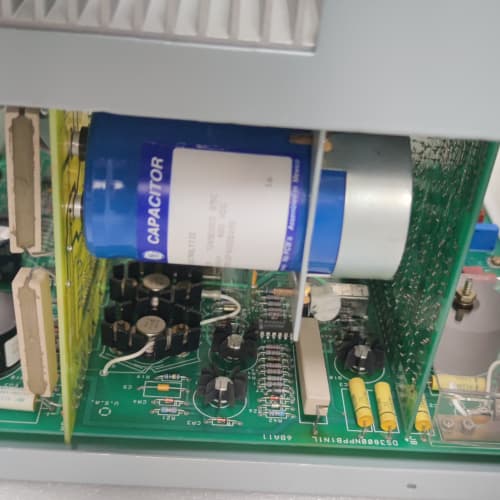
Description
Key Parameters
-
Channels: 8 differential, individually configurable
-
Sensor Types: J, K, T, E, R, S, B, N thermocouples; ±10 mV, ±20 mV, ±50 mV, ±100 mV
-
Cold-Junction Compensation: Built-in per channel with automatic compensation
-
Resolution: 16-bit ADC
-
Accuracy: ±0.03% of reading + ±0.3°C (K-type, 25°C); ±0.6°C over –40°C to +85°C (includes CJC error)
-
Operating Temperature: –40°C to +85°C (extended vs. standard –40°C to +70°C)
-
Input Impedance: >10 MΩ
-
Isolation: 1500 V RMS field-to-logic (group isolated)
-
Power: 24 V DC, ≤6 W
-
Diagnostics: Open-circuit detection (burnout), over/under-range, CJC sensor fault, watchdog timer
-
CMRR: >110 dB (enhanced noise rejection)
Advantages
-
Superior accuracy – ±0.03% reading + ±0.3°C (K-type) – significantly better than standard TC modules.
-
Extended temperature range – operates reliably from –40°C to +85°C for harsh outdoor or high-ambient environments.
-
Enhanced noise rejection – CMRR > 110 dB for stable readings in high-EMI environments.
-
Direct thermocouple connection – eliminates external transmitters; saves panel space and cost.
-
Per-channel CJC – each channel has independent cold-junction compensation for maximum accuracy.
-
Software configurable per channel – each channel independently set for thermocouple type or mV range.
-
Open-circuit detection (burnout) – automatically detects broken thermocouple wires.
-
Hot-swappable – replace without rack power-down.
Applications
-
Metrology & calibration labs – high-precision temperature measurement and sensor verification
-
Semiconductor manufacturing – diffusion furnace and wafer processing with tight temperature tolerances
-
Aerospace testing – engine and component thermal profiling in extreme environments
-
Power generation – turbine inlet and exhaust temperature monitoring with high accuracy
-
Research & development – experimental thermal analysis and material testing
-
Pharmaceutical – critical reactor temperature control with strict regulatory requirements
-
Oil & gas – high-temperature process monitoring in desert (hot) or arctic (cold) locations
Competitor Comparison
| Feature | DS3820ATAE | DS3820ATAD (Standard) | Competitor Premium TC Module |
|---|---|---|---|
| Accuracy (K-type) | ±0.03% + ±0.3°C | ±0.05% + ±0.5°C | ±0.03% + ±0.3°C |
| Operating Temp | –40°C to +85°C | –40°C to +70°C | –25°C to +70°C |
| CMRR | >110 dB | >100 dB | >100 dB |
| Per-channel CJC | Yes | Yes | Yes |
| Config | Software per-channel | Software per-channel | Software/Jumper |
| Cost | High | Mid | Very High |
The DS3820ATAE is the precision variant of the TC input family, offering the highest accuracy and widest operating range. Compared to the standard DS3820ATAD, the DS3820ATAE delivers approximately 40% better accuracy and extends operation to +85°C – critical for high-temperature environments like turbine monitoring or desert installations. Against competitor premium modules, the DS3820ATAE provides comparable or superior performance at a more accessible price point, making it the best-in-class choice for applications demanding the highest measurement fidelity. For plants with strict quality or regulatory requirements, the DS3820ATAE is the recommended upgrade over standard TC modules.
Selection Tips
-
Choose DS3820ATAE when your application demands maximum accuracy (calibration labs, semiconductor, aerospace).
-
Ideal for environments with ambient temperatures above +70°C or below –40°C.
-
Perfect for high-EMI environments (near VFDs, welding equipment, or substations) where enhanced CMRR is beneficial.
-
Verify your thermocouple type is supported – covers all common standards.
-
Not suitable for RTD sensors – use DS3820AIRA family instead.
-
If accuracy and temperature range requirements are less critical, the standard DS3820ATAD offers a more cost-effective solution.
Precautions
-
CJC placement: The built-in cold-junction sensor measures temperature at the terminal block. Position the DS3820ATAE away from drafts, heat sources, or cooling fans that could create localized temperature gradients.
-
Extension wires: Use the correct thermocouple extension wire (same type as sensor) from field to module. Standard copper wire introduces measurement errors.
-
Wiring: Use shielded twisted-pair cables; ground shield at module end only. Low-level mV signals are highly susceptible to noise – maintain separation from power cables.
-
Grounding: For grounded thermocouples, maintain single-point grounding to avoid ground loops. The high input impedance (>10 MΩ) minimizes but does not eliminate ground loop effects.
-
Polarity: Double-check thermocouple polarity – reversed connections produce negative temperature readings.
-
Power sequencing: Apply backplane power before field power to avoid spurious diagnostics.
-
Calibration: Perform periodic calibration using precision mV sources – the DS3820ATAE‘s superior accuracy requires regular verification to maintain specification.
-
Spare: Keep one spare DS3820ATAE for critical high-precision loops – enhanced-accuracy modules typically have longer lead times.
ABB CL-513R ͺ CL2-513R
ABB CL-513G ͺ CL2-513G
SCHNEIDER GR-2C-DC24V+PGR-2C-E
.jpg)

Reviews
There are no reviews yet.