
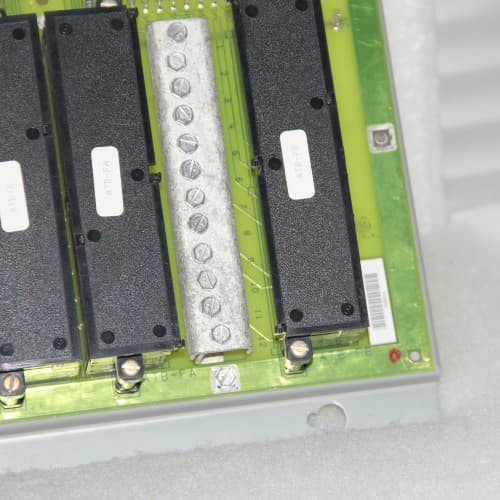
Description
Key Parameters
-
Channels: 8 differential, individually configurable
-
Sensor Types: Pt100/Pt1000 (2/3/4-wire), Ni100/Ni1000, 0–500 Ω, 0–2 kΩ, 0–10 kΩ (potentiometer)
-
Excitation Current: 0.1 mA, 0.5 mA, 1 mA, 2 mA (software-selectable per channel)
-
Resolution: 16-bit ADC with ratiometric conversion
-
Accuracy: ±0.06% of reading + ±0.15°C (Pt100, 3-wire, 25°C); ±0.3°C over –40°C to +85°C
-
Operating Temperature: –40°C to +85°C (extended range vs. standard –40°C to +70°C)
-
Lead Compensation: Automatic for 3-wire and 4-wire configurations
-
Isolation: 1500 V RMS field-to-logic (group isolated)
-
EMI Protection: Enhanced filtering with CMRR > 110 dB and additional surge suppression
-
Power: 24 V DC, ≤7 W
-
Diagnostics: Open-circuit, short-circuit, over-range, wire-break monitoring
Advantages
-
Extended temperature range – operates reliably in extreme ambient conditions (up to +85°C), ideal for outdoor or unheated enclosures.
-
Enhanced EMI protection – superior noise rejection (CMRR > 110 dB) and built-in surge suppression for high-interference environments.
-
Direct RTD connection – eliminates external signal conditioners; reduces cost and failure points.
-
Ratiometric measurement – immune to power supply drift for stable, accurate readings.
-
Software configurable per channel – each channel independently set for sensor type, wire configuration, and excitation current.
-
Hot-swappable – replace without rack power-down.
-
Full diagnostics – detects broken wires and sensor shorts in real-time.
Applications
-
Oil & gas pipelines – remote temperature monitoring in desert (high ambient) or arctic (low ambient) conditions
-
Steel mills & foundries – furnace and cooling water temperature near high-heat zones
-
Outdoor power substations – transformer and busbar temperature monitoring in direct sunlight
-
Mining operations – equipment temperature sensing in dusty, high-vibration environments
-
Food processing – oven and sterilization chamber temperature profiling
-
Marine & offshore – engine room temperature monitoring with high EMI from generators
Competitor Comparison
| Feature | DS3820AIRE | DS3820AIRA (Standard) | Competitor RTD Module (Industrial) |
|---|---|---|---|
| Operating Temp | –40°C to +85°C | –40°C to +70°C | –25°C to +70°C |
| CMRR | >110 dB | >100 dB | >90 dB |
| Surge Protection | Yes (enhanced) | Basic | Basic |
| Sensor Config | Software per-channel | Software per-channel | Software/Jumper |
| Lead Compensation | 3/4-wire auto | 3/4-wire auto | 3/4-wire auto |
| Accuracy | ±0.06% | ±0.05% | ±0.1% |
| Cost | High | Mid | Mid-high |
The DS3820AIRE is specifically engineered for environments where the standard DS3820AIRA would exceed its thermal limits. Compared to the standard version, the DS3820AIRE sacrifices a marginal amount of absolute accuracy (±0.06% vs ±0.05%) in exchange for significantly broader operating range and enhanced protection – a worthwhile trade-off for harsh sites. Against competitor modules with lower temperature ratings, the DS3820AIRE offers the widest operational envelope and superior noise immunity, making it the preferred choice for extreme industrial applications.
Selection Tips
-
Choose DS3820AIRE if your installation environment experiences ambient temperatures above +70°C or below –40°C.
-
Ideal for outdoor skid-mounted equipment, desert installations, or unheated northern facilities.
-
Perfect for high-EMI environments like substations, welding areas, or near variable-frequency drives.
-
Verify sensor type and wire configuration – the DS3820AIRE supports most common RTD standards.
-
Not suitable for thermocouple inputs (use dedicated thermocouple module).
-
Consider the higher power consumption (7 W) when planning rack power budgets.
Precautions
-
Lead resistance: For 2-wire RTDs, lead resistance directly adds error – use 3-wire or 4-wire for accurate measurements.
-
Excitation current: Higher currents (2 mA) produce self-heating errors – use 0.1 mA or 0.5 mA for small RTD elements.
-
Wiring: Use shielded twisted-pair cables; ground shield at module end only. The DS3820AIRE‘s enhanced surge protection requires proper grounding to function effectively.
-
Temperature derating: At sustained +85°C ambient, ensure adequate airflow – the DS3820AIRE dissipates up to 7 W and may require forced cooling in dense racks.
-
Power sequencing: Apply backplane power before field power to avoid spurious diagnostics.
-
Calibration: Perform periodic calibration using precision resistors – temperature extremes may affect long-term drift.
-
Spare: Keep one spare DS3820AIRE for critical temperature loops – extended-range modules typically have longer lead times.
SIEMENS 3SB34000A
ABB CR-MX110AC4L
OMRON MY2N-GS DC24



Reviews
There are no reviews yet.