
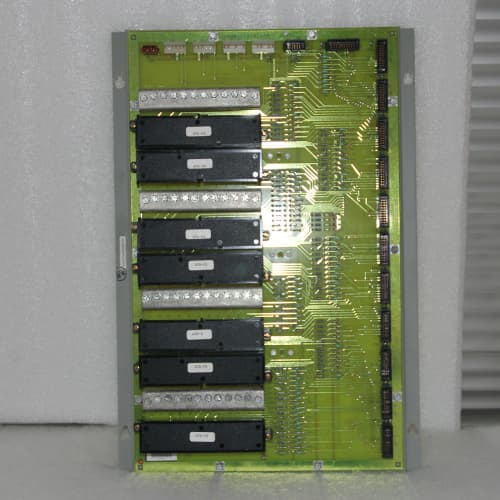
Description
Key Parameters
-
Channels: 8 differential, individually configurable
-
Sensor Types: Pt100/Pt1000 (2/3/4-wire), Ni100/Ni1000, 0–500 Ω, 0–2 kΩ, 0–10 kΩ (potentiometer)
-
Excitation Current: 0.1 mA, 0.5 mA, 1 mA, 2 mA (software-selectable per channel)
-
Resolution: 16-bit ADC with built-in ratiometric conversion
-
Accuracy: ±0.05% of reading + ±0.1°C (Pt100, 3-wire, 25°C); ±0.2°C over –40°C to +70°C
-
Lead Resistance Compensation: Automatic for 3-wire and 4-wire configurations
-
Isolation: 1500 V RMS field-to-logic (group isolated)
-
Power: 24 V DC, ≤6 W
-
Diagnostics: Open-circuit detection, short-circuit detection, over-range alerts, wire-break monitoring
-
CMRR: >100 dB
Advantages
-
Direct RTD connection – eliminates external signal conditioners; reduces panel space and cost.
-
Ratiometric measurement – uses reference resistor instead of absolute voltage, eliminating power supply drift errors.
-
Automatic lead compensation – for 3-wire/4-wire RTDs, cancels lead resistance errors for high-accuracy temperature readings.
-
Software configurable per channel – each channel can be set independently for sensor type, wire configuration, and excitation current.
-
Hot-swappable – replace without rack power-down.
-
Built-in diagnostics – detects broken wires and sensor shorts instantly.
Applications
-
HVAC systems – duct and return air temperature monitoring with Pt100 sensors
-
Pharmaceutical manufacturing – fermenter temperature control with high-accuracy Pt1000
-
Food processing – oven and kiln temperature profiles
-
Semiconductor fabrication – precision chamber temperature monitoring
-
Power generation – bearing and winding temperature measurement
-
Laboratory equipment – environmental chambers and incubators
Competitor Comparison
| Feature | DS3820AIRA | Standard Analog AI + External RTD Module | Competitor RTD AI Module |
|---|---|---|---|
| Sensor Direct | Yes (RTD) | No (requires transmitter) | Yes |
| Lead Compensation | 3/4-wire auto | N/A | 3/4-wire auto |
| Configuration | Software per-channel | Hardware/jumper | Software |
| Accuracy | ±0.05% | ±0.1% (transmitter adds error) | ±0.05% |
| Cost (per channel) | Low | High (module + transmitter) | Medium |
| Hot-swap | Yes | Varies | Yes |
The DS3820AIRA eliminates the need for separate temperature transmitters, dramatically reducing installed cost compared to using standard analog inputs with external signal conditioners. Against competitor RTD modules, the DS3820AIRA offers comparable accuracy with the advantage of per-channel software configurability, making it more flexible for mixed sensor types. The DS3820AIRA also provides superior lead compensation, ensuring accurate readings even with long sensor cables – a common pain point in large industrial sites.
Selection Tips
-
Choose DS3820AIRA if you need to connect RTDs or resistive sensors directly without external transmitters.
-
Ideal for applications requiring high accuracy over wide temperature ranges with long cable runs (3-wire/4-wire RTDs).
-
Verify the sensor type and wire configuration match your system – the DS3820AIRA supports most common RTD standards.
-
Not suitable for thermocouple inputs (use dedicated thermocouple module).
-
Consider channel count – if you need more than 8 RTD inputs, multiple DS3820AIRA modules can be used in the same rack.
Precautions
-
Lead resistance: For 2-wire RTDs, lead resistance directly adds error – use 3-wire or 4-wire for accurate measurements.
-
Excitation current: Higher currents (2 mA) produce self-heating errors in small RTD elements – use 0.1 mA or 0.5 mA for sensitive sensors.
-
Wiring: Use shielded twisted-pair cables; ground shield at module end only. For 4-wire, use separate pairs for excitation and sense leads.
-
Power sequencing: Apply backplane power before field power.
-
Calibration: Perform periodic calibration using precision resistors to maintain accuracy.
-
Cooling: Ensure adequate airflow in dense racks – the DS3820AIRA dissipates up to 6 W.
-
Spare: Keep a spare DS3820AIRA for critical temperature loops to minimize downtime.
 .
.
SCHNEIDER GV-AE11
A-B 1747-BA
A-B 1747-BA



Reviews
There are no reviews yet.