
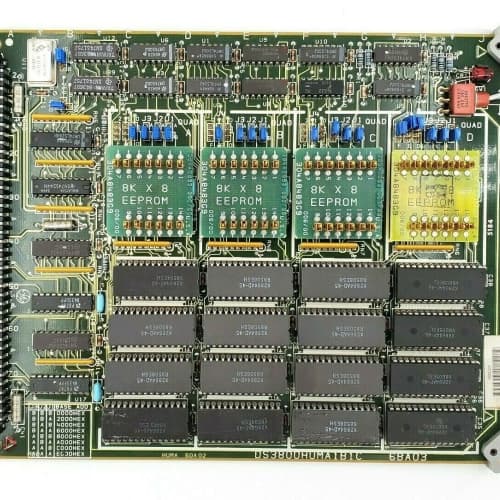
Description
Key Parameters
Power Supply Section:
-
Power Outputs: Multiple regulated DC outputs (+5V, ±15V, +24V, and configurable auxiliary outputs)
-
Excitation Outputs: Adjustable excitation for transducers (e.g., 3V, 5V, 10V DC, or 4–20mA loop power)
-
Output Accuracy: ±0.05% regulation
-
Ripple/Noise: <5 mV peak-to-peak
-
Diagnostics: LED status indicators for each output, over-voltage/over-current protection, thermal shutdown, output voltage monitoring
Digital I/O Section:
-
Digital Input Channels: 64 optically isolated inputs (maximum density)
-
Digital Output Channels: 48 or 64 solid-state outputs (depending on configuration)
-
Input Voltage: 24V DC or 48V DC (jumper-selectable per bank)
-
Output Type: Solid-state (high-side or low-side, jumper-selectable per bank)
-
Output Current: 0.5A per channel (continuous)
-
Total I/O Count: 112–128 digital I/O points per module
-
Diagnostics: Per-channel LED status, input open-circuit detection, output short-circuit protection, self-test on power-up
Serial Communication Section:
-
Communication Ports: 1 or 2 independent serial ports
-
Protocols Supported: Modbus RTU (Master/Slave), GE Mark IV proprietary protocol, ASCII
-
Physical Interfaces: RS-232, RS-422, RS-485 (jumper-selectable per port)
-
Baud Rates: 300 to 921.6 kbps (higher than standard)
-
Diagnostics: Per-port LED status (TX/RX/error), communication error counters
Common Section:
-
Isolation: 2500V RMS channel-to-backplane
-
Temp Range: –40°C to +85°C (extended)
-
Power Supply: +5V (logic), +24V/48V (field power) from backplane or external supply (high current draw)
-
Physical: 6U VME single-slot board
-
Key Features: Integrated power supply + high-density digital I/O + serial communication, adjustable excitation, extended temp range, high isolation
Advantages
-
High-density digital I/O with power and communication – the DS3815PDLC combines sensor excitation, high-density digital I/O (64 inputs / 48–64 outputs), and serial communication in a single module, significantly reducing board count and rack space.
-
Maximum I/O density – provides up to 128 digital I/O points per module, ideal for sensor-rich discrete control applications.
-
Space-saving – replaces up to five separate boards (power supply, digital input, digital output, serial communication, and additional I/O boards) with one module.
-
Stable sensor excitation – provides clean, regulated power for speed pickups, proximity probes, and other field devices requiring external power.
-
Adjustable excitation – allows matching excitation levels to specific sensor requirements.
-
Bank-configurable – both inputs and outputs can be independently configured for 24V or 48V operation.
-
Solid-state outputs – no mechanical contacts to wear out, providing fast, maintenance-free switching.
-
High-speed serial connectivity – the General Electric DS3815PDLC provides Modbus RTU and other serial protocols at higher baud rates (up to 921.6 kbps) for communication with DCS, SCADA, and HMIs.
-
Extended temperature range – operates from –40°C to +85°C for harsh environments.
-
Comprehensive protection – over-voltage, over-current, and thermal protection safeguard the board and connected field devices.
-
High isolation – 2500V RMS isolation protects the backplane from field-side faults.
-
Drop-in compatible – works with all Mark IV backplanes and processor configurations.
Applications
-
Large turbine control systems with extensive digital I/O – the DS3815PDLC provides high-density digital I/O with power and communication for large gas and steam turbines with numerous discrete field devices.
-
Combined-cycle plants – monitors and controls multiple turbine sections and balance-of-plant equipment with high sensor density.
-
Sensor excitation and discrete control – powers field sensors and handles high-density digital I/O for turbine sequencing, interlock logic, and alarm annunciation.
-
Distributed control integration – enables Mark IV systems to communicate with plant-wide DCS via Modbus while handling high-density digital I/O locally.
-
Offshore and harsh environments – extended temperature range makes it suitable for demanding applications.
-
Space-constrained cabinets – the General Electric DS3815PDLC significantly reduces rack space requirements compared to multiple separate boards.
-
Retrofits – replaces up to five separate boards with a single, integrated solution.
vs Competitors & Separate Boards
| Feature | DS3815PDLC | DS3815PDLA | DS3810HDDD + DS3800XJBA | DS3800XPEN + DS3810HDDD + DS3800XJBA |
|---|---|---|---|---|
| Power outputs | Yes | Yes | No + No | Yes + No + No |
| Digital inputs | 64 | 32–48 | 64 + 0 | 0 + 64 + 0 |
| Digital outputs | 48–64 | 24–32 | 64 + 0 | 0 + 64 + 0 |
| Total digital I/O | 112–128 | 56–80 | 128 | 128 |
| Serial communication | Yes (921.6 kbps) | Yes (115.2 kbps) | Yes | Yes |
| Board count | 1 | 1 | 2 | 3 |
| Extended temp range | –40°C to +85°C | –40°C to +85°C | –40°C to +85°C | –40°C to +85°C |
| Isolation | 2500V | 2500V | 2500V | 2500V |
Selection Tips
-
Maximum digital I/O with power and communication – choose the DS3815PDLC when you need the highest density of digital I/O (up to 128 points) with sensor excitation and serial communication in a single module.
-
Slot-limited installations – the General Electric DS3815PDLC significantly reduces board count compared to separate power, digital input, digital output, and communication boards.
-
High-speed communication – the higher baud rate (921.6 kbps) is ideal for integration with modern DCS and SCADA systems.
-
Mixed voltage inputs – the bank-configurable 24V/48V inputs accommodate plants with both legacy 48V and modern 24V field devices.
-
Harsh environments – the extended temperature range makes it suitable for offshore, desert, or unheated cabinet installations.
-
Power budget verification – the DS3815PDLC draws significant current due to high I/O density and power outputs. Verify your backplane power capacity.
-
Sensor compatibility – verify that the excitation voltage and current requirements of your sensors match the DS3815PDLC outputs.
-
Protocol requirements – confirm that your external systems support Modbus RTU or GE proprietary protocols.
-
Spare strategy – keep one DS3815PDLC per 5–8 installed units, especially in systems where it serves as the primary field interface.
-
Wiring planning – plan field wiring terminations carefully to leverage the integrated high-density terminal blocks efficiently.
-
Calibration – periodically verify output voltages and communication integrity using precision instruments.
Critical Precautions
-
Power supply loading – the DS3815PDLC has the highest current draw of any digital-focused Mark IV module. Do not exceed backplane power ratings, especially when installing multiple high-density boards.
-
Output voltage selection – verify that the DS3815PDLC output voltages are correctly configured before connecting sensors. Incorrect voltage can damage sensors.
-
Input voltage selection – ensure the digital input bank jumpers on the DS3815PDLC are correctly set for 24V or 48V before applying field power. Incorrect settings can damage input optocouplers.
-
Output over-current – do not exceed the General Electric DS3815PDLC output current rating (0.5A per channel). Overloading can cause overheating or damage.
-
Inductive loads – for DC solenoid and relay coil loads on digital outputs, install a flyback diode across the load to prevent voltage spikes.
-
Serial interface selection – ensure the serial port jumpers are correctly set for RS-232, RS-422, or RS-485 before connecting field devices. Incorrect settings can damage the board or connected devices.
-
Cable length limits – RS-232: <15 m; RS-422/485: <1200 m. Higher baud rates may require shorter cable lengths.
-
Grounding – for RS-485 multi-drop networks, ensure proper termination resistors (120Ω) are installed at each end of the bus.
-
Shielded cabling – use shielded cables for digital and serial connections. Ground the shield only at the DS3815PDLC end to prevent ground loops.
-
Ground loops – use a common return (DC common) for field inputs and outputs connected to the DS3815PDLC to avoid floating grounds.
-
Heat dissipation – due to extreme component density, ensure adequate cabinet cooling (>250 CFM) and unobstructed airflow over the DS3815PDLC heatsink.
-
Self-test – allow the DS3815PDLC to complete its power-up self-test (~2 seconds) before relying on outputs or communication.
-
Calibration intervals – schedule periodic calibration verification (every 6–12 months) to maintain accuracy.
-
Hot-swap – never insert or remove the DS3815PDLC while the rack is powered.
-
ESD handling – always use a grounded wrist strap; all components are ESD-sensitive.
-
Storage – store spare DS3815PDLC boards in anti-static bags in a dry, temperature-controlled environment.
A-B 1734-TB
3UA52/5-8A
3UA52/16-25A
.jpg)

Reviews
There are no reviews yet.