
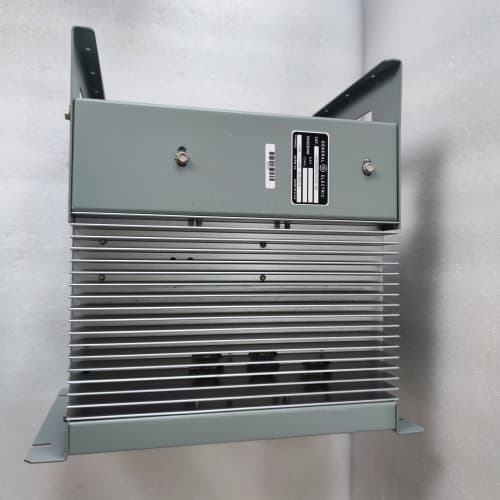
Description
Key Parameters
Analog Input Section:
-
Input Channels: 32 differential or 64 single-ended (software-configurable)
-
Input Types: 0–10V, ±10V, 4–20mA (jumper-selectable per channel)
-
Resolution: 16-bit ADC with ±0.05% accuracy
-
Diagnostics: Per-channel LED status, over-range/under-range detection, open-circuit detection
Analog Output Section:
-
Output Channels: 16 independent analog output channels
-
Output Types: 4–20mA or 0–10V (software-selectable per channel)
-
Resolution: 12-bit DAC with ±0.1% accuracy
-
Diagnostics: Output short-circuit detection, over-range detection, LED status per channel
Common Section:
-
Isolation: 2500V RMS channel-to-backplane
-
Temp Range: –30°C to +70°C
-
Power Supply: +5V, ±15V from VME backplane (higher current draw)
-
Physical: 6U VME single-slot board
-
Key Features: 32 analog inputs, 16 analog outputs, 16-bit ADC, 2500V isolation, per-channel diagnostics
Advantages
-
High I/O density – the DS3810EEPA provides 32 analog inputs and 16 analog outputs on a single board, significantly reducing board count and rack space requirements compared to separate input and output boards.
-
Integrated I/O – combines both analog input and output capability, reducing the need for multiple separate boards and simplifying system architecture.
-
Per-channel configurability – each input and output can be independently configured for voltage or current, accommodating mixed sensor and actuator types.
-
High accuracy – 16-bit ADC with ±0.05% accuracy ensures precise measurement for critical turbine parameters.
-
Comprehensive diagnostics – per-channel LEDs, open-circuit detection, and short-circuit protection simplify troubleshooting.
-
High isolation – 2500V RMS isolation protects the backplane from field-side noise and transients.
-
Drop-in compatible – works with all Mark IV backplanes and processor configurations.
Applications
-
Large turbine monitoring and control – the General Electric DS3810EEPA provides extensive analog I/O for large gas and steam turbines, including temperature, pressure, flow, and position monitoring, as well as valve and actuator control.
-
Combined-cycle plants – monitors and controls multiple turbine sections and balance-of-plant equipment from a single board.
-
Valve position control – reads LVDT or potentiometer feedback and drives analog outputs for valve positioners.
-
Data acquisition – collects extensive process data for performance monitoring and trending.
-
Retrofits – replaces multiple separate analog input and output boards with a single, integrated solution.
vs Competitors & Separate Boards
| Feature | DS3810EEPA | DS3800XAID (32 AI / 16 AO) | DS3800XAIC (16 AI / 8 AO) | Two Separate Boards (AI + AO) |
|---|---|---|---|---|
| Analog inputs | 32 | 32 | 16 | 16–32 |
| Analog outputs | 16 | 16 | 8 | 8–16 |
| Input resolution | 16-bit | 14-bit | 14-bit | 12–16-bit |
| Isolation | 2500V | 1500V | 1500V | 500–1500V |
| Board count | 1 | 1 | 1 | 2 |
| Per-channel config | Yes | Yes | Yes | Varies |
| Extended temp range | –30°C to +70°C | –30°C to +70°C | –30°C to +70°C | 0°C to +60°C |
Selection Tips
-
High-density analog I/O – choose the DS3810EEPA when you need both a large number of analog inputs (up to 32) and outputs (up to 16) in a single slot.
-
Slot-limited installations – the General Electric DS3810EEPA reduces board count compared to separate input and output boards.
-
Mixed signal types – per-channel configurability accommodates both voltage and current sensors and actuators.
-
Power budget verification – the DS3810EEPA draws more current due to high channel count. Verify your backplane power capacity.
-
Spare strategy – keep one DS3810EEPA per 5–8 installed units, especially in systems where it serves multiple critical functions.
-
Calibration – periodically verify analog input accuracy using a precision calibrator and analog output accuracy using a precision multimeter.
Critical Precautions
-
Input over-voltage – never apply voltage above ±30V to any analog input of the DS3810EEPA; this can damage the ADC front-end.
-
Output short circuit – do not short the analog outputs to ground or positive supply; the General Electric DS3810EEPA has current protection but repeated shorts can degrade output accuracy.
-
Output load limits – do not exceed the maximum load resistance for 4–20mA outputs (typically 600Ω) or the minimum load resistance for 0–10V outputs (typically 2kΩ).
-
Ground loops – use single-point grounding for field transmitters and actuators to avoid common-mode voltage exceeding ±10V on inputs.
-
Wiring separation – keep analog signal wiring away from AC power lines and high-voltage cables to prevent noise coupling.
-
Shielded cabling – use shielded twisted-pair cables for all analog connections. Ground the shield only at the DS3810EEPA end to prevent ground loops.
-
Heat dissipation – due to high component density, ensure adequate cabinet cooling (>250 CFM) if multiple high-density boards are installed.
-
Calibration intervals – schedule periodic calibration verification (every 6–12 months) to maintain accuracy.
-
Hot-swap – never insert or remove the DS3810EEPA while the rack is powered; this can cause bus errors or component damage.
-
ESD handling – always use a grounded wrist strap when handling the DS3810EEPA; precision analog components are ESD-sensitive.
-
Storage – store spare DS3810EEPA boards in anti-static bags in a dry, temperature-controlled environment.
A-B 100-FA22
SCHNEIDER LRD-21C
SCHNEIDER LCD1-D25M7C

.jpg)



Reviews
There are no reviews yet.